

Thousands march in Dublin against Irish abortion laws

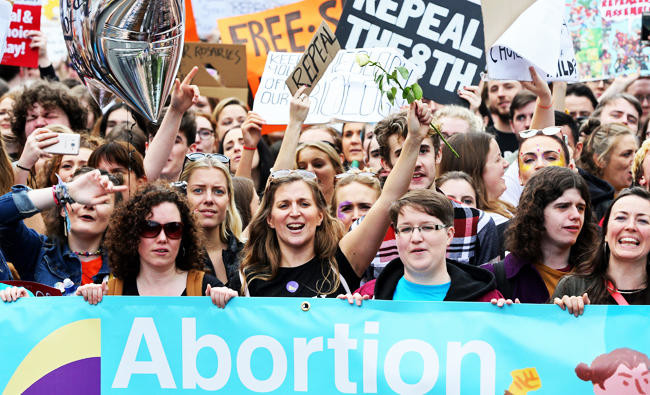
Protesters hold up placards as they take part in the March for Choice, calling for the legalising of abortion in Ireland after the referendum announcement, in Dublin on Saturday. (AFP)
Updated 01 October 2017
Follow

Thousands march in Dublin against Irish abortion laws

DUBLIN: Thousands of demonstrators marched in Dublin on Saturday in favor of liberalising Ireland’s tight abortion laws ahead of a planned referendum on the fiercely-debated issue.
Protesters chanted, “My body, my choice” and waved placards reading “Not the church, not the state: women should decide their fate,” as they headed through the capital toward the parliament.
Linda Kavanagh, a spokeswoman from the Abortion Rights Campaign which organized the rally, told AFP: “The message today is ‘time to act’ because we’ve waited for a long time for a change.
“We want full repeal. We can’t support exceptions and only a hundred people allowed to get access to abortion.”
Keishia Taylor, a spokeswoman for the organization ROSA (For Reproductive Rights, told AFP: “I think today is going to be a huge turnout, a turning point.”
Campaigners were expecting 30,000 to attend, but the police declined to give a crowd estimate.
Abortion has always been illegal in Ireland and in 1983 an eighth amendment was added to the constitution after a referendum, giving equal rights to the life of the unborn child and the mother.
The law was changed three decades later to allow terminations when the mother’s life is at risk, following public outrage at the death of a pregnant woman in 2012 who was refused an abortion.
In the face of mounting public pressure, Irish Prime Minister Leo Varadkar on Tuesday announced plans for a referendum on the issue to be held in May or June 2018, ahead of a visit by Pope Francis in August.

Ireland is still deeply divided over the issue.
A recent poll by Ipsos/MRBI found 67 percent of respondents were opposed to abortion in general but that 76 percent were in favor of legalizing it cases of rape.
Varadkar, who trained as a doctor, has called the current laws “too restrictive.”
Varadkar has said he would support abortion in cases of fatal foetal abnormalities but is not supporting wider liberalization.
Thousands of Irish women currently travel abroad for abortions every year, mainly to England.
A “March for Choice” took place in London outside the Irish embassy on Saturday.
The upcoming vote has rallied those on both sides of the debate, including activists seeking to keep the current legislation in place.
In central Dublin, a small number of activists opposed to abortion handed out leaflets on Saturday, something they intend to do every week from now on.
“The country is very polarized at the moment, so what we try to do now is to reach people on the fence, who haven’t made up their minds yet,” said organizer Alan Keena.

The Irish government has already sought to gauge public opinion, setting up a Citizens’ Assembly which between November and April debated the eighth amendment.
Summing up their discussions, a majority of the 99 members recommended legalizing abortion in a wide range of circumstances.
A parliamentary committee has also been examining the abortion law, but on both sides of the debate there is mistrust of officials’ approach.
“The wording of the referendum will have a large bearing on the outcome and my instinct is that there will be compromise, there has to be, because there are 22 people from all sides on that committee,” said Anna McKenna, 66, a retired teacher on Saturday’s march.
Although the pro-abortion camp reacted positively to the referendum announcement, there is suspicion that MPs continue to be heavily influenced by the church in the mainly Catholic country.
Unlike the referendum which saw Ireland vote in favor of same-sex marriage in May 2015, no politicians have yet taken a strong position calling for greater abortion access.
Irish media has reacted similarly, reluctant to take a bold stance on an issue which has divided Irish society.

US and Mideast countries seek Kyiv's drone expertise as Russia-Ukraine talks put on ice

Updated 4 sec ago
Follow

US and Mideast countries seek Kyiv's drone expertise as Russia-Ukraine talks put on ice

KYIV, Ukraine: The United States and its allies in the Middle East are seeking Ukraine's expertise in countering Iran's Shahed drones, according to Ukrainian President Volodymyr Zelenskyy.

Various countries, including the United States, have approached Ukraine for help in defending against the Iranian drones, Zelenskyy said late Wednesday. He said he has spoken in recent days with the leaders of the United Arab Emirates, Qatar, Bahrain, Jordan and Kuwait about possible cooperation.

Russia has fired tens of thousands of Shaheds at Ukraine since it invaded its neighbor just over four years ago, launching a swarm of more than 800 drones and decoys in its biggest nighttime barrage. Iran has responded to joint U.S.-Israeli strikes by launching the same type of drones at countries in the Middle East.

Ukrainian assistance in countering Iranian drones will be provided only if it does not weaken Ukraine's own defenses, and if it adds leverage to Kyiv's diplomatic efforts to stop the Russian invasion, according to the Ukrainian leader.

"We help to defend from war those who help us, Ukraine, bring a just end to the war" with Russia, Zelenskyy said. Later Thursday, Zelenskyy said he had received a U.S. request for support to defend against the drones in the Middle East and had given the order for equipment to be provided along with Ukrainian experts without providing further details.

"Ukraine helps partners who help our security and the protection of our people's lives," he added in a social media post.

Trump, in an interview Thursday with Reuters, said, "Certainly I'll take, you know, any assistance from any country."

Ukraine has battle-tested drone defenses

Ukraine has pioneered the development of cut-price drone killers that cost as little as $1,000, rewriting the air defense rule book and making other countries take notice.

European countries got a wake-up call last September on the changed nature of air defense when Poland scrambled multimillion-dollar military assets, including F-35 and F-16 fighter jets and Black Hawk helicopters, in response to airspace violations by cheap drones.

Ukrainian manufacturers have developed low-cost interceptor drones specifically designed to hunt and destroy Shaheds, and its rapidly expanding drone industry is producing excess capacity.

Zelenskyy announced earlier this year that Ukraine would begin exporting the battle-tested systems.

The European Union's top diplomat, Kaja Kallas, said before chairing a meeting of EU and Gulf foreign ministers via video link Thursday that the talks would look at how Ukraine's experience can help countries counter Iranian drones.

Middle East war delays Russia-Ukraine talks

The Iran war, now in its sixth day, has drawn international attention away from Europe's biggest conflict since World War II, and forced the postponement of a new round of U. S-brokered talks between Russia and Ukraine planned for this week, Zelenskyy said.

Western governments and analysts say the Russia-Ukraine war has killed hundreds of thousands of people, while there is no sign that yearlong U.S.-led peace efforts will stop the fighting any time soon.

"Right now, because of the situation around Iran, there are not yet the necessary signals for a trilateral meeting," Zelenskyy said. "But as soon as the security situation and the overall political context allow us to resume that trilateral diplomatic work, it will be done."

Zelenskyy thanked the United States for the return from Russia on Thursday of 200 Ukrainian prisoners of war. Russia's Defense Ministry also said it received the same number of prisoners from Ukraine and thanked the U.S. and United Arab Emirates for mediating.

Prisoner swaps have been one of the few tangible results of the talks. Vladimir Medinsky, a Russian negotiator, said on social media that a total of 500 prisoners from each side would be exchanged between Thursday and Friday.

Oleksandr Merezhko, the head of Ukraine's parliamentary foreign affairs committee, said Russian President Vladimir Putin is trying to drag out the negotiations so that he can press on with Russia's invasion while escaping further U.S. sanctions.

He urged the U.S. administration to look at the Russia-Ukraine war and the war in the Middle East as linked.

"In reality, Russia and Iran are close allies that act in concert — Iran supplies weapons and Russia helps Iran develop its defense industry. These are interconnected conflicts," Merezhko told The Associated Press.

Ukraine's army has recently pushed back Russian forces at some points along the roughly 1,250-kilometer (750-mile) front line, according to the Institute for the Study of War.

Localized Ukrainian counterattacks liberated more territory than Ukrainian forces lost in the last two weeks of February, the Washington-based think tank said this week, estimating the recovered land at about 257 square kilometers (100 square miles) since Jan. 1.