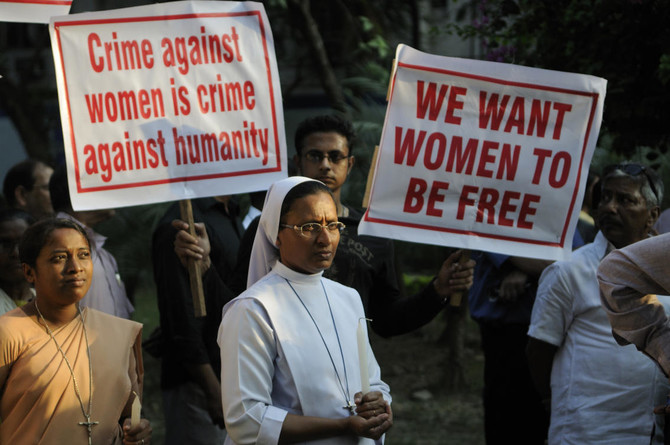
DUBAI: The family of a 13-year-old girl, who claims she was raped by her father’s colleague, has had to endure a court battle for their daughter to be allowed to terminate her pregnancy.
Her pregnancy was only discovered after her parents sought medical treatment for her, thinking she was obese and now 30 weeks pregnant, the Mumbai girl needs the permission of the Supreme Court to undergo an abortion, as Indian law only allows terminations after 20 weeks when the mother’s life is in danger.
The alleged rapist has been arrested.
Dr. Nikhil Datar, Mumbai-based gynecologist told the BBC: “(The girl’s parents) suspected she had a thyroid problem or some other medical condition because she was gaining weight… The scan showed that she was 27 weeks pregnant so I informed the police.”
The doctor recommended the abortion because the girl’s pelvis is not fully developed and giving birth would cause her “physical and mental trauma.”
This is the second such case in India in the last two months. A 10-year-old girl, who was repeatedly raped by her uncle, gave birth to a child earlier this month.
In that case India’s Supreme Court rejected pleas for an abortion because it was deemed to not be in the interest “of the child or the live fetus.”
The baby was delivered by C-section according to local reports, the girl unaware that she was about to have a baby, but instead told she needed surgery to remove a stone from her stomach.
The 10-year-old’s father has requested the child be put up for adoption.
Her parents discovered she was pregnant when she said she had stomach pains.
She later told her mother that she had been raped by her maternal uncle six times when he visited their home.
In her case the Chief Justice J S Khehar-headed bench rejected the girl’s plea that she faced a “grave threat” to her life.

Family of girl, 13, forced to go to court to seek abortion after being ‘raped by father’s colleague’
US abstains in UN vote voicing support for Ukraine
- The resolution also called for an immediate and unconditional ceasefire and “comprehensive, just and lasting peace“
- The US delegation had pressed for a separate vote on paragraphs involving Ukraine’s territorial integrity and international law but this idea was rejected
UNITED NATIONS: The UN General Assembly voiced support for Ukraine Tuesday on the fourth anniversary of Russia’s invasion, with the United States among countries abstaining from the vote.
The assembly passed a resolution saying it was committed to “the sovereignty, independence, unity and territorial integrity of Ukraine within its internationally recognized borders.”
It passed by a tally of 107 countries in favor, 12 against and 51 abstentions, which included the United States.
The resolution also called for an immediate and unconditional ceasefire and “comprehensive, just and lasting peace.”
The US delegation had pressed for a separate vote on paragraphs involving Ukraine’s territorial integrity and international law but this idea was rejected.
The transition from Joe Biden to Donald Trump in the White House last year has seen firm, unconditional US support for Ukraine cool dramatically.
Trump has brought Russian leader Vladimir Putin back in from the diplomatic cold and Washington has repeatedly refused to condemn the Russian invasion of 2022.
US deputy ambassador Tammy Bruce said she welcomed the UN appeal for a ceasefire.
But she said the resolution includes “language that is likely to distract” from diplomatic efforts to end the war rather than support them. She did not identify these words.
Still, leaders of the G7 global powers, including Trump, on Tuesday reaffirmed their “unwavering support for Ukraine” in a statement on the fourth anniversary of the invasion.
A month after Trump returned to power in January 2025, the United States voted against a UN General Assembly resolution calling for a “just and lasting peace” to end the war.
The US delegation later won Security Council passage of a Russian-backed resolution that called for peace but made no mention of Ukraine’s territorial integrity, frustrating Ukraine’s European allies.
Until then, the council had failed to speak out on the war because Russia consistently used its veto power.
“Despite peace efforts led by the US and supported by Europe, Russia continues to demonstrate no genuine willingness to stop this aggression,” Ukraine’s Deputy Foreign Minister Mariana Betsa said.
Russia’s deputy ambassador Anna Evstigneeva answered, saying Ukraine should focus on diplomacy to end the war “rather than initiating yet another politicized vote.”
In Washington, Ukraine’s Ambassador to the US Olga Stefanishyna urged the Trump administration to intensify pressure on Russia.
“We hope that the US government this particular day... will get to the understanding that the language which is understood by Russians is not the dialog or diplomatic effort, it’s the pressure,” Stefanishyna told reporters.
She expressed hope that US lawmakers would soon pass a bill imposing tariffs and secondary sanctions on countries doing business with Russia in order to choke its economy and ability to finance the war.
Stefanishyna added that Ukraine is in desperate need of air defenses at a time when Russia has been intensifying its attacks on civilians and critical infrastructure during a brutal winter.
While acknowledging that “it’s too premature to speak about any settlement in the nearest period of time,” she said that any deal to end the war must include powerful US and EU Security guarantees.