Middle East-inspired collection hits the runway at Paris Fashion Week

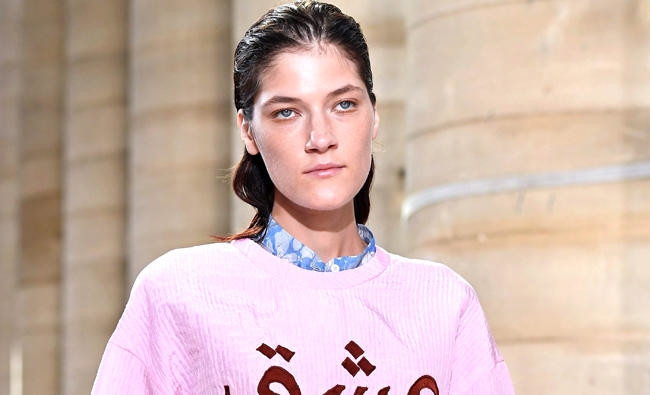
A model presents a creation by Christian Wijnants during the women’s 2018 Spring/Summer ready-to-wear collection fashion show in Paris, on Friday. (AFP)
Updated 30 September 2017
Follow

Middle East-inspired collection hits the runway at Paris Fashion Week

PARIS: Soirees merged from night to day as design houses showed off color-rich creations in Friday’s instalment of celebrity-filled Paris Fashion Week. Belgian designer Christian Wijnants’ collection took inspiration from the Middle East.
It was prints galore for Wijnants as his guests were treated to the silks and decorations of the Ottoman Empire.
The talented Belgian designer evoked the floral motif found on fine Ottoman and Persian ceramics — that also adorns manuscripts and miniatures — in his diaphanous array of fluttery, lightly-colored printed silken gowns.
There was great thought behind the deceptively-simple collection.
A loose blue embroidered coat had a shimmery finish like the glaze on pottery. And a beautiful jade green dress had an Eastern feel with its swirling multitudinous layers and long fine neck scarf.
At several points, an Arabic text print covered the bust. Flashes of the West — like denim dungarees — added a fun contrast.
American model and actress Emily Ratajkowski posed ahead of the Nina Ricci show in a checked brown 70s-style suit taken from its fall collection.
But for spring, designer Guillaume Henry channeled suits of a different nature: The military.
It was a theme that spoke to the show’s venue: The former French military hospital, the grand Hotel des Invalides, which is now home to France’s Army Museum.
Meanwhile, the great mysteries of nature and Iceland were touchstones for Issey Miyake in its Paris show.
Loose silhouettes — the display’s principle style — hung from the shoulder featuring hazy images of the Icelandic landscape.
The blurred motifs were created by baking printed glue on the fabric, sealing the fashion house’s reputation for cutting-edge clothes-making techniques.
Elsewhere, fabric panels of colorful checks folded haphazardly across the torso used a brown hue taken from a natural mud pigment. To end the show, squares were pieced together, creating a dark, geometric fabric that evoked light reflecting on volcanic Icelandic rocks.


Cambodia takes back looted historic artifacts handled by British art dealer

Updated 28 February 2026
Follow

Cambodia takes back looted historic artifacts handled by British art dealer

  • The objects were returned under a 2020 agreement between the Ministry of Culture and Fine Arts and the family of the late Douglas Latchford, a British art collector and dealer who allegedly had the items smuggled out of Cambodia

PHNOM PENH, Cambodia: Cambodian officials on Friday received more than six dozen historic artifacts described as part of the country’s cultural heritage that had been looted during decades of war and instability.
At a ceremony attended by Deputy Prime Minister Hun Many, the 74 items were unveiled at the National Museum in Phnom Penh after their repatriation from the United Kingdom.
The objects were returned under a 2020 agreement between the Ministry of Culture and Fine Arts and the family of the late Douglas Latchford, a British art collector and dealer who allegedly had the items smuggled out of Cambodia.
“This substantial restitution represents one of the most important returns of Khmer cultural heritage in recent years, following major repatriations in 2021 and 2023 from the same collection,” the Culture Ministry said in a statement. “It marks a significant step forward in Cambodia’s continued efforts to recover, preserve, and restore its ancestral legacy for future generations.”
The artifacts were described as dating from the pre-Angkorian period through the height of the Angkor Empire, including “monumental sandstone sculptures, refined bronze works, and significant ritual objects.” The Angkor Empire, which extended from the ninth to the 15th century, is best known for the Angkor Wat archaeological site, the nation’s biggest tourist attraction.
Latchford was a prominent antiquities dealer who allegedly orchestrated an operation to sell looted Cambodian sculptures on the international market.
From 1970 to the 1980s, during Cambodia’s civil wars and the communist Khmer Rouge ‘s brutal reign, organized looting networks sent artifacts to Latchford, who then sold them to Western collectors, dealers, and institutions. These pieces were often physically damaged, having been pried off temple walls or other structures by the looters.
Latchford was indicted in a New York federal court in 2019 on charges including wire fraud and conspiracy. He died in 2020, aged 88, before he could be extradited to face charges.
Cambodia, like neighboring Thailand, has benefited from a trend in recent decades involving the repatriation of art and archaeological treasures. These include ancient Asian artworks as well as pieces lost or stolen during turmoil in places such as Syria, Iraq and Nazi-occupied Europe. New York’s Metropolitan Museum of Art is one of the prominent institutions that has been returning illegally smuggled art, including to Cambodia.
“The ancient artifacts created and preserved by our ancestors are now being returned to Cambodia, bringing warmth and joy, following the country’s return to peace,” said Hun Many, who is the younger brother of Prime Minister Hun Manet.