ANKARA: In a strategic move just a week before a planned independence referendum in the Kurdistan Region of Iraq, the Turkish Army announced major military exercises on Monday on the Turkey-Iraq border.
The army said the exercises in the southeastern provinces of Silopi and Habur, across the Syrian frontier controlled by the Kurdish PYD militia, were part of Turkey’s anti-terror operations.
With the Kurdish referendum scheduled for Sept. 25, the location of the military exercises near Habur border gate is significant. It is the main door for cross-border trade from Turkey to the Kurdistan Region and Iraq. Turkey is also a key buyer of oil and natural gas from the Kurdistan Region.
Experts say the military exercises are not a coincidence, but are intended to show Ankara’s determination to emphasize its stance to the global community as the UN General Assembly convenes in New York.
The US is also opposed to the referendum because it could be a distraction from counter-terrorism efforts against Daesh.
Ankara views the vote as “a grave mistake,” and is concerned that it could fuel separatism in Turkey.
“We don’t want to impose sanctions. But if we arrive at that point, there are steps that have been already planned that Turkey can take,” Turkish Prime Minister Binali Yildirim said last week, underlining that Ankara wanted the referendum canceled, not merely postponed.
At a meeting on Monday with members of NGOs and opinion leaders in the southeastern province of Sanliurfa, Yildirim again warned that Turkey would not hesitate in taking necessary measures to ensure its security against a “fait accompli” on its southern borders.
“Those who are dreaming of an artificial state in Syria and Iraq should be well aware that we will react immediately against any attempt that threatens our national security from inside and outside the country,” he said.
Ankara is expected to announce its “decisive stance” on the issue on Friday after a meeting of the National Security Council, attended by senior military and civilian officials under the leadership of President Recep Tayyip Erdogan.
Barin Kayaoglu, an assistant professor of world history at the American University of Iraq, Sulaimani, told Arab News: “We have seen Turkey toughening its rhetoric against the independence referendum in the past few weeks.
“The military exercise that started today, literally across the spot where Turkey’s borders with Syria and Iraq intersect, is a clear signal to the Kurdistan Regional Government that it has to back off.”
Under international law, Kayaoglu said, it would not be easy for Turkey to intervene unilaterally should the referendum happen. “If Ankara could coordinate with the US, Iran and other influential regional and international powers, these concerted efforts could convince KRG President Masoud Barzani to postpone the referendum,” he said.
Emrah Kekilli, an expert on Turkey-Iraq relations from SETA, a think tank in Ankara, said a referendum and subsequent independence would bring serious risks not only to the Kurdistan Region, but also for all of Iraq and the region.
“At this point, Turkey prioritizes its own national security and takes precautions against possible threats. But today’s military exercise on the border should not be considered blackmail. Rather, Ankara prefers to resolve this issue through diplomatic channels with regional actors and at international platforms.”
Kekilli said a declaration of independence in the Kurdistan Region would deal a blow to counter-terrorism efforts in the region, as the subsequent crisis would assist terror groups such as Daesh, the PKK and the PYD.
“The establishment of a Kurdish state would threaten Turkey’s national and border security because it would create greater instability in the region with the presence of the PYD in northern Syria,” he said, and such a process would be unmanageable even by Barzani.
Turkey also dispatched military forces, armored vehicles and military construction vehicles on Monday to Reyhanli district on its southern border with Syria.


Military drills show Erdogan’s stance before Kurdish independence vote
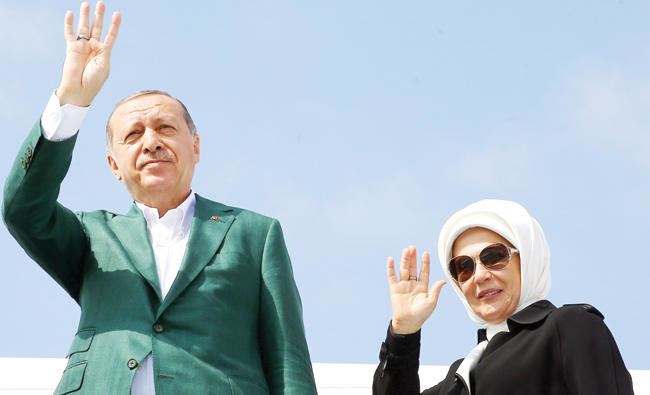
Military drills show Erdogan’s stance before Kurdish independence vote




Hamas official says group in final stage of choosing new chief
- Hayya, 65, a Gaza native and Hamas’s chief negotiator in ceasefire talks, has held senior roles since at least 2006
- Meshaal, who led the political bureau from 2004 to 2017, has never lived in Gaza
CAIRO: A senior Hamas official told AFP on Sunday that the Palestinian movement was in the final phase of selecting a new leader, with two prominent figures competing for the position.
Hamas recently completed the formation of a new Shoura Council, a consultative body largely composed of religious scholars, as well as a new political bureau.
Members of the council are elected every four years by representatives from Hamas’s three branches: the Gaza Strip, the occupied West Bank and the movement’s external leadership.
Hamas prisoners in Israeli jails are also eligible to vote.
The council subsequently elects the political bureau, which in turn selects the head of the movement.
“The movement has completed its internal elections in the three regions and has reached the final stage of selecting the head of the political bureau,” the official said, speaking on condition of anonymity as he was not authorized to speak publicly.
He added that the race for the group’s leadership is now between Khaled Meshaal and Khalil Al-Hayya.
A second Hamas source confirmed the development within the organization, which fought a devastating war with Israel following its October 7, 2023 attack.
Hayya, 65, a Gaza native and Hamas’s chief negotiator in ceasefire talks, has held senior roles since at least 2006, according to the US-based NGO the Counter Extremism Project (CEP).
Meshaal, who led the political bureau from 2004 to 2017, has never lived in Gaza. He was born in the West Bank in 1956.
He joined Hamas in Kuwait and later lived in Jordan, Syria and Qatar. The CEP says he oversaw Hamas’s evolution into a political-military hybrid.
He currently heads the movement’s diaspora office.
Last month, a Hamas source told AFP that Hayya enjoys backing from the group’s armed wing, the Ezzedine Al-Qassem Brigades.
After Israel killed former Hamas leader Ismail Haniyeh in Tehran in July 2024, the group chose its then-Gaza chief Yahya Sinwar as his successor.
Israel accused Sinwar of masterminding the October 7 attack.
He too was killed by Israeli forces in the southern Gaza city of Rafah, three months after Haniyeh’s assassination.
Hamas then opted for an interim five-member leadership committee based in Qatar, postponing the appointment of a single leader until elections, given the risk of the new chief being targeted by Israel.


