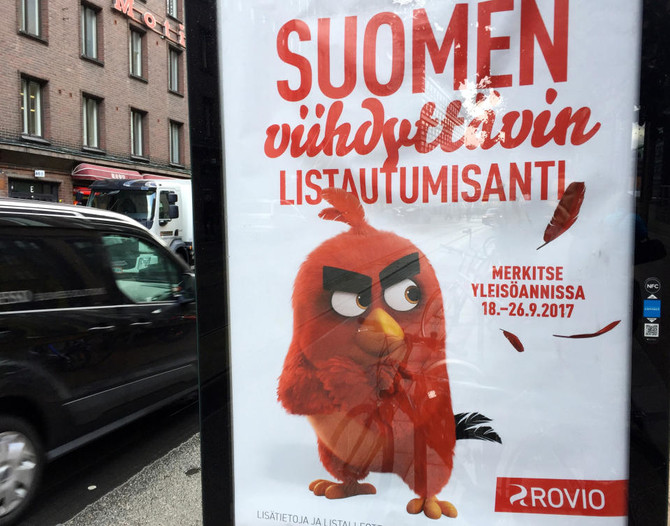
HELSINKI: Rovio, the maker of hit mobile game “Angry Birds,” will look to buy up other players in the gaming industry following its listing on Friday, its main owner Kaj Hed said.
The Finnish company’s shares got off to a flying start on their stock market debut, trading up as much as 7 percent from their initial public offering price (IPO) of €11.50.
Hed, who cut his stake from 69 percent to 37 percent in the IPO, said Rovio now had more muscle to do deals in a gaming sector he believes is ripe for consolidation.
“We have a clear will to be a consolidator, and we are in a very good position to do that,” he told Reuters at Rovio’s headquarters by the Baltic Sea.
“Many good (gaming industry) players face the question of whether they should go public, or whether they should consolidate. Going public is expensive and requires hard work, so finding a partner could be easier.”
Analysts have long urged Rovio to do more to reduce its reliance on the “Angry Birds” franchise.
Hed, the uncle of Rovio’s co-founder Niklas Hed, said he remained strongly committed to the company.
“The reason that I sold shares was to give the company the liquidity, because that is very important. My intention is to remain as a long-term investor in the company.”
Rovio saw rapid growth after the 2009 launch of the original “Angry Birds” game, but it plunged to an operating loss and cut a third of its staff in 2015 due to a pick up in competition and a shift among consumers to freely available games.
But the 2016 release of 3D Hollywood movie “Angry Birds”, together with new games, have revived the brand and helped sales recover.
In the first half of this year, Rovio’s sales almost doubled from a year earlier to €153 million, while core profit increased to €42 million from €11 million.
Rovio’s market valuation of around €950 million, looks high based on Rovio’s historical profit, said Atte Riikola, an analyst at research firm Inderes.
“There seems to be initial demand for (the stock). But given that the IPO was multiple times oversubscribed, the share price reaction is not too dramatic,” he added.
“Profit growth is priced in, so they need to keep up the good performance which they had in the first half of the year.”
At 1135 GMT, Rovio shares were trading at €11.77, off a high of €12.34.


![]()
‘Angry Birds’ maker looks to swoop on rivals after high-flying IPO
‘Angry Birds’ maker looks to swoop on rivals after high-flying IPO

Latest updates


© 2026 SAUDI RESEARCH & PUBLISHING COMPANY, All Rights Reserved And subject to Terms of Use Agreement.