BEIJING: Two Chinese lunar missions will be delayed by the failed launch of a powerful rocket in July, a state-run newspaper said, in a setback for the country’s ambitious space program.
Beijing sees its multi-billion-dollar forays into space as a symbol of China’s rise and the success of the Communist Party in turning around the fortunes of the once poverty-stricken nation.
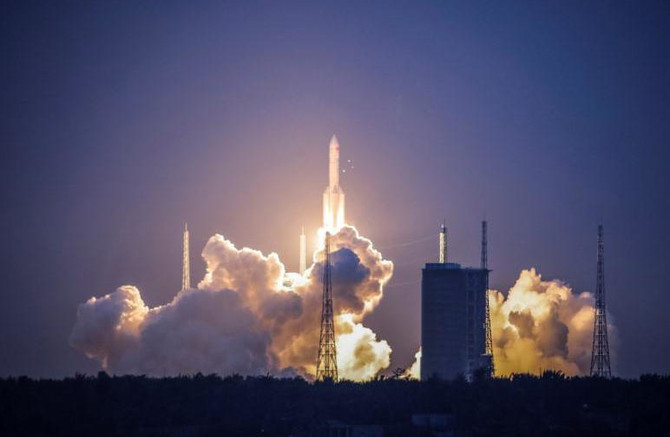
Officials are still investigating why the Long March-5 Y2 rocket malfunctioned on July 2, the Science and Technology Daily reported this week, citing Tian Yulong, secretary-general of the China National Space Administration.
It was China’s second heavy-lift rocket and was designed to carry communication satellites into orbit. Authorities have not given any details about the incident.
The failure means the launches of lunar probes Chang’e-5, originally scheduled to collect samples from the moon in the second half of 2017, and Chang’e-4, due to land on the dark side of the moon in 2018, will both have to be revised.
New launch dates for the probes will be announced at the end of this year, Tian said.
A core module for the construction of China’s space station was also set to be blasted into space in 2018 but this will be delayed to 2019, Tian said Tuesday at the 68th International Astronautical Congress in Adelaide, Australia.
China, which hopes to one day send humans to the moon, joined the United States and Soviet Union as the only nations to land on the Earth’s natural satellite in 2013, when its lunar rover Yutu embarked on a 31-month mission beset by mechanical troubles.
The following year the country completed its first return mission to the moon, with an unmanned probe landing successfully back on Earth.
The Long March-5 Y2 had taken off in July with the Shijian-18 experimental communications satellite (7.5 tons), which it was supposed to put into orbit.
The satellite would have provided communications services over China’s territory — boosting Internet access and providing access to more television channels.
Its failure followed successful space missions, including the June launch of the Long March-4B, China’s first X-ray space telescope, to study black holes, pulsars and gamma-ray bursts.
In April, the country’s first cargo spacecraft completed its docking with an orbiting space lab — a key development toward China’s goal of having its own crewed space station by 2022.
China is also aiming to launch six rovers to Mars in 2020.


![]()
Chinese moon missions delayed by rocket failure: report
Chinese moon missions delayed by rocket failure: report



Latest updates


© 2026 SAUDI RESEARCH & PUBLISHING COMPANY, All Rights Reserved And subject to Terms of Use Agreement.