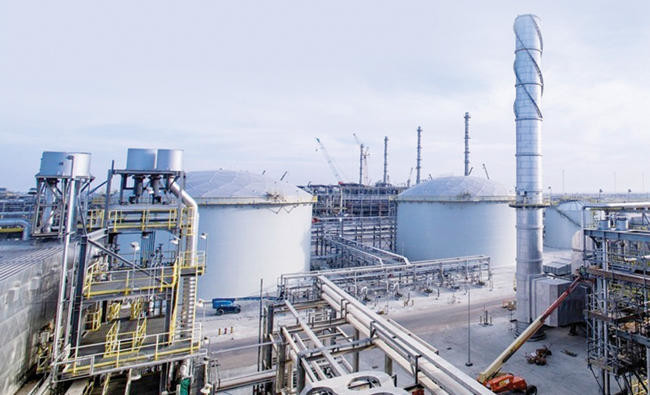
There is no geological formation known to mankind bigger than the Ghawar in Saudi Arabia, the world’s largest onshore oil field.
The Ghawar was discovered in 1948, and was put into production in the 1950s. It is responsible for pumping around half of the oil that Saudi Arabia produces on any given day. As of 2012, the field has estimated remaining proved oil reserves of 75 billion barrels, more than all but seven other countries, according to the US Energy Information Administration.
But a research firm is arguing that the Ghawar might not enjoy its prime position forever as the Permian Basin of Texas and New Mexico holds 60 billion to 70 billion barrels of yet-to-be pumped crude oil.
The findings of the study on the Permian made by IHS Markit and published on Sept. 25, echo a previous statement made by Pioneer Natural Resources Chairman Scott Sheffield who claimed that the Permian could hold 75 billion barrels of recoverable oil, equalling the Ghawar. That estimate may grow as IHS geologists and data scientists extend their analytical techniques to deeper geological zones.
“The Permian Basin is America’s super basin in terms of its oil and gas production history and for operators it presents a significant variety of stacked targets that are profitable at today’s oil prices,” Prithiraj Chungkham, director of unconventional resources for IHS, said in a statement to announce the finding of the study, carried by Bloomberg.
IHS spent three years studying output data from more than 440,000 wells to calculate the amount of crude remaining within the basin that pumps more oil than any other US field, the London-based researcher said in the statement.
The Permian region’s so-called recoverable resources would be enough to supply every refinery in the US for 12 years and have a market value of about $3.3 trillion at current prices for West Texas Intermediate oil, the domestic benchmark, the study found.
However, taking over the Ghawar isn’t going to be that easy, argues Sadad Al-Husseini a former senior executive with Saudi Aramco.
“The estimated proven reserves of the Ghawar doesn’t explain everything about the field. If the source rocks of the field are added into the calculation, we will find that Ghawar is a massive structure that no other formation in the world can keep up with,” said Al-Husseini, who was the top official responsible for exploration and development at Aramco until he retired in 2004.
He believes that the good news is that this study dispels the peak oil theory and suggests that the world is awash with oil resources and no peak in supply is on the horizon. “The problem is that not all the recoverable resources in the Permian can translate into production,” he added. Without knowing the right prices of oil for this to be recovered and many other conditions, “these estimates are only good headlines,” he said.


Can a ‘Super Basin’ in Texas eclipse the Ghawar?
Can a ‘Super Basin’ in Texas eclipse the Ghawar?


Closing Bell: Saudi stocks slip as Tadawul falls 1% amid broad market weakness
RIYADH: Saudi stocks fell sharply on Tuesday, with the Tadawul All Share Index closing down 108.14 points, or 1.03 percent, at 10,381.51.
The broader decline was reflected across major indices. The MSCI Tadawul 30 Index slipped 0.78 percent to 1,378.00, while Nomu, the parallel market index, fell 1 percent to 23,040.79.
Market breadth was strongly negative on the main board, with 237 stocks falling compared to just 24 gainers. Trading activity remained robust, with 164.7 million shares changing hands and a total traded value of SR3.19 billion ($850.6 million).
Among the gainers, SEDCO Capital REIT Fund led, rising 2.73 percent to SR6.77, followed by Chubb Arabia Cooperative Insurance Co., which gained 2.69 percent to SR20.20.
National Medical Care Co. added 1.72 percent to close at SR141.60, while Alyamamah Steel Industries Co. and Thimar Advertising, Public Relations and Marketing Co. advanced 1.57 percent and 1.13 percent, respectively.
Losses were led by Al Masar Al Shamil Education Co., which tumbled 8.36 percent to SR24.65. Raoom Trading Co.fell 6.75 percent to SR64.20, while Alkhaleej Training and Education Co. dropped 6.60 percent to SR18.12 and Naqi Water Co. declined 5.51 percent to SR54.00. Gulf General Cooperative Insurance Co. closed 5.44 percent lower at SR3.65.
On the announcement front, Chubb Arabia Cooperative Insurance Co. signed a multiyear insurance agreement with Saudi Electricity Co. to provide various coverages, expected to positively impact its financial results over the 2025–2026 period. The deal will run for three years and two months and is within the company’s normal course of business.
Meanwhile, Bupa Arabia for Cooperative Insurance Co. announced a one-year health insurance contract with Saudi National Bank, valued at SR330.2 million, covering the bank’s employees and their families from January 2026. Despite the sizable contract, Bupa Arabia shares fell 0.8 percent to close at SR137, weighed down by the broader market weakness.
In contrast, United Cooperative Assurance Co. revealed an extension of its engineering insurance agreement with Saudi Binladin Group for the Grand Mosque expansion in Makkah. The contract value exceeds 20 percent of the company’s gross written premiums based on its latest audited financials and is expected to support results through 2026. However, the stock came under selling pressure, ending the session down 4.51 percent at SR3.39.


