WASHINGTON: Donald Trump on Tuesday accused North Korea of torturing a captive US student “beyond belief,” spurning pleas from allies and foes in east Asia to tone down his warlike rhetoric.
For the first time, Trump publicly accused Pyongyang of abusing the late 22-year-old Otto Warmbier, an allegation likely to heighten tensions between the two nuclear powers.
Last June the Ohio native was sent home in a coma after more than a year in prison in North Korea. He died a few days later.
Aides say Trump was personally shocked and angered by Warmbier’s death, and that the government suspects mistreatment.
But the US president had stopped short of publicly accusing the regime of torture, a move that would raise expectations of a tough response, raise tensions and could complicate any future releases.
Since June, the US and North Korea have traded military moves and bombastic insults in a stand-off over Kim Jong-Un’s nuclear and ballistic weapons programs.
After seeing Warmbier’s parents on television Tuesday morning, Trump cast previous concerns aside.
“Otto was tortured beyond belief by North Korea,” he said in an early morning tweet.
The missive came just hours after South Korea — whose densely-populated capital Seoul is located just 35 miles from the demilitarized zone dividing the Korean peninsula — asked its US ally to take the heat out of the situation.
Foreign Minister Kang Kyung-wha visited Washington to warn it was imperative to “prevent further escalation of tensions or any kind of accidental military clashes which can quickly go out of control.”
Similarly, China, the North’s neighbor and only major ally, warned Tuesday that any conflict would have “no winners.”
Foreign ministry spokesman Lu Kang said rhetorical sparring “will only increase the risk of confrontation and reduce the room for policy maneuver.”
US Defense Secretary Jim Mattis, visiting India, stressed that Washington wants a diplomatic solution to the North Korean nuclear crisis.
“We maintain the capability to deter North Korea’s most dangerous threats but also to back up our diplomats in a manner that keeps this as long as possible in the diplomatic realm,” he said in New Delhi after talks with his Indian counterpart.
Trump and North Korean leader Kim Jong-Un traded barbs in the wake of the North’s sixth nuclear bomb and multiple missile tests.
Pyongyang says it needs the weapons to defend itself against the threat of a US invasion.
Alarm over Pyongyang’s nuclear and ballistic missile programs dominated the gathering of world leaders at the United Nations, amid fears the heated rhetoric could accidentally trigger a war.
In his UN address last week, Trump delivered the blunt threat to “totally destroy” North Korea if provoked, deriding leader Kim Jong-un as “Rocket Man.”
Kim hit back with a personal attack of his own, branding Trump “mentally deranged” and a “dotard” and warning he would “pay dearly.”
The North’s Foreign Minister Ri Yong-ho on Monday called a press conference to hit back at a US bomber mission near the North’s coastline and a slew of bombastic warnings from the American president.
Taking umbrage at Trump’s weekend tweet that North Korea’s leadership “won’t be around much longer” if it keeps up its threats, Ri told reporters the international community hoped that a “war of words” would “not turn into real actions.”
“However, last weekend, Trump claimed our leadership would not be around much longer,” said Ri, who attended this year’s UN General Assembly session. “He declared a war on our country.”
The White House said Ri’s interpretation of Trump’s saber-rattling as “absurd.”
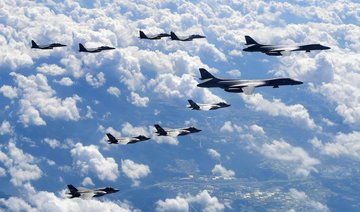
Fears of a clash were sharpened after US bombers flew off the coast of North Korea on Saturday — going further north of the demilitarized zone than any US aircraft has flown this century.
“Since the United States declared war on our country, we will have every right to take counter-measures including the right to shoot down US strategic bombers even when they are not yet inside the airspace border of our country,” Ri said.
“The question of who won’t be around much longer will be answered then.”
A Pentagon spokesman stressed the bombers flew in international airspace and had every right to do so.
South Korea’s National Intelligence Service (NIS) said that while Pyongyang did not appear to have picked up the presence of the US warplanes over the weekend, it had since bolstered its coastal defenses.
“North Korea relocated its warplanes and strengthened defenses along the east coast,” said Lee Cheol-Woo, the chief of the National Assembly’s intelligence committee.


![]()

Trump ignores pleas to calm North Korea tensions
Trump ignores pleas to calm North Korea tensions

Latest updates


Recommended


© 2026 SAUDI RESEARCH & PUBLISHING COMPANY, All Rights Reserved And subject to Terms of Use Agreement.