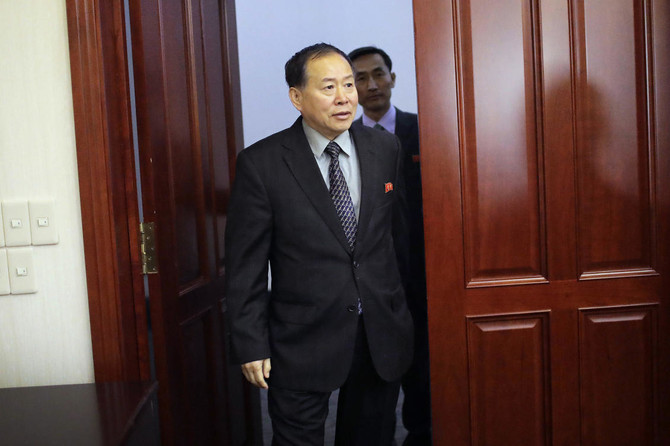
PYONGYANG: North Korea’s vice foreign minister told The Associated Press on Friday that the situation on the Korean Peninsula is now in a “vicious cycle,” and that Pyongyang won’t “keep its arms crossed” in the face of a pre-emptive strike by US.
In an exclusive interview with the AP in Pyongyang on Friday, Vice Minister Han Song Ryol also blamed President Donald Trump for raising tensions, saying that his “aggressive” tweets were “making trouble.”
Tensions are deepening as the US has sent an aircraft carrier to waters off the peninsula and is conducting its biggest-ever joint military exercises with South Korea. Pyongyang, meanwhile, recently launched a ballistic missile and some experts say it could conduct another nuclear test at virtually anytime.
Trump added to the growing war of words with a tweet on Tuesday that said the North is “looking for trouble.” He added that if China doesn’t do its part to rein in Pyongyang’s nuclear ambitions, the US can handle it.
Many North Korea watchers believe North Korea could have a viable nuclear warhead and a ballistic missile capable of hitting the United States’ mainland on Trump’s watch as president — within the next few years.
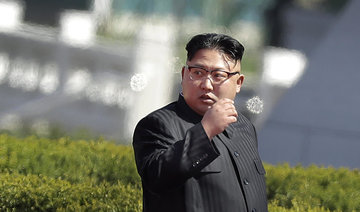
Outwardly, there are few signs of concern in North Korea despite the political back and forth. Instead, the country is gearing up for its biggest holiday of the year, the 105th anniversary of the birth of the late Kim Il Sung, the country’s founder and leader Kim Jong Un’s grandfather.
The Saturday anniversary may provide the world with a look at some of that arsenal. Expectations are high the North may put its newest missiles on display during a military parade that could be held to mark the event.
At the same time, speculation is growing that Pyongyang may be close to conducting more nuclear or missile tests, despite a raft of international sanctions punishing it over its nuclear weapons program.
Japanese Prime Minister Shinzo Abe warned Thursday that North Korea may be capable of firing a missile loaded with sarin nerve gas toward Japan, as international concern mounted that a missile or nuclear test by the authoritarian state could be imminent.

N. Korean official blames Trump for region’s ‘vicious cycle’
Congressional candidates slam AIPAC influence in US elections
- Democrats Joseph Ruzevich, Kina Collins, Bushra Amiwala say pro-Israel lobby group interfering in their races
- They represent districts with large and growing Arab and Muslim constituencies
CHICAGO: Candidates in three Illinois congressional districts denounced the American Israel Public Affairs Committee at a press conference attended by Arab News on Thursday.
Democrats Joseph Ruzevich in the 6th District, Kina Collins in the 7th District and Bushra Amiwala in the 9th District accused the powerful lobby group of corrupting US elections and interfering in their races.
The three candidates, all running in the March 17 Democratic primary, represent districts with large and growing Arab and Muslim constituencies.
They said AIPAC pours millions of dollars into election campaigns to defeat candidates who criticize Israel.
“AIPAC and PACs like it do only one thing, fund negative attack ads on candidates and opponents,” said Ruzevich, whose district in the western suburbs of Chicago represents one of the largest concentrations of Arab voters in the country.
“We’d like to educate voters and candidates, offer solutions, and implore current elected officials running for reelection, and current candidates, to reject this money,” he added.
“This money is suffocating the voice of the voters. All three of us are Democrats here. It’s no longer enough to vote blue no matter who. We must make sure that we’re electing candidates who are loyal only to the people of their district.”
Ruzevich said: “AIPAC money undermines the voting rights of Americans and empowers foreign interests over American interests.
“We urge Americans to only vote for candidates who don’t accept AIPAC donations to their election campaigns.”
He added: “Americans must remain sovereign in America, and AIPAC's influence over our elections threatens that sovereignty.”
Ruzevich accused the incumbent in the 6th District, Congressman Sean Casten, of ignoring the concerns of Arab Americans there.
Casten, elected to Congress in 2019, has received hundreds of thousands of dollars in AIPAC funds. He has not responded to repeated requests for comment from Arab News.
Collins said AIPAC spent more than $500,000 to prevent her from winning election to the 7th Congressional District seat two years ago, and made false accusations that distorted her policies “all because I criticized Israel.”
She added: “I’m not for sale and our community isn’t for lease … Let’s be clear about what that money is doing … It’s being used to silence any voice that dares to stand up for human rights, for peace, and for an independent foreign policy that prioritizes people over the weapons industry.”
AIPAC “money goes way deeper than this election,” she said. “This is about a democracy that’s fragile right now. And we have the opportunity to change it.”
Amiwala said AIPAC money undermines the public debate on local issues such as funding families in need, improving education, and holding the line on rising costs for groceries, insurance and healthcare, instead pushing officials to focus on the political and financial needs of Israel’s government.
“Instead of confronting that reality, we’re finding our political system allows powerful interests to … pour extraordinary sums of money to shape American elections and American policy in the service of a foreign government,” she added.
“When you challenge AIPAC they come after you, after your family and after your allies, so you have to decide what kind of leader you’re going to be. Are you here to serve the public or to protect your own position?
“Just yesterday, Congress approved another $3.3 billion in weapons funding for Israel. Shame. Shame.”
The influence of AIPAC money has become a major controversy in this election cycle, with even Republicans speaking out for the first time.
Niki Conforti, who is running in the Republican primary in the 6th District on March 17, last week publicly said she refuses to accept AIPAC money.
Kentucky Republican Thomas Massie is among 20 members of Congress who have denounced AIPAC’s influence over elections.
Former Republican Congresswoman Marjorie Taylor Greene said recently: “The truth is AIPAC doesn’t like it because I unapologetically represent American. AIPAC needs to register as a foreign lobbyist by US law because they’re representing the secular government of nuclear-armed Israel 100 percent.”
She added: “I believe that political donations from any foreign entity or organization can corrupt our politicians and undermine our democracy. We need to stop foreign entities from dictating our policies and influencing our elections.”
Illinois Democrat Anabel Mendoza, also running for Congress in the 7th District, last week urged voters at a press conference attended by Arab News to “vote against” candidates who accept AIPAC funds.
In the 2022 election cycle, AIPAC endorsed 365 candidates, donating $17.5 million to their campaigns.
A total of 349 out of the 535 members in the current Congress received AIPAC funds, according to data compiled from OpenSecrets.org and TrackAIPAC.com.