Japan kills 177 whales in Pacific campaign: government

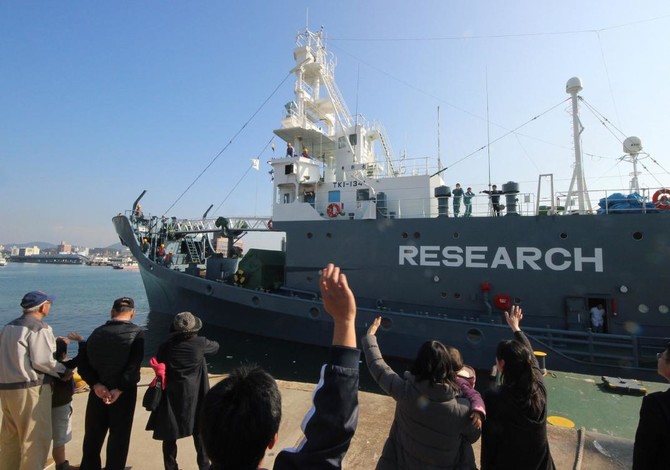
This file photo shows a Japanese whaling ship leaving the port of Shimonoseki in Yamaguchi prefecture, western Japan to resume whale hunting in the Antarctic on December 1, 2015. (File photo: JIJI PRESS via AFP)
Updated 26 September 2017
Follow

Japan kills 177 whales in Pacific campaign: government

TOKYO: Japan said Tuesday it killed 177 whales off its northeast coast in an annual hunt that sparks anger among animal rights activists and others.
Three ships which left port in June returned with 43 minke whales and 134 sei whales, the number stipulated beforehand, according to the country’s fisheries agency.
Japan is a signatory to the International Whaling Commission’s (IWC) moratorium on hunting, but exploits a loophole which allows whales to be killed in the name of scientific research.
The studies are “necessary to estimate the precise number of (sustainable) catches as we look to restart commercial whaling,” agency official Kohei Ito told AFP.
Norway — which does not consider itself bound by the 1986 moratorium — and Iceland are the only countries in the world that authorize commercial whaling.
Tokyo claims it is trying to prove the whale population is large enough to sustain a return to commercial hunting for a traditional source of food.
But Japanese consumer demand for whale meat has declined significantly over the years, raising the question of whether such hunts still make economic sense.
Foreign pressure on Japan to stop whaling has only made conservatives and politicians more resolute about continuing. It is a rare thorny issue in Tokyo’s otherwise amiable diplomacy.
In 2014 the United Nations’ International Court of Justice (ICJ) ordered Tokyo to end a regular hunt in the Antarctic waters, saying the project did not meet conventional scientific standards.
Japan canceled its 2014-15 hunt, only to resume it the following year under a new program — saying the fresh plan is genuinely scientific.
Its hunt in the Antarctic has seen clashes on the high seas between Japanese whalers and animal rights activists.


India plans AI ‘data city’ on staggering scale

Updated 56 min 27 sec ago
Follow

India plans AI ‘data city’ on staggering scale

  • ‘The data city is going to come in one ecosystem ... with a 100 kilometer radius’

NEW DELHI: As India races to narrow the artificial intelligence gap with the United States and China, it is planning a vast new “data city” to power digital growth on a staggering scale, the man spearheading the project says.

“The AI revolution is here, no second thoughts about it,” said Nara Lokesh, information technology minister for Andhra Pradesh state, which is positioning the city of Visakhapatnam as a cornerstone of India’s AI push.

“And as a nation ... we have taken a stand that we’ve got to embrace it,” he said ahead of an international AI summit next week in New Delhi.

Lokesh boasts the state has secured investment agreements of $175 billion involving 760 projects, including a $15 billion investment by Google for its largest AI infrastructure hub outside the United States.

And a joint venture between India’s Reliance Industries, Canada’s Brookfield and US firm Digital Realty is investing $11 billion to develop an AI data center in the same city.

Visakhapatnam — home to around two million people and popularly known as “Vizag” — is better known for its cricket ground that hosts international matches than cutting-edge technology.

But the southeastern port city is now being pitched as a landing point for submarine internet cables linking India to Singapore.

“The data city is going to come in one ecosystem ... with a 100 kilometer radius,” Lokesh said. For comparison, Taiwan is roughly 100 kilometers wide.

Lokesh said the plan goes far beyond data connectivity, adding that his state had “received close to 25 percent of all foreign direct investments” to India in 2025.

“It’s not just about the data centers,” he explained while outlining a sweeping vision of change, with Andhra Pradesh offering land at one US cent per acre for major investors.