IRBIL: The Kurds, a non-Arab ethnic group, number between 25 and 35 million people who are spread across four countries but without a state of their own.
The Kurds inhabit mainly mountainous regions that cover almost half a million square km, spanning from southeast Turkey through northern Syria and Iraq to central Iran.
They number around 12 to 15 million in Turkey, (about 20 percent of the overall population), six million in Iran (less than 10 percent), 4.7 million in Iraq (15-20 percent), and more than two million in Syria (15 percent).
The Kurds have preserved their culture, dialects and clan-based social structures. Large expatriate communities exist in Armenia, Azerbaijan, Germany and Lebanon.
Although predominantly Sunnis, some are Christians and their political structures are often non-denominational.
Kurdish ambitions of a unified nation are seen as a threat to the main host countries.
- In Turkey, the outlawed Kurdistan Workers’ Party (PKK) has been labeled a terrorist organization by the EU and US. More than 30 years of fighting with Turkish forces has killed more than 40,000 people.
- In Syria, the US-backed Kurdish People’s Protection Units (YPG) are one of the most effective forces against Daesh. They control more than 10 percent of the country in the north and northeast, and three quarters of the border region with Turkey.
- In Iraq, Kurds are an important US ally, and after having resisted the army of dictator Saddam Hussein for decades, now lead the fight against Daesh.
They control roughly 40,600 square km of territory, including many of northern Iraq’s oilfields and the cities of Irbil and Kirkuk.
- In Iran, where the army crushed a fledgling Kurdish republic in 1946, the Party for Free Life in Kurdistan (PJAK) is pushing for autonomy in three provinces.
Kurdish peshmerga fighters are considered to be experienced warriors and Western countries have provided them with air cover, sophisticated weapons and training to combat Daesh.
Notable Kurdish victories include the YPG’s four-month assault against Daesh fighters in Kobani on Syria’s border with Turkey and peshmerga gains in Iraq.
Turkey has regularly attacked YPG positions in Syria since mid-2015.
The Kurds have never lived under a single, centralized power and are split among a myriad of parties and factions.
While some of these groups straddle borders, others are in conflict with each other because of alliances with the governments where they live.
Iraq’s two main Kurdish parties, the Kurdistan Democratic Party (PDK) and Patriotic Union of Kurdistan (PUK), were locked in a 1994-1998 conflict that left 3,000 people dead. They reconciled in 2003.


Kurds: One stateless people across 4 countries
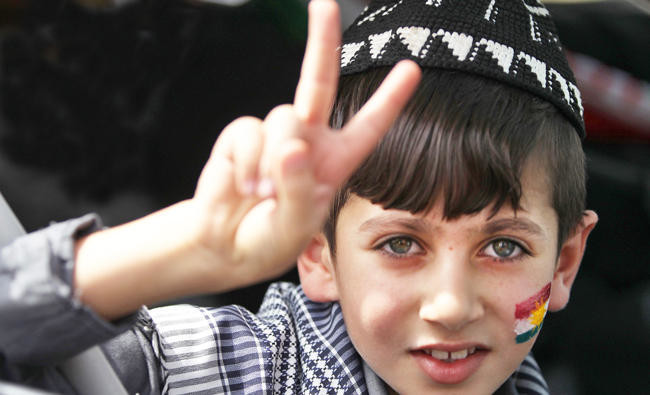
Kurds: One stateless people across 4 countries


Syrian government and SDF agree to de-escalate after Aleppo violence
- Turkiye views the US-backed SDF, which controls swathes of northeastern Syria, as a terrorist organization and has warned of military action if the group does not honor the agreement
DAMASCUS: Syrian government forces and the Kurdish-led Syrian Democratic Forces agreed to de-escalate on Monday evening in the northern city of Aleppo, after a wave of attacks that both sides blamed on each other left at least two civilians dead and several wounded.
Syria’s state news agency SANA, citing the defense ministry, said the army’s general command issued an order to stop targeting the SDF’s fire sources. The SDF said in a statement later that it had issued instructions to stop responding to attacks by Syrian government forces following de-escalation contacts.
The Syrian health ministry said two people were killed and several were wounded in shelling by the SDF on residential neighborhoods in the city. The injuries included two children and two civil defense workers. The violence erupted hours after Turkish Foreign Minister Hakan Fidan said during a visit to Damascus that the SDF appeared to have no intention of honoring a commitment to integrate into the state’s armed forces by an agreed year-end deadline.
Turkiye views the US-backed SDF, which controls swathes of northeastern Syria, as a terrorist organization and has warned of military action if the group does not honor the agreement.
Integrating the SDF would mend Syria’s deepest remaining fracture, but failing to do so risks an armed clash that could derail the country’s emergence from 14 years of war and potentially draw in Turkiye, which has threatened an incursion against Kurdish fighters it views as terrorists.
Both sides have accused the other of stalling and acting in bad faith. The SDF is reluctant to give up autonomy it won as the main US ally during the war, which left it with control of Islamic State prisons and rich oil resources.
SANA, citing the defense ministry, reported earlier that the SDF had launched a sudden attack on security forces and the army in the Sheikh Maqsoud and Ashrafiyah neighborhoods of Aleppo, resulting in injuries.
The SDF denied this and said the attack was carried out by factions affiliated with the Syrian government. It said those factions were using tanks and artillery against residential neighborhoods in the city.
The defense ministry denied the SDF’s statements, saying the army was responding to sources of fire from Kurdish forces. “We’re hearing the sounds of artillery and mortar shells, and there is a heavy army presence in most areas of Aleppo,” an eyewitness in Aleppo told Reuters earlier on Monday. Another eyewitness said the sound of strikes had been very strong and described the situation as “terrifying.”
Aleppo’s governor announced a temporary suspension of attendance in all public and private schools and universities on Tuesday, as well as government offices within the city center.


