JERUSALEM: Palestinian prime minister Rami Hamdallah will travel to Gaza on October 2 as part of a fresh push to end a decade-long split between Fatah and Hamas, which runs the enclave, his government said Monday.
The visit follows concessions by Islamist group Hamas after discussions with Egypt, which has urged it to take steps toward reconciliation with Palestinian president Mahmud Abbas’s Fatah, based in the occupied West Bank.
Fatah and Hamas have been divided for a decade, with separate administrations in the West Bank and Gaza Strip.
“Prime minister Rami Hamdallah has decided after consulting with president Mahmud Abbas that the government will hold its weekly meeting in Gaza next week,” government spokesman Yusuf Al Mahmoud said in a statement published by official Palestinian news agency WAFA.
“Hamdallah and members of the government will arrive in Gaza next Monday to start taking over government responsibilities after Hamas announced its agreement to dissolve the administrative committee and enable the government to assume its full responsibilities.”
Hamdallah, who is not believed to have traveled to the Gaza Strip since 2015, also wrote about the visit on his Facebook page.
“I am heading to the beloved Gaza Strip next Monday with the government and all bodies, authorities and security services,” he wrote.
“We hope all parties and all Palestinians will focus on the national interest to enable the government to continue carrying out all of its functions in a way which serves the Palestinian citizens first.”
Hamas said a week ago that it had agreed to steps toward resolving the split with Abbas’s Fatah, announcing it would dissolve a body seen as a rival government — known as the administrative committee — and was ready to hold elections.
The statement came after Hamas leaders held talks with Egyptian officials and with the Gaza Strip facing a mounting humanitarian crisis.
It remains unclear whether the steps will result in further concrete action toward ending the deep division with Fatah.
Hamas for now continues to run a de facto separate administration in the Gaza Strip and is in charge of security forces there.
Previous attempts to resolve the split have repeatedly failed. The last attempt at a unity government fell apart in 2015, with the two sides exchanging blame.
Hamas has run Gaza since 2007, having seized it in a near civil war from Fatah following a dispute over parliamentary elections won by the Islamist movement the previous year.
It formed the administrative committee in March, and since then Abbas has sought to put further pressure on the Islamist movement, reducing electricity payments for the Gaza Strip and cutting salaries for public employees.
The West Bank and Gaza have not participated in an election together since 2006.
Abbas, whose term was meant to end in 2009, has remained in office with no election held.
The Gaza Strip has meanwhile faced deteriorating humanitarian conditions, including a severe electricity crisis and a lack of clean water.
The coastal enclave of some two million people also has one of the world’s highest unemployment rates and has seen three wars with Israel since 2008.
It has been under an Israeli blockade for around a decade, while its border with Egypt has also remained largely closed in recent years.
Facing those conditions, Hamas has turned to Egypt for assistance, particularly for fuel to produce power and with hopes of opening the border — and has faced pressure to take steps toward Palestinian reconciliation in return.


![]()
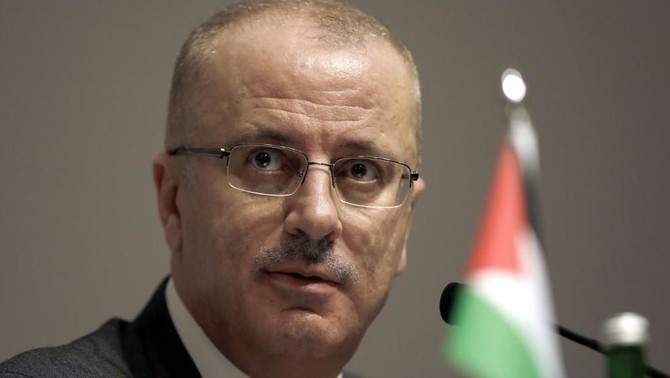
Palestinian PM to visit Gaza next week for reconciliation efforts
Palestinian PM to visit Gaza next week for reconciliation efforts


Latest updates



Recommended


© 2026 SAUDI RESEARCH & PUBLISHING COMPANY, All Rights Reserved And subject to Terms of Use Agreement.