North Korea, Venezuela, Chad among 8 countries on new US travel ban

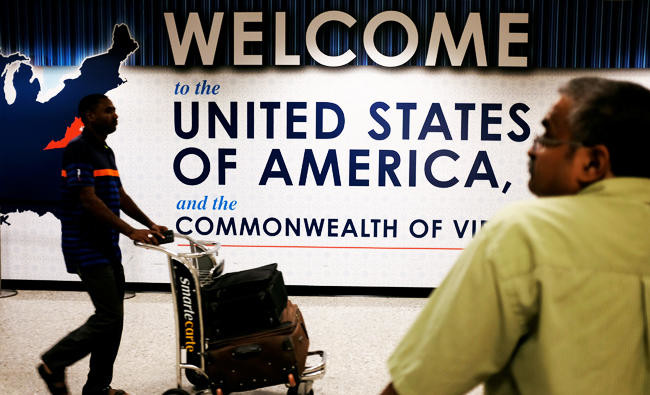
An international passenger (L) arrives at Dulles International Airport as a man (R) waits for loved ones to arrive in Dulles, Virginia, U.S. on Monday. (REUTERS)
Updated 25 September 2017
Follow

North Korea, Venezuela, Chad among 8 countries on new US travel ban

WASHINGTON: Citizens of eight countries will face new restrictions on entry to the US under a proclamation signed by President Donald Trump on Sunday.
The new rules, which will impact the citizens of Chad, Iran, Libya, North Korea, Somalia, Syria, Venezuela and Yemen, will go into effect on October 18.
The restrictions rage from full travel bans on nationals from countries like Syria to more targeted restrictions. A suspension of non-immigrant visas to citizens for Venezuela, for instance, applies only to senior government officials and their immediate families.
The announcement comes the same day as Trump’s temporary ban on visitors from six Muslim-majority countries is set to expire, 90 days after it went into effect. That ban had barred citizens of Iran, Libya, Somalia, Sudan, Syria and Yemen who lack a “credible claim of a bona fide relationship with a person or entity in the United States” from entering the US
“As President, I must act to protect the security and interests of the United States and its people,” reads the proclamation.
Officials stressed that valid visas would not be revoked as a result of the proclamation. The order also permits, but does not guarantee, case-by-case waivers .
The restrictions are targeted at countries that Department of Homeland Security officials say refuse to share information with the US or haven’t taken necessary security precautions.
“The acting secretary has recommended actions that are tough and that are tailored, including restrictions and enhanced screening for certain countries,” said Miles Taylor, counselor to acting Homeland Security Secretary Elaine Duke, said Friday.
Unlike Trump’s first travel ban, which sparked chaos at airports across the country and a flurry of legal challenges, officials said they had been working for months on the new rules, in collaboration with various agencies and in conversation with foreign governments.
The restrictions are based on a new baseline developed by DHS that includes factors such as whether countries issue electronic passports with biometric information and share information about travelers’ terror-related and criminal histories. The US then shared those benchmarks with every country in the world and gave them 50 days to comply.
The eight countries are those that refused or were unable to comply.
Trump last week called for a “tougher” travel ban after a bomb partially exploded on a London subway.
“The travel ban into the United States should be far larger, tougher and more specific-but stupidly, that would not be politically correct!” he tweeted.
Critics have accused Trump of overstepping his authority and violating the US Constitution’s protections against religious bias. Trump had called for a “total and complete shutdown of Muslims entering the United States” during his campaign.
The new policy could complicate the Supreme Court’s review of the order, which is scheduled for argument next month.


Russian minister visits Cuba as Trump ramps up pressure on Havana

Updated 21 January 2026
Follow

Russian minister visits Cuba as Trump ramps up pressure on Havana

  • The Russian embassy in Havana said the minister would “hold a series of bilateral meetings” while in Cuba

HAVANA: Russia’s interior minister began a visit to ally Cuba on Tuesday, a show of solidarity after US President Donald Trump warned that the island’s longtime communist government “is ready to fall.”
Trump this month warned Havana to “make a deal,” the nature of which he did not divulge, or pay a price similar to Venezuela, whose leader Nicolas Maduro was ousted by US forces in a January 3 bombing raid that killed dozens of people.
Venezuela was a key ally of Cuba and a critical supplier of oil and money, which Trump has vowed to cut off.
“We in Russia regard this as an act of unprovoked armed aggression against Venezuela,” Russia’s Interior Minister Vladimir Kolokoltsev told Russian state TV Rossiya-1 of the US actions after landing in Cuba.
“This act cannot be justified in any way and once again proves the need to increase vigilance and consolidate all efforts to counter external factors,” he added.
The Russian embassy in Havana said the minister would “hold a series of bilateral meetings” while in Cuba.
Russia and Cuba, both under Western sanctions, have intensified their relations since 2022, with an isolated Moscow seeking new friends and trading partners since its invasion of Ukraine.
Cuba needs all the help it can get as it grapples with its worst economic crisis in decades and now added pressure from Washington.
Trump has warned that acting President Delcy Rodriguez will pay “a very big price” if she does not toe Washington’s line — specifically on access to Venezuela’s oil and loosening ties with US foes Cuba, Russia, China and Iran.
On Tuesday, Russia’s ambassador to Havana, Victor Koronelli, wrote on X that Kolokoltsev was in Cuba “to strengthen bilateral cooperation and the fight against crime.”
The US chief of mission in Cuba, Mike Hammer, meanwhile, met the head of the US Southern Command in Miami on Tuesday “to discuss the situation in Cuba and the Caribbean,” the embassy said on X.
The command is responsible for American forces operating in Central and South America that have carried out seizures of tankers transporting Venezuelan oil and strikes on alleged drug-trafficking boats.

- Soldiers killed -

Cuba has been a thorn in the side of the United States since the revolution that swept communist Fidel Castro to power in 1959.
Havana and Moscow were close communist allies during the Cold War, but that cooperation was abruptly halted in 1991 with the dissolution of the Soviet bloc.
The deployment of Soviet nuclear missile sites on the island triggered the Cuban Missile Crisis of 1962, when Washington and Moscow came close to war.
During his first presidential term, Trump walked back a detente with Cuba launched by his predecessor Barack Obama.
Thirty-two Cuban soldiers, some of them assigned to Maduro’s security detail, were killed in the US strikes that saw the Venezuelan strongman whisked away in cuffs to stand trial in New York.
Kolokoltsev attended a memorial for the fallen men on Tuesday.