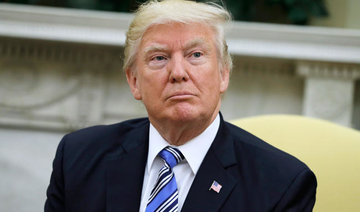
Trump weighs replacement to travel ban

US President Donald Trump
Updated 25 September 2017
Follow

Trump weighs replacement to travel ban

SOMERSET, New Jersey: US President Donald Trump on Sunday was considering a replacement to his controversial executive order barring travel to the US from several majority Muslim countries.
The current ban, enacted in March and set to expire on Sunday evening, extended to travelers from Iran, Libya, Somalia, Syria and Yemen. The new order could fall short of a complete ban, instead tailoring travel restrictions on a country-by-country basis.
Trump received a set of policy recommendations on Friday from acting Secretary of Homeland Security Elaine Duke and was briefed on the matter by other administration officials, including Attorney General Jeff Sessions and Secretary of State Rex Tillerson, a White House aide said.
As of Friday, the president had not made a final decision as the contents of the new order and which nations would be affected, leaving open the possibility that the list could be expanded. He was spending the weekend at his golf club in Bedminster, New Jersey.
Rather than a total ban on entry to the US, the proposed restrictions would differ by nation, based on cooperation with American security mandates, the threat the US believes each country presents and other variables, Miles Taylor, an aide to Duke, said on Friday.
After the Sept. 15 bombing attack on a London train, Trump wrote on Twitter that the new ban “should be far larger, tougher and more specific — but stupidly, that would not be politically correct.”
The expiring ban blocked entry into the US by people from the six countries for 90 days and locked out most aspiring refugees for 120 days to give Trump’s administration time to conduct a worldwide review of US vetting procedures for foreign visitors.
Critics have accused the Republican president of discriminating against Muslims in violation of constitutional guarantees of religious liberty and equal protection under the law, breaking existing US immigration law and stoking religious hatred.
Some federal courts blocked the ban, but the US Supreme Court allowed it to take effect in June with some restrictions.
The Supreme Court will hear arguments on Oct. 10 on whether the current ban discriminates against Muslims in violation of the US Constitution, as lower courts previously ruled.


Pakistan finance minister touts debt discipline, export focus at Davos panel

Updated 5 sec ago
Follow

Pakistan finance minister touts debt discipline, export focus at Davos panel

  • Aurangzeb says debt must fund exports, not consumption, for sustainable growth
  • He says Pakistan used fiscal buffers to respond to floods without external appeals

KARACHI: Pakistan’s Finance Minister Muhammad Aurangzeb said on Wednesday disciplined borrowing, export-led growth and careful debt management were central to stabilizing the country’s economy, as Islamabad looks to unlock new sources of growth amid rising global debt levels.

Speaking at a panel discussion on the sidelines of the World Economic Forum (WEF) in Davos, he said debt was not inherently harmful if used productively, but warned that emerging economies such as Pakistan could not afford to deploy borrowed funds for consumption.

“For countries like Pakistan, debt must be channeled into investments that generate exportable surplus,” Aurangzeb said, according to a statement circulated by the Finance Division. “It is not about the availability of debt or funding, but how wisely and effectively it is steered to create long-term economic value.”

Pakistan has been pursuing fiscal reforms as part of an International Monetary Fund-backed stabilization program, including cutting subsidies, broadening the tax base and restructuring state-owned enterprises, as the government seeks to restore macroeconomic stability and revive growth.

Aurangzeb said Pakistan had reduced its debt-to-GDP ratio to 70 percent from 75 percent, achieved a primary fiscal surplus and brought inflation down from a peak of 38 percent to single digits, allowing the central bank to cut its policy rate to 10.5 percent.

He also flagged ongoing debt-management reforms, including liability management operations and buybacks, and said Pakistan plans to enter China’s capital markets with its first Panda bond, structured as a green bond.

Addressing climate risks, Aurangzeb said building fiscal buffers had allowed Pakistan to respond to recent floods using domestic resources rather than international emergency appeals, underscoring the need for resilience in climate-vulnerable economies.

He added that public-private partnerships and capital markets were playing a growing role in financing development, citing a $3.6 billion syndicated financing for a major copper mining project expected to generate $2.8 billion in annual exports from 2028.

The finance minister is part of Pakistan’s delegation visiting Davos for the annual gathering of global leaders and investors.

The delegation is led by Prime Minister Shehbaz Sharif, who highlighted the country’s shift toward an export-driven growth model, with a focus on minerals, information technology, artificial intelligence and digital services, while speaking at a breakfast event on the sidelines of the forum.