Brexit voters turn their backs on Mideast

Updated 25 September 2017
Follow

Brexit voters turn their backs on Mideast

LONDON: The majority of Britons have limited knowledge about the Arab world and many have little or no interest in learning more, a survey has found.
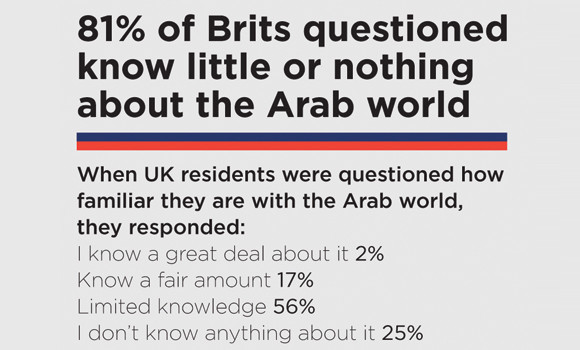
Eight in 10 Brits polled said they know little or nothing about the Arab world, while 52 percent of those who voted to leave the EU said they would never visit the Middle East, according to an Arab News/YouGov survey of over 2,000 UK citizens.
The poll, conducted in August, found that half of those who voted to remain in the bloc said they were interested in learning more about the Arab world, compared to just 25 percent of “leave” voters.
Stefan Sperl, senior lecturer in Arabic at the London School of Oriental and African Studies (SOAS), said “a new kind of inward-looking mentality” had been reinforced by the vote to leave the EU.
“Brexit is a symptom of this,” he said. “The new nationalism is not linked to Britain, you find it everywhere, this is a globalized phenomenon we are facing.”
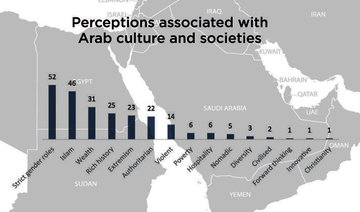
Many of those polled in the “UK attitudes toward the Arab world” survey subscribed to certain stereotypes, associating Arab culture with strict gender roles (52 percent) extremism and violence (23 percent and 14 percent respectively).
“Media reporting focuses more on these issues and much less on real day-to-day life in these countries. We are facing the problem that whatever is newsworthy is always more negative,” said Sperl.
“When it comes to the position of women especially, the image conveyed is too influenced by the negative,” he added. “In some Arab countries, women are a major part of the workforce and fully engaged in public life but these issues are much less known.”
“For people whose knowledge of the Middle East derives from what they see in the news, these points will be paramount.”

A majority of Brits interviewed in the survey also associated the region with vast wealth while just 6 percent linked it with poverty, regardless of large-scale migration and the impact of wars on the region.
Visible symbols of Middle Eastern affluence throughout London, such as the supercar-driving visitors to the Knightsbridge area, and high-profile property purchases, are likely to have driven the image of the wealthy Gulf Arab.
“It’s another source of misunderstanding,” said Sperl.
“The association with wealth is very understandable as the visibility here is very much slanted towards one particular reality. But if anything it diminishes any kind of empathy people might have with what is going on in the region.”
This has not necessarily detracted from the willingness of the British public to support humanitarian causes across the region, other commentators said.
“What we’ve consistently seen is generosity of spirit from the British public and I think if anything people are proud of the role that British aid can play in crises in the Arab world and beyond,” said Ruairidh Villar, senior media manager at Save the Children UK.
Despite only 18 percent of Brits saying they have visited the Arab world, the Gulf Cooperation Council (GCC) countries remain popular with visitors from the UK, commentators said.
“In terms of business and tourism, we’re not seeing a change in attitudes in the bigger GCC markets,” said Andrew Campbell, managing director for the Middle East at Brand Finance, a London-based consultancy. “There’s been no deterioration in the strength of GCC brands from a British perspective,” he added.
Figures shared with Arab News by Euromonitor International showed that the UK remains a strong source market for the UAE in particular, accounting for 8 percent of visitors to the Emirates in 2015, which marked a 12 percent increase in the number of arrivals from the previous year.
However, elsewhere in the region countries like Jordan and Egypt have suffered a significant decline in tourist numbers due to recent regional turmoil.
“The perception (of the Middle East) from the news is often quite negative, with a strong focus on brutality and (Daesh) so rarely would people go off and explore the Arab world if they feel that everything on the news is dangerous,” said Middle East cultural and political analyst Nicolai Due-Gundersen.

• For full report and related articles please visit: How Brits view Arab world


Gaza ceasefire enters phase two despite unresolved issues

Updated 16 January 2026
Follow

Gaza ceasefire enters phase two despite unresolved issues

  • Under the second phase, Gaza is to be administered by a 15-member Palestinian technocratic committee operating under the supervision of a so-called “Board of Peace,” to be chaired by Trump

JERUSALEM: A US-backed plan to end the war in Gaza has entered its second phase despite unresolved disputes between Israel and Hamas over alleged ceasefire violations and issues unaddressed in the first stage.
The most contentious questions remain Hamas’s refusal to publicly commit to full disarmament, a non-negotiable demand from Israel, and Israel’s lack of clarity over whether it will fully withdraw its forces from Gaza.
The creation of a Palestinian technocratic committee, announced on Wednesday, is intended to manage day-to-day governance in post-war Gaza, but it leaves unresolved broader political and security questions.
Below is a breakdown of developments from phase one to the newly launched second stage.

Gains and gaps in phase one

The first phase of the plan, part of a 20-point proposal unveiled by US President Donald Trump, began on October 10 and aimed primarily to stop the fighting in the Gaza Strip, allow in aid and secure the return of all remaining living and deceased hostages held by Hamas and allied Palestinian militant groups.
All hostages have since been returned, except for the remains of one Israeli, Ran Gvili.
Israel has accused Hamas of delaying the handover of Gvili’s body, while Hamas has said widespread destruction in Gaza made locating the remains difficult.
Gvili’s family had urged mediators to delay the transition to phase two.
“Moving on breaks my heart. Have we given up? Ran did not give up on anyone,” his sister, Shira Gvili, said after mediators announced the move.
Israeli Prime Minister Benjamin Netanyahu said efforts to recover Gvili’s remains would continue but has not publicly commented on the launch of phase two.
Hamas has accused Israel of repeated ceasefire violations, including air strikes, firing on civilians and advancing the so-called “Yellow Line,” an informal boundary separating areas under Israeli military control from those under Hamas authority.
Gaza’s Hamas-run health ministry said Israeli forces had killed 451 people since the ceasefire took effect.
Israel’s military said it had targeted suspected militants who crossed into restricted zones near the Yellow Line, adding that three Israeli soldiers were also killed by militants during the same period.
Aid agencies say Israel has not allowed the volume of humanitarian assistance envisaged under phase one, a claim Israel rejects.
Gaza, whose borders and access points remain under Israeli control, continues to face severe shortages of food, clean water, medicine and fuel.
Israel and the United Nations have repeatedly disputed figures on the number of aid trucks permitted to enter the Palestinian territory.

Disarmament, governance in phase two

Under the second phase, Gaza is to be administered by a 15-member Palestinian technocratic committee operating under the supervision of a so-called “Board of Peace,” to be chaired by Trump.
“The ball is now in the court of the mediators, the American guarantor and the international community to empower the committee,” Bassem Naim, a senior Hamas leader, said in a statement on Thursday.
Trump on Thursday announced the board of peace had been formed and its members would be announced “shortly.”
Mediators Egypt, Turkiye and Qatar said Ali Shaath, a former deputy minister in the Ramallah-based Palestinian Authority, had been appointed to lead the committee.
Later on Thursday, Egyptian state television reported that all members of the committee had “arrived in Egypt and begun their meetings in preparation for entering the territory.”
Al-Qahera News, which is close to Egypt’s state intelligence services, said the members’ arrival followed US Middle East envoy Steve Witkoff’s announcement on Wednesday “of the start of the second phase and what was agreed upon at the meeting of Palestinian factions in Cairo yesterday.”
Shaath, in a recent interview, said the committee would rely on “brains rather than weapons” and would not coordinate with armed groups.
On Wednesday, Witkoff said phase two aims for the “full demilitarization and reconstruction of Gaza,” including the disarmament of all unauthorized armed factions.
Witkoff said Washington expected Hamas to fulfil its remaining obligations, including the return of Gvili’s body, warning that failure to do so would bring “serious consequences.”
The plan also calls for the deployment of an International Stabilization Force to help secure Gaza and train vetted Palestinian police units.
For Palestinians, the central issue remains Israel’s full military withdrawal from Gaza — a step included in the framework but for which no detailed timetable has been announced.
With fundamental disagreements persisting over disarmament, withdrawal and governance, diplomats say the success of phase two will depend on sustained pressure from mediators and whether both sides are willing — or able — to move beyond long-standing red lines.