MEXICO CITY: A new earthquake sowed panic in Mexico City on Saturday, forcing a brief pause in rescue operations to free survivors from the more powerful tremor this week that devastated parts of the capital.
The latest quake, with a magnitude of 6.1, was smaller and further south than the 7.1-magnitude one that struck on Tuesday, killing more than 300 people and toppling 39 buildings in the capital.
As an alarm sounded, hundreds of startled residents raced out into the street, some barefoot, some carrying children.
Trauma from the previous quake was evident.
“Oh God, have mercy,” exclaimed Teresa Martinez, 74, who stood in the street with other women, all crying.
Two women died of heart attacks as they tried to leave their homes, according to local media reports. One was in her 80s and the other was 52, according to the website of the daily Reforma.
Authorities said two people also died in the quake in the southern state of Oaxaca, where the epicenter was located.
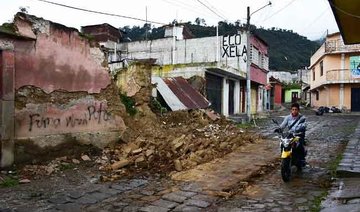
A bridge collapsed near the town of Juchitan, Oaxaca, already hit hard by a September 7 quake that killed nearly 100 people. Some buildings with previous damage collapsed.
In a jittery Mexico City, the quake made buildings sway, but some didn’t notice.
“This time, we didn’t feel the ground move... maybe since the last one we’re getting used to them,” said Pablo Martinez, who had run out of his apartment building with his six-year-old daughter in his arms.
The new tremor sparked concern it could have caused heavy rubble on top of survivors awaiting rescue in the capital to shift — posing a danger both to those trapped and to rescuers.
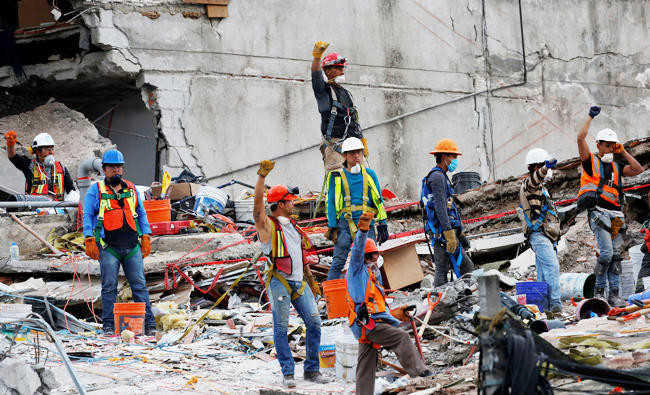
Rescue crews quickly evacuated five sites in the capital where they had been working.
They hesitated for a couple of hours, discussing the added risk, before going back in to look for survivors.
Mexico City’s mayor, Miguel Angel Mancera, told Televisa television that around “30 people may yet be able to be found in this search and rescue operation.”
So far, 69 people have been pulled alive from the rubble in Mexico City, according to authorities.
“We’ve been told they have detected areas with life. They’ve sent in dogs and the dogs have indicated life,” Paola Solorio, a 35-year-old who had three relatives trapped, told AFP.
But the smell of decaying bodies wafting out from the buildings four days after the quake presaged grief for some relatives. Rescue workers wore face masks to shield themselves from the odor.
Still, they refused to give up hope.
“We’re here to save lives. You have to have faith and believe (the people inside) are in a place with access to air and managed to survive,” said Karin Kvitca, a 29-year-old with an Israeli rescue crew.
Anxious families have been holding vigils at the flattened sites, urging exhausted emergency workers to keep trying.
“A lot of time has passed. But we won’t give up,” said the head of the civil protection service, Luis Felipe Puente.
“Time has gotten the best of us. There are structures that are very complicated to access. But we’re going to keep fighting for the families,” he told Televisa.
Many Mexicans remember “miracle” rescues a week after a 1985 quake that killed more than 10,000 people in the capital, spurring hopes that some might yet be pulled out alive.
Yet psychologists dispatched to the scene were already preparing to help relatives deal with tragic news.
“The families are still hopeful, but we psychologists are starting to prepare ourselves to counsel them in the context of mourning,” said Penelope Exzacarias.
The latest death toll stands at 305, of which more than half — 167 fatalities — were in Mexico City.
The rest of the deaths occurred in the states of Morelos, Puebla, Mexico, Guerrero and Oaxaca.
In the south of Mexico City, at a flattened school where 19 children died, relatives and neighbors had placed wreaths of white flowers.
Families were starting to hold funerals. One of the first was that of Gabriel Morales and Agueda Mendoza, a married couple found locked in embrace under the rubble, along with their dog Quino.
Elsewhere, Japanese rescuers removed their helmets and bowed before a recovered body, rescuers sang the Mexican national anthem after concluding work at a building and a volunteer joked with a young woman pulled from the rubble that she would have to invite his crew to dinner.