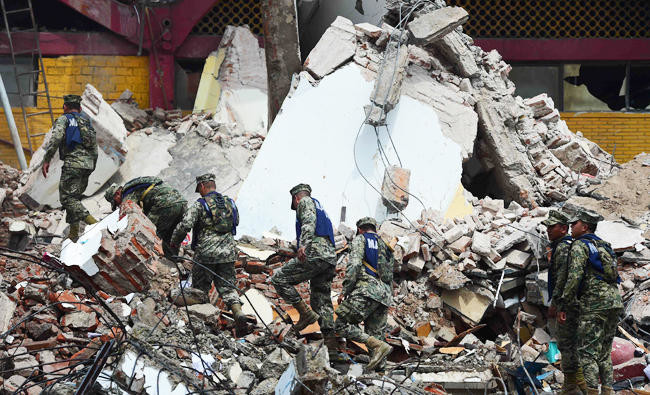
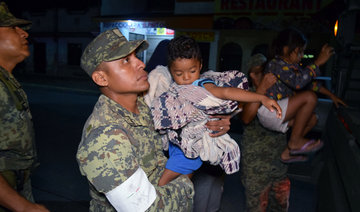
MEXICO CITY: A powerful 8.2-magnitude earthquake rocked Mexico late on Thursday, killing at least 32 people in what the president called the quake-prone country’s biggest one in a century.
The quake hit offshore in the Pacific at 11:49 p.m. (04:49 GMT), about 100 km from the coastal town of Tonala, in far southern Chiapas state, Mexico’s seismologic service said.
“It was a major earthquake in scale and magnitude, the strongest in the past 100 years,” said President Enrique Pena Nieto in an address from the National Disaster Prevention Center’s headquarters, where he was supervising the emergency response.
The quake was apparently stronger than a devastating 1985 temblor that flattened swathes of Mexico City and killed thousands, but this time, damage to the city was limited.
A number of buildings suffered severe damage in parts of southern Mexico. Some of the worst initial reports came from the town of Juchitan in Oaxaca state, where sections of the town hall, a hotel and other buildings were reduced to rubble.
Alejandro Murat, the state governor, said 23 deaths were registered in Oaxaca, 17 of them in Juchitan.
A spokesman for emergency services said seven people were also confirmed dead in the neighboring state of Chiapas. Earlier, Arturo Nunez, governor of Tabasco, said two children had died in his state.
Rescue workers labored through the night in badly affected areas to check for people trapped in collapsed buildings.
Windows were shattered at Mexico City airport and power went out in several neighborhoods of the capital, affecting more than 1 million people. The cornice of a hotel came down in the southern tourist city of Oaxaca, a witness said.
The tremor was felt as far away as neighboring Guatemala. The quake triggered waves as high as 0.7 meters in Mexico, the Pacific Tsunami Warning Center said. Mexican television showed images of the sea retreating about 50 meters, and authorities evacuated some coastal areas.
The president said the tsunami risk on the Chiapas coast was not major. “We are alert,” he told local television.
More aftershocks were likely, the president said, advising people to check their homes and offices for structural damage and for gas leaks.
The US Geological Survey (USGS) reported multiple aftershocks, ranging in magnitude from 4.3 to 5.7.
Classes were suspended in most of central and southern Mexico on Friday to allow authorities to review damage.
There was no tsunami threat for American Samoa and Hawaii, according to the US Tsunami Warning System. The national disaster agency of the Philippines put the country’s eastern seaboard on alert, but no evacuation was ordered.
“The house moved like chewing gum and the light and Internet went out momentarily,” said Rodrigo Soberanes, who lives near the Chiapas state city of San Cristobal de las Casas.
People in Mexico City, one of the world’s largest cities, ran out into the streets in pajamas and alarms sounded after the quake struck just before midnight, a Reuters witness said.
“I had never been anywhere where the earth moved so much. At first I laughed, but when the lights went out, I didn’t know what to do,” said Luis Carlos Briceno, an architect, 31, who was visiting Mexico City. “I nearly fell over.”
State oil company Pemex said it was still checking for damage at its installations.
President Pena Nieto said operations at the Salina Cruz refinery in the same region as the epicenter were temporarily suspended as a precautionary measure.

32 dead in Mexico’s biggest earthquake in a century
Dark times under Syria’s Assad hit Arab screens for Ramadan
BEIRUT: A Syrian prison warden screams at a group of chained, crouching inmates in a harrowing scene from one of several Ramadan television series this year that tackle the era of former ruler Bashar Assad.
Talking about Syria’s prisons and the torture, enforced disappearances and executions that took place there was taboo during half a century of the Assad family’s iron-fisted rule, but the topics are now fertile ground for creative productions, though not without controversy.
An abandoned soap factory north of the Lebanese capital Beirut has been transformed into a replica of the basements and corridors of Syria’s Saydnaya prison, a facility synonymous with horror under Assad, for the series “Going Out to the Well.”
Crews were filming the last episodes this week as the Muslim holy month kicked off — primetime viewing in the Arab world, with channels and outlets furiously competing for eager audiences’ attention.
Director Mohammed Lutfi told AFP that “for Syrians, Saydnaya prison is a dark place, full of stories and tales.”
The series focuses on the 2008 prison riots in Saydnaya, “when inmates revolted against the soldiers and took control of the prison, and there were negotiations between them and Syrian intelligence services,” he said.
The military prison, one of Syria’s largest and which also held political prisoners, remains an open wound for thousands of families still looking for traces of their loved ones.
Tragedy into drama
The Association of Detainees and Missing Persons of Saydnaya Prison estimates that some 30,000 people were thrown into the facility after the 2011 uprising against Assad began, but only 6,000 came out after he was toppled.
Amnesty International has described the prison outside Damascus, which was notorious for torture and enforced disappearances, as a “human slaughterhouse.”
In the opening scene of the series, the main character is seen in a tense exchange with his family before jumping into a deep well.
The symbolic scene in part captures the struggles of the detainees’ relatives. Many spent years going from one Assad-era security facility to another in search of their missing family members.
Syrian writer Samer Radwan said on Facebook that he finished writing the series several months before Assad’s fall.
Director Lutfi had previously told AFP that challenges including actors’ fears of the Assad authorities’ reaction had prevented filming until after his ouster.
Since then, productions have jumped on the chance to finally tackle issues related to his family’s brutal rule.
Another series titled “Caesar, no time, no place” presents testimonies and experiences based on true stories from inside Syria’s prisons during the civil war, which erupted in 2011.
But in a statement this week, the Caesar Families Association strongly rejected “transforming our tragedy into dramatic material to be shown on screen.”
“Justice is sought in court, not in film studios,” said the association, whose name refers to thousands of images smuggled out of Syria more than a decade ago showing bodies of people tortured and starved to death in the country’s prisons.
Refugees
Another series, “Governorate 15,” sees two Saydnaya inmates, one Lebanese and one Syrian, leave the facility after Assad’s fall and return to their families.
Producer Marwan Haddad said that the series tackles the period of “the Syrian presence in Lebanon” through the Lebanese character.
The show also addresses the Syria refugee crisis through the story of the Syrian character’s family, who fled to the struggling neighboring country to escape the civil war.
“For years we said we didn’t want Lebanon to be (Syria’s) 15th province” and each person fought it in their own way, said Lebanese screenwriter Carine Rizkallah.
Under Assad’s father Hafez, Syria’s army entered Lebanon in 1976 during the country’s civil war and only left in 2005 after dominating all aspects of Lebanese life for almost three decades.
It was also accused of numerous political assassinations.
Lebanese director Samir Habchy said that the actors represent their “own community’s problems” in the “Lebanese-Syrian series.”
The show could prove controversial because it includes real people who “are still alive and will see themselves” in the episodes, he added.
BEIRUT: A Syrian prison warden screams at a group of chained, crouching inmates in a harrowing scene from one of several Ramadan television series this year that tackle the era of former ruler Bashar Assad.
Talking about Syria’s prisons and the torture, enforced disappearances and executions that took place there was taboo during half a century of the Assad family’s iron-fisted rule, but the topics are now fertile ground for creative productions, though not without controversy.
An abandoned soap factory north of the Lebanese capital Beirut has been transformed into a replica of the basements and corridors of Syria’s Saydnaya prison, a facility synonymous with horror under Assad, for the series “Going Out to the Well.”
Crews were filming the last episodes this week as the Muslim holy month kicked off — primetime viewing in the Arab world, with channels and outlets furiously competing for eager audiences’ attention.
Director Mohammed Lutfi told AFP that “for Syrians, Saydnaya prison is a dark place, full of stories and tales.”
The series focuses on the 2008 prison riots in Saydnaya, “when inmates revolted against the soldiers and took control of the prison, and there were negotiations between them and Syrian intelligence services,” he said.
The military prison, one of Syria’s largest and which also held political prisoners, remains an open wound for thousands of families still looking for traces of their loved ones.
Tragedy into drama
The Association of Detainees and Missing Persons of Saydnaya Prison estimates that some 30,000 people were thrown into the facility after the 2011 uprising against Assad began, but only 6,000 came out after he was toppled.
Amnesty International has described the prison outside Damascus, which was notorious for torture and enforced disappearances, as a “human slaughterhouse.”
In the opening scene of the series, the main character is seen in a tense exchange with his family before jumping into a deep well.
The symbolic scene in part captures the struggles of the detainees’ relatives. Many spent years going from one Assad-era security facility to another in search of their missing family members.
Syrian writer Samer Radwan said on Facebook that he finished writing the series several months before Assad’s fall.
Director Lutfi had previously told AFP that challenges including actors’ fears of the Assad authorities’ reaction had prevented filming until after his ouster.
Since then, productions have jumped on the chance to finally tackle issues related to his family’s brutal rule.
Another series titled “Caesar, no time, no place” presents testimonies and experiences based on true stories from inside Syria’s prisons during the civil war, which erupted in 2011.
But in a statement this week, the Caesar Families Association strongly rejected “transforming our tragedy into dramatic material to be shown on screen.”
“Justice is sought in court, not in film studios,” said the association, whose name refers to thousands of images smuggled out of Syria more than a decade ago showing bodies of people tortured and starved to death in the country’s prisons.
Refugees
Another series, “Governorate 15,” sees two Saydnaya inmates, one Lebanese and one Syrian, leave the facility after Assad’s fall and return to their families.
Producer Marwan Haddad said that the series tackles the period of “the Syrian presence in Lebanon” through the Lebanese character.
The show also addresses the Syria refugee crisis through the story of the Syrian character’s family, who fled to the struggling neighboring country to escape the civil war.
“For years we said we didn’t want Lebanon to be (Syria’s) 15th province” and each person fought it in their own way, said Lebanese screenwriter Carine Rizkallah.
Under Assad’s father Hafez, Syria’s army entered Lebanon in 1976 during the country’s civil war and only left in 2005 after dominating all aspects of Lebanese life for almost three decades.
It was also accused of numerous political assassinations.
Lebanese director Samir Habchy said that the actors represent their “own community’s problems” in the “Lebanese-Syrian series.”
The show could prove controversial because it includes real people who “are still alive and will see themselves” in the episodes, he added.
© 2026 SAUDI RESEARCH & PUBLISHING COMPANY, All Rights Reserved And subject to Terms of Use Agreement.