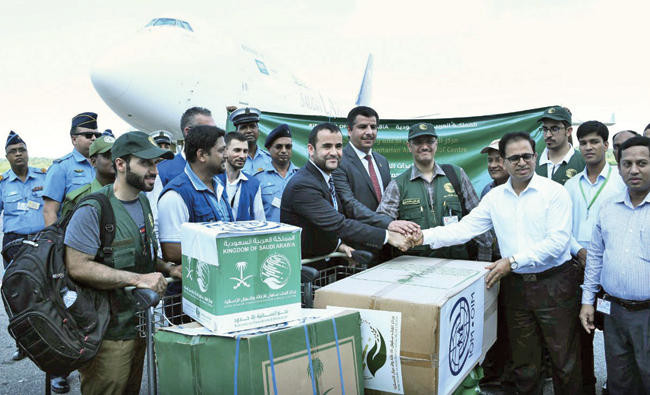
RIYADH: The King Salman Humanitarian Aid and Relief Center (KSRelief), launched by King Salman in 2015, has saved “millions of people,” said its General Supervisor Abdullah Al-Rabeeah.
KSRelief has improved the lives of people in need in numerous countries, including Yemen and Syria.
King Salman on Tuesday ordered the payment of $15 million in aid for Rohingya refugees fleeing genocide in Myanmar.
The announcement came following a meeting of the Saudi Cabinet, which renewed a call for the international community to take urgent action to end the organized violence and allow Myanmar’s Muslim minority their basic human rights.
“The Kingdom, represented by KSRelief, has saved millions of people, victims of conflicts and crises worldwide, without discrimination in terms of their religion, race or color,” said Al-Rabeeah.
He added that the level of development and humanitarian assistance provided by the Kingdom, as a percentage of gross domestic product (GDP), exceeds the target set by the UN.
Al-Rabeeah was speaking in Washington at a symposium hosted by the National Council on US-Arab Relations and a committee for US-Gulf partnerships.
He said KSRelief, despite its recent establishment, has implemented 231 projects in 38 countries via 108 partnerships with the UN, international and local organizations.
Al-Rabeeah added that war-torn Yemen is suffering from poor infrastructure and poor health services, and is in dire need of humanitarian aid in the areas of food, health care and child malnutrition.
He cited the situation regarding humanitarian funding for Yemen by the international community, with only 42 percent of the UN’s target for 2017 — $976.5 million of $2.3 billion — met so far.
Al-Rabeeah said the Kingdom is one of the most active countries in the world in responding to the UN appeal for 2017, with its funding amounting to $221.9 million. The Kingdom gave Yemen a total of $8.27 billion between 2015 and 2017, he added.
Al-Rabeeah said the Kingdom responded to appeals by the World Health Organization (WHO) and UNICEF to fight cholera in Yemen by providing $66.7 million upon the directives of Crown Prince Mohammed bin Salman.
KSRelief implemented 103 projects benefiting almost 32 million women, with total funding of more than $157 million, he added.
These projects included 68 initiatives in the fields of education, protection, food security, health, water and environmental sanitation for Yemeni women.
Projects for children in Yemen focused on protection, rehabilitation, food, nutrition, health and environmental sanitation.
KSRelief implemented 116 projects for children worldwide, benefiting more than 60 million of them.
The center last week signed contracts with hospitals in Yemen to treat about 700 victims of the conflict.
It also freed and rehabilitated 40 Yemeni children who had previously been conscripted by Houthi militias. The children were returned to school and reintroduced to their peers.
For one month, they will receive psychological, educational, social and sports courses supervised by qualified psychologists, according to international standards for reintegration programs.
These children were forced by Houthi militias to take part in fighting and supply them with ammunition and food.
According to Yemeni government estimates, more than 10,000 children have been conscripted by the Houthis.
KSRelief is also supporting the Syrian people by coordinating with the Saudi National Campaign (SNC), which is offering humanitarian support including providing medical services via specialized clinics at Zaatari refugee camp in Jordan.
A Kingdom-wide fundraising campaign for people displaced by the war in Syria, including those evacuated from east Aleppo, was launched last December, and has received an overwhelming response.
Saudi Arabia is one of the biggest donors to UN relief campaigns for Syria, and has an ongoing aid program for refugees and those internally displaced.


![]()
Humanitarian work puts Saudi Arabia at forefront of philanthropy
Humanitarian work puts Saudi Arabia at forefront of philanthropy
Related


Latest updates


© 2026 SAUDI RESEARCH & PUBLISHING COMPANY, All Rights Reserved And subject to Terms of Use Agreement.