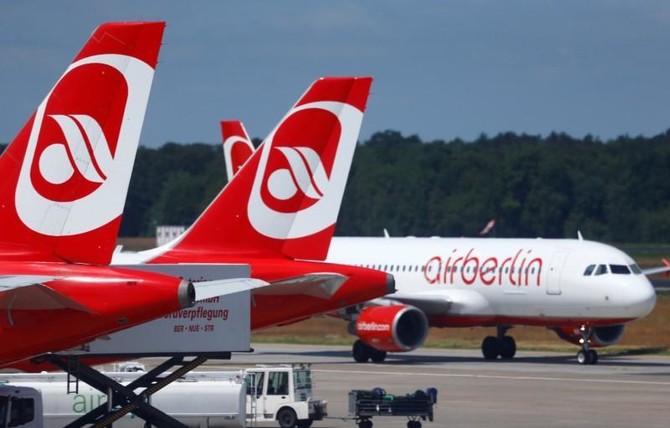
FRANKFURT: Lufthansa’s bid for Air Berlin assets is focused on securing the 38 crewed planes it currently leases from the insolvent carrier and it is interested in a further 20 to 40 planes, Lufthansa’s chief executive said.
Those 38 planes currently carry about 1,000 passengers a day, mainly for the group’s budget unit Eurowings, and Lufthansa’s priority is on keeping that operation stable, Carsten Spohr said at a media event late on Wednesday.
Eurowings was hit last week, when Air Berlin pilots called in sick in unusually high numbers, forcing the cancelation of flights.
Spohr said Lufthansa also expected it could grow its short-haul operations by another 20 to 40 planes without falling foul of anti-trust concerns due to the expected exit of Air Berlin from the market.
“The next few days will show whether that growth comes organically via Eurowings or through an Air Berlin transaction,” he said, adding that Lufthansa would need around 3,000 new employees as it seeks to build on its market share following the exit of Air Berlin.
Lufthansa is however not interested in Air Berlin’s long-haul routes however, with Spohr saying the flagship carrier could grow in that area on its own.
After announcing plans to start Eurowings long-haul routes from Duesseldorf this winter, following Air Berlin’s retreat there, the budget unit also intends to offer long-haul flights from Berlin Tegel airport next year, albeit starting with just one route.
Spohr also said business so far in 2017 was proving significantly better than the last two years, both of which were record years in terms of financial results.
He added that Lufthansa was sticking with a goal of reducing its unit costs this year and said it hoped to sign a wide-ranging deal on pay and conditions with its pilots this month.

Lufthansa CEO puts focus on 38 wet lease planes in Air Berlin battle
Lebanese social entrepreneur Omar Itani recognized by Schwab Foundation
- FabricAID co-founder among 21 global recipients recognized for social innovation
DAVOS: Lebanon’s Omar Itani is one of 21 recipients of the Social Entrepreneurs and Innovators of the Year Award by the Schwab Foundation for Social Entrepreneurship.
Itani is the co-founder of social enterprise FabricAID, which aims to “eradicate symptoms of poverty” by collecting and sanitizing secondhand clothing before placing items in stores in “extremely marginalized areas,” he told Arab News on the sidelines of the World Economic Forum in Davos, Switzerland.
With prices ranging from $0.25 to $4, the goal is for people to have a “dignified shopping experience” at affordable prices, he added.
FabricAID operates a network of clothing collection bins across key locations in Lebanon and Jordan, allowing people to donate pre-loved items. The garments are cleaned and sorted before being sold through the organization’s stores, while items that cannot be resold due to damage or heavy wear are repurposed for other uses, including corporate merchandise.
Since its launch, FabricAID has sold more than 1 million items, reached 200,000 beneficiaries and is preparing to expand into the Egyptian market.
Amid uncertainty in the Middle East, Itani advised young entrepreneurs to reframe challenges as opportunities.
“In Lebanon and the Arab world, we complain a lot,” he said. Understandably so, as “there are a lot of issues” in the region, resulting in people feeling frustrated and wanting to move away. But, he added, “a good portion of the challenges” facing the Middle East are “great economic and commercial opportunities.”
Over the past year, social innovators raised a combined $970 million in funding and secured a further $89 million in non-cash contributions, according to the Schwab Foundation’s recent report, “Built to Last: Social Innovation in Transition.”
This is particularly significant in an environment of geopolitical uncertainty and at a time when 82 percent report being affected by shrinking resources, triggering delays in program rollout (70 percent) and disruptions to scaling plans (72 percent).
Francois Bonnici, director of the Schwab Foundation for Social Entrepreneurship and a member of the World Economic Forum’s Executive Committee, said: “The next decade must move the models of social innovation decisively from the margins to the mainstream, transforming not only markets but mindsets.”
Award recipients take part in a structured three-year engagement with the Schwab Foundation, after which they join its global network as lifelong members. The program connects social entrepreneurs with international peers, collaborative initiatives, and capacity-building support aimed at strengthening and scaling their work.