Hurricane Maria clobbers Puerto Rico, plunges island into darkness

A woman with a flashlight illuminates her baby inside a shelter before the arrival of the Hurricane Maria in Punta Cana, Dominican Republic. (Reuters)
Updated 21 September 2017
Follow

Hurricane Maria clobbers Puerto Rico, plunges island into darkness

SAN JUAN, Puerto Rico: Hurricane Maria, the strongest storm to strike Puerto Rico in nearly 90 years, carved a path of destruction through the US territory on Wednesday, causing severe flooding and plunging the island into darkness as the storm’s death toll in the Caribbean rose to at least 10.
Maria, the second major hurricane to rage through the region this month, was left weakened by its encounter with Puerto Rico and on a course projected to pass north of the Dominican Republic, the Miami-based US National Hurricane Center (NHC) said.
Hours earlier, Maria pummeled St. Croix, the largest and southern-most of the US Virgin Islands, as a rare Category 5 hurricane on the five-step Saffir-Simpson scale, causing widespread heavy damage.
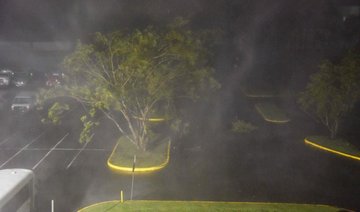
Moving on to Puerto Rico ranked a Category 4 storm, with sustained winds of up to 155 miles per hour (250 km per hour), Maria ripped roofs from buildings and turned low-lying roadways into rushing debris-laden rivers as it cut a diagonal swath across the island.
The island’s governor, Ricardo Rossello, said the only fatality immediately reported was a man struck by a piece of lumber hurled by high winds.
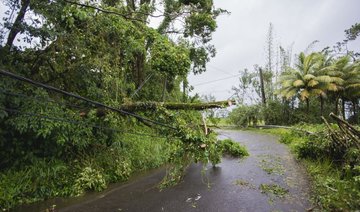
The streets of Puerto Rico’s historic Old Town in the capital, San Juan, were strewn with broken balconies, air conditioning units, shattered lamp posts, fallen power lines and dead birds. Few trees escaped unscathed. Thick branches were torn down from most and others were simply uprooted.
“It’s nothing short of a major disaster,” Rossello said in a CNN interview, adding it may take months for the island’s electricity to be completely restored. Earlier he imposed a dusk-to-dawn curfew for the island.
The Hurricane Center reported “catastrophic flash flooding” in portions of the island, and news pictures showed whole blocks under water in areas of the capital.
“When we are able to go outside, we are going to find our island destroyed,” Abner Gomez, the director of the island’s emergency management agency, was quoted as saying by El Nuevo Dia newspaper. “It’s a system that has destroyed everything in its path.”
Virtually the entire island was without electricity as night fell, said Pedro Cerame, a spokesman for the governor.
By 11 p.m. EDT (0300 GMT), Maria’s center was drifting away from Puerto Rico. The storm was packing maximum sustained winds of 110 mph (175 kph) and was 55 miles (90 km) off the eastern tip of the Dominican Republic, the NHC said.
As is typical for hurricanes passing over hilly or mountainous terrain, Maria was markedly diminished by the time it crossed Puerto Rico, though the NHC said the storm was likely to regain major hurricane status on Thursday.
Maria was expected to skirt past the northeastern coast of the Dominican Republic Wednesday night and Thursday before approaching the Turks and Caicos Islands and southeastern Bahamas on Thursday night and Friday, the NHC said. So far, it looked unlikely to threaten the US mainland.
Storm-related rainfall was expected to range from 20 to 30 inches (50 to 76 cm) on much of Puerto Rico through Friday, according to NHC.
Maria was classified a Category 5 storm when it struck the eastern Caribbean island nation of Dominica on Monday night with devastating force, killing at least seven people there, government officials.
Based on an aerial survey, about 95 percent of roofs in Dominica, one of the poorest countries in the Caribbean with a population of about 73,000, were damaged or destroyed by Maria, the UN Office for the Coordination of Humanitarian Affairs said. It added damage to the island could be in the billions of dollars.
Hartley Henry, principal adviser to Prime Minister Roosevelt Skerrit, said in a Facebook post on Wednesday that “the country is in a daze.”
Two people died in the French territory of Guadeloupe before Maria raked St. Croix.
Hurricane Irma, which ranked as one of the most powerful Atlantic storms on record, also left a trail of destruction in several Caribbean islands and Florida this month, killing at least 84 people.


Israel is risking global security, warns Somali Information Minister

Updated 6 sec ago
Follow

Israel is risking global security, warns Somali Information Minister

  • Tel Aviv’s actions boost terror groups he tells Arab News in exclusive interview
  • Jama accuses Tel Aviv of wanting to relocate Palestinians from Gaza to region

RIYADH: Israel’s recognition of Somaliland and its presence in the region risks inflaming the situation there, allowing terrorist groups to undermine regional security and stability, according to Somali Information, Culture and Tourism Minister Daud Aweis Jama.

In a special interview with Arab News, Jama insisted that Israel’s unprecedented Dec. 26 move to recognize Somaliland as a sovereign state represents a major setback for Mogadishu’s fight against terrorist organizations like Al-Shabab and Daesh.

“The presence of Israel will be used by the terrorist groups to expand their operations in the region. (They will) have a pretext to spread their ideologies in the region,” he said.

“That is another factor that is also risking global security and regional stability, because we have been in the last stage of overcoming the challenges of the terrorist groups Al-Shabab and ISIS,” he added, using another term for Daesh.

Jama added: “We have been putting all our resources and all our time into making sure that we finalize the final stages of the fight against Al-Shabab. So, if something else interrupts us, that means that we are not going to focus fully on the operations against Al-Shabab. And that means we are giving more opportunities to Al-Shabab or other organizations.”

The consequences of this hit to Somalia’s ability to fight terror will not be restricted to the country’s borders, according to Jama, but will spread across the region and beyond.

“This might invite other, external terrorist groups to the region, because they will take advantage of this crisis and will make sure that they take over all the areas that have been defeated before,” the minister said.

“We believe this has come at a time that is going to affect our security as a Somali government, the security of the Horn of Africa, the security of the Gulf of Aden, the security of the Red Sea, the security of the Middle East and global stability. This is a very important location that holds the trade of the world.”

The minister underlined that Israel’s recognition and larger presence in the region are leading to more challenges, “putting more fuel on the ongoing challenges that exist in the region, especially in Somalia.” He added: “And at this time, it is not only limited to Somalia, but it’s going to be a challenge that is going to spread like a fire all over the region and all over the world.”

Jama told Arab News that Israel has other strategic motives for its recognition of Somaliland — including the forced resettlement of Palestinians from Gaza.

“According to reliable sources that our intelligence gathered, one of the conditions that Israel put forward (for recognizing Somaliland) was to have a place that they can settle the people from Gaza,” he said.

“We find that it is a violation also of the people of Palestine, because we believe that the people of Palestine have the right to self-determination. The two-state solution that has been the call of the international community has to be adhered to and implemented.”

Israel’s coalition government, the most right-wing ‌and religiously conservative in its history, includes far-right politicians who advocate the ‍annexation of both Gaza and the West ‍Bank and encouraging Palestinians to leave their homeland.

Somalia’s UN Ambassador Abukar Dahir Osman said ‍Security Council members Algeria, Guyana, Sierra Leone and Somalia “unequivocally reject any steps aimed at advancing this objective, including any attempt by Israel to relocate the Palestinian population from Gaza to the northwestern region of Somalia.”

Israel last month became the first country to recognize Somaliland as an independent nation. In the three-plus decades since its self-declaration of independence in 1991, no state had recognized the northwestern territory as being separate from Somalia.

Mogadishu immediately rejected the Israeli move, alongside countries all over the world.

Saudi Arabia affirmed its rejection of any attempts to impose parallel entities that conflict with the unity of Somalia. It also affirmed its support for the legitimate institutions of the Somali state and its keenness to preserve the stability of Somalia and its people.

A group of foreign ministers from Arab and Islamic countries, alongside the Organization of Islamic Cooperation, also firmly rejected Israel’s announcement. In a joint statement, the ministers warned that the move carries “serious repercussions for peace and security in the Horn of Africa and the Red Sea region” and undermines international peace and security.

The 22-member Arab League rejected “any measures arising from this illegitimate recognition aimed at facilitating forced displacement of the Palestinian people or exploiting northern Somali ports to establish military bases,” the organization’s UN Ambassador Maged Abdelfattah Abdelaziz told the UN Security Council.

In the most recent development in Israel-Somaliland relations, less than two weeks after Tel Aviv’s recognition, Israeli Foreign Minister Gideon Saar visited the region on Tuesday to publicly formalize diplomatic relations.

“It was a blatant violation of Somalia’s sovereignty that Israel recognized a region within the Somali Federal Republic as an independent state,” Jama underlined. “That was a total violation of international laws. It was a violation of the territorial integrity and sovereignty of Somalia.

“From the beginning, our path was to follow diplomatic efforts. And we kind of started with a successful UN Security Council meeting that supported Somalia’s territorial integrity and sovereignty. (This was) followed by other international actors like the Arab League, the Organization of Islamic Cooperation, the African Union and regional bodies like the East African Community and IGAD.

“Also, the Peace and Security Council of the African Union has reiterated the importance of supporting Somali sovereignty and territorial integrity.”