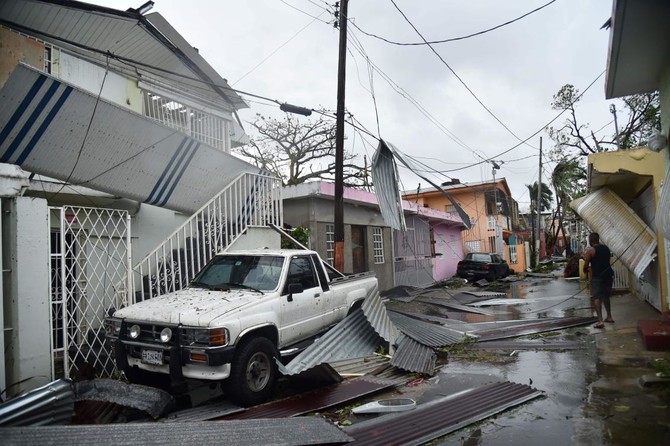
SAN JUAN, Puerto Rico: Hurricane Maria caused devastation across Puerto Rico Wednesday as 150 mile-an-hour winds from the island’s worst storm in living memory flooded the capital and sent thousands scurrying to shelters.
After killing at least nine people on a string of small Caribbean islands, Maria slammed into Puerto Rico’s southeast coast at daybreak before churning across a territory which is home to 3.4 million.
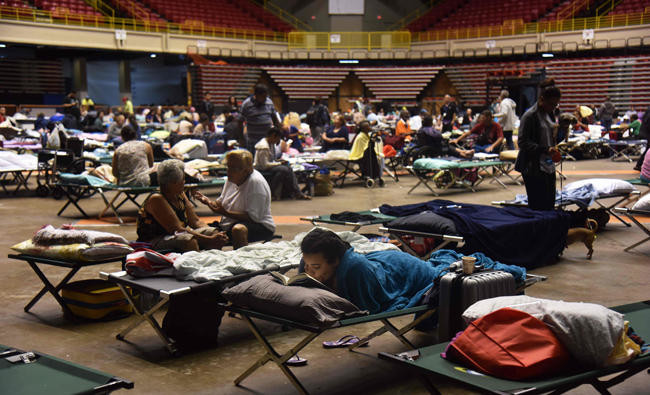
As tens of thousands of people hunkered down in shelters in the capital San Juan, Mayor Carmen Yulin Cruz broke down in tears as she spoke of the utter devastation she had witnessed.
“Many parts of San Juan are completely flooded,” Yulin Cruz told reporters in one of the shelters whose roof swayed as she spoke.
“Our life as we know it has changed... There is a lot of pain and a lot of devastation.”
Maria made landfall as a Category Four storm on the five-point Saffir-Simpson scale, initially packing winds of a little over 150 mph (240 kph) before easing slightly as it powered toward San Juan.
“The wind sounds like a woman screaming at the top of her lungs!” Mike Theiss wrote on Twitter, sheltering in a safe room in the eye of the storm.
“We are getting absolutely hammered right now.”
Imy Rigau, who was riding out the storm in her apartment in San Juan, said water had “cascaded” through her ceiling.
“We are taking refuge in the hallway as there is about a foot of water in my apartment,” she told AFP.
“I boarded up the windows but with all of this, it seems they are going to be blown away. One of them was smashed up, so we are here in the hallway where there are no windows.”
Many of the most vulnerable of Puerto Rico’s residents took cover in the 500 shelters set up around the island, with officials warning of life-threatening floods.
“As we anticipated, this is the most devastating storm in a century or in modern history,” Puerto Rico governor Ricardo Rossello said on CNN as he warned of the danger of flooding and mudslides.
Puerto Rico’s most catastrophic hurricane was back in 1928 when Hurricane Okeechobee — also known as San Felipe Segundo — killed 300 people.
Although engineers had managed to restore power to most of the island after the recent Hurricane Irma, Maria caused a new black-out across the island.
Brock Long, who heads the US federal government’s emergency agency FEMA, warned it could take days for power to be restored on Puerto Rico and the smaller US Virgin Islands which have also been badly hit by Maria.
“Because of the nature of the geography of the islands, it’s a logistical challenge so it will be a frustrating event to get the power back on,” said Long.
The US and British Virgin Islands — still struggling to recover from the devastation of Irma — are also on alert, along with the Turks and Caicos Islands and parts of the Dominican Republic.
Maria has already torn through several Caribbean islands, leaving at least seven people dead on the island of Dominica.
Communications to Dominica have been largely cut, and its airports and ports have been closed.
But an adviser to Prime Minister Roosevelt Skerrit, who spoke to the premier by satellite phone, painted a picture of devastation on an island that is home to around 73,000 people.
“It’s difficult to determine the level of fatalities but so far seven are confirmed, as a direct result of the hurricane,” Hartley Henry said in a statement.
Reports from rural communities spoke of a “total destruction of homes, some roadways and crops,” added Henry.
“The country is in a daze — no electricity, no running water — as a result of uprooted pipes in most communities and definitely no landline or cellphone services on island, and that will be for quite a while.”
In the French territory of Guadeloupe, one person was killed by a falling tree as Maria hit, while another died on the seafront.
At least two more are missing after their boat sank off the French territory, while some 40 percent of households were without power.
In the US Virgin Islands, locals reported horizontal rain and trees swirling in the wind.
“Very violent and intense right now as we have just begun to experience hurricane force winds,” said 31-year-old Coral Megahy, hunkered down on St. Croix island.
There had been fears that Maria could wreak fresh havoc on islands that were already flattened by Category Five hurricane Irma earlier in the month.
Reports suggested St. Martin, a French-Dutch island that was among the most severely hit by Irma with 14 dead, had escaped the worst this time around.
Britain, France and the Netherlands had boosted resources in their Caribbean territories ahead of Maria, after heavy criticism of poor preparations for Irma.
All three European countries have increased their troop deployments to the region after complaints of looting and lawlessness after Irma.


![]()
![]()
’Storm of the century’ Maria pummels Puerto Rico
’Storm of the century’ Maria pummels Puerto Rico
Latest updates


© 2026 SAUDI RESEARCH & PUBLISHING COMPANY, All Rights Reserved And subject to Terms of Use Agreement.