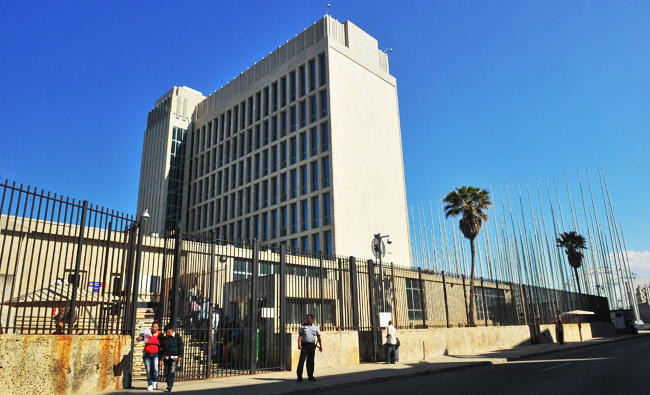
NEW YORK: The Trump administration is considering closing down the recently reopened US Embassy in Havana following a string of unexplained incidents harming the health of American diplomats in Cuba, Secretary of State Rex Tillerson said Sunday.
Tillerson’s comments were the strongest indication to date that the United States might mount a major diplomatic response, potentially jeopardizing the historic restart of relations between the US and Cuba. The two former foes reopened embassies in Washington and Havana in 2015 after a half-century of estrangement.
“We have it under evaluation,” Tillerson said of a possible embassy closure. “It’s a very serious issue with respect to the harm that certain individuals have suffered. We’ve brought some of those people home. It’s under review.”
Of the 21 medically confirmed US victims — diplomats and their families — some have permanent hearing loss or concussions, while others suffered nausea, headaches and ear-ringing. Some are struggling with concentration or common word recall, The Associated Press has reported .
Some victims felt vibrations or heard loud sounds mysteriously audible in only parts of rooms, leading investigators to consider a potential “sonic attack.” Others heard nothing but later developed symptoms.
Tillerson once called the events “health attacks,” but the State Department has since used the term “incidents” while emphasizing the US still doesn’t know what has occurred. Cuba has denied any involvement or responsibility but stressed it’s eager to help the US resolve the matter.
The US has said the tally of Americans affected could grow as more cases are potentially detected.
The last reported incident was on Aug. 21, according to a US official briefed on the matter. The official wasn’t authorized to discuss the matter publicly and requested anonymity.
A decision to shutter the embassy, even temporarily, would deal a demoralizing blow to the delicate detente that President Barack Obama and Cuban leader Raul Castro announced in late 2014. The next year, embassies were reopened and restrictions on travel and commerce eased — signs of a warming relationship that displeased some hard-liners in Cuba’s government. President Donald Trump has reversed some of the changes, but left many in place.
Tillerson spoke on CBS’ “Face the Nation” as world leaders and top diplomats descended on New York for annual UN General Assembly meetings. President Donald Trump will give his first speech on the major global platform this week.
Cuba is also represented at the UN, but it’s not expected Trump will meet with any Cuban leaders or officials during his visit.
The US hasn’t identified either a culprit or a device. Investigators have explored the possibility of sonic waves, an electromagnetic weapon, or an advanced spying operation gone awry, US officials briefed on the probe told the AP. The US hasn’t ruled out that a third country or a rogue faction of Cuba’s security services might be involved.
In Washington, lawmakers in Congress have been raising alarm over the incidents, with some calling for the embassy to be closed. On Friday, five Republican senators wrote Tillerson urging him to not only shutter the embassy, but also kick all Cuban diplomats out of the United States — a move with dramatic diplomatic implications
“Cuba’s neglect of its duty to protect our diplomats and their families cannot go unchallenged,” said the lawmakers, who included Sen. Tom Cotton of Arkansas, who led the effort, and Sen. Marco Rubio of Florida, a prominent Cuban-American and critic of the US detente.
The incidents have frightened Havana’s tight-knit diplomatic community, raising concerns about the potential scope. At least one other country, France, has tested embassy staff for potential sonic-induced injuries, the AP has reported.


Top US diplomat says closing embassy in Cuba ‘under review’
Top US diplomat says closing embassy in Cuba ‘under review’

French court slashes jails term for trio over 2020 teacher beheading
- Brahim Chnina, the Moroccan father of a girl who falsely claimed that Paty had asked Muslim students to leave his classroom before showing the caricatures, had his 13-year sentence reduced to 10 years
PARIS, France: A French court on Monday reduced on appeal the jail sentences of three men convicted over the 2020 terrorist beheading of a teacher who showed a class cartoons of the Prophet Muhammad.
Samuel Paty, 47, was murdered in October 2020 by an 18-year-old radical Islamist of Chechen origin in an act that horrified France.
His attacker, Abdoullakh Anzorov, was killed in a shootout with police.
Two friends of Anzorov, French national Naim Boudaoud and Azim Epsirkhanov, a Russian of Chechen origin, had their sentences of 16 years in prison reduced to six and seven years respectively by a Paris court of appeal.
Both were accused of having driven Anzorov and helping him to procure weapons before the beheading.
Brahim Chnina, the Moroccan father of a girl who falsely claimed that Paty had asked Muslim students to leave his classroom before showing the caricatures, had his 13-year sentence reduced to 10 years.
His daughter, then aged 13, was not actually in the classroom at the time and during the first trial apologized to the teacher’s family.
The court however left the 15-year term for French-Moroccan Islamist activist Abdelhakim Sefrioui untouched.
The quartet were among the seven men and one woman found guilty in 2024 of contributing to the climate of hatred that led to the beheading of the history and geography teacher in Conflans-Sainte-Honorine, west of Paris.
Paty, who has become a free-speech icon, used the cartoons as part of an ethics class to discuss freedom of expression laws in France.


