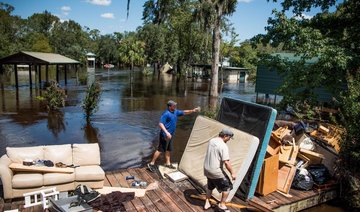
MIAMI: Hurricane Jose is expected to pass east of the North Carolina coast on Monday and remain off the US East Coast from Virginia to New England, while Tropical Storm Maria formed and is forecast to become a hurricane early next week, the US National Hurricane Center said on Saturday.
Maria could threaten several Caribbean islands, some of which were devastated by Hurricane Irma less than two weeks ago. It is expected to approach the Leeward Islands on Monday and become a hurricane around that time, the NHC said.
A hurricane watch is in effect for Antigua, Barbuda, St. Kitts, Nevis and Montserrat and France has also issued a hurricane watch for the island of Guadeloupe. A hurricane watch is typically issued 48 hours before the first occurrence of storm-force winds, NHC said.
Meanwhile, the NHC said the coastline from North Carolina to New England should monitor Hurricane Jose’s progress and forecast that tropical storm watches may be needed for portions of that stretch during the next day or two.
“However, an increase in the size of the storm or a westward adjustment in the track forecast could bring tropical storm conditions closer to the Outer Banks” of North Carolina, the forecast said.
As a large cyclone, Jose could also affect the Virginia-to-New England area, especially if it deviates from its forecast track, the NHC said.
At 5 p.m. EDT (2100 GMT), the NHC said Hurricane Jose was moving northward at 6 miles per hour (106 kph), with maximum sustained winds of 80 miles per hour (130 kph).
The NHC said it was generating swells affecting Bermuda, the Bahamas, the northern coasts of Hispaniola and Puerto Rico, and much of the US East Coast. It said these swells are likely to cause dangerous surf and life-threatening rip currents for several days in these areas.
The 2017 hurricane season in the Atlantic has been one of the most active in recent memory, generating the hugely powerful Irma that went on to lash Florida and Hurricane Harvey, which slammed into the Texas Gulf coast and caused deadly flooding in Houston.

Hurricane Jose staying off US East Coast as Storm Maria forms
Rubio says technical talks with Denmark, Greenland officials over Arctic security have begun
- US Secretary of State on Wednesday appeared eager to downplay Trump’s rift with Europe over Greenland
WASHINGTON: Technical talks between the US, Denmark and Greenland over hatching an Arctic security deal are now underway, Secretary of State Marco Rubio said on Wednesday.
The foreign ministers of Denmark and Greenland agreed to create a working group aimed at addressing differences with the US during a Washington meeting earlier this month with Vice President JD Vance and Rubio.
The group was created after President Donald Trump’s repeated calls for the US to take over Greenland, a Danish territory, in the name of countering threats from Russia and China — calls that Greenland, Denmark and European allies forcefully rejected.
“It begins today and it will be a regular process,” Rubio said of the working group, as he testified before the Senate Foreign Relations Committee. “We’re going to try to do it in a way that isn’t like a media circus every time these conversations happen, because we think that creates more flexibility on both sides to arrive at a positive outcome.”
The Danish Foreign Ministry said Wednesday’s talks focused on “how we can address US concerns about security in the Arctic while respecting the red lines of the Kingdom.” Red lines refers to the sovereignty of Greenland.
Trump’s renewed threats in recent weeks to annex Greenland, which is a semiautonomous territory of a NATO ally, has roiled US-European relations.
Trump this month announced he would slap new tariffs on Denmark and seven other European countries that opposed his takeover calls, only to abruptly drop his threats after a “framework” for a deal over access to the mineral-rich island was reached, with NATO Secretary-General Mark Rutte’s help. Few details of the agreement have emerged.
After stiff pushback from European allies to his Greenland rhetoric, Trump also announced at the World Economic Forum in Davos, Switzerland, last week that he would take off the table the possibility of using American military force to acquire Greenland.
The president backed off his tariff threats and softened his language after Wall Street suffered its biggest losses in months over concerns that Trump’s Greenland ambitions could spur a trade war and fundamentally rupture NATO, a 32-member transatlantic military alliance that’s been a linchpin of post-World War II security.
Rubio on Wednesday appeared eager to downplay Trump’s rift with Europe over Greenland.
“We’ve got a little bit of work to do, but I think we’re going to wind up in a good place, and I think you’ll hear the same from our colleagues in Europe very shortly,” Rubio said.
Rubio during Wednesday’s hearing also had a pointed exchange with Sen. Tim Kaine, D-Virginia, about Trump repeatedly referring to Greenland as Iceland while at Davos.
“Yeah, he meant to say Greenland, but I think we’re all familiar with presidents that have verbal stumbles,” Rubio said in responding to Kaine’s questions about Trump’s flub — taking a veiled dig at former President Joe Biden. “We’ve had presidents like that before. Some made a lot more than this one.”