HOLLYWOOD, Fla: US President Donald Trump visits hurricane-ravaged Florida on Thursday where police are probing the deaths of eight patients inside a nursing home as Hurricane Irma left millions in the state without power.
Police in Hollywood, north of Miami, opened a criminal investigation on Wednesday after finding three dead patients at the Rehabilitation Center at Hollywood Hill, a facility that had been operating with little or no air conditioning.
Four more patients died at or en route to hospital and a fifth was later identified as having died the night before, officials said.
The death toll from Irma stood at 81, with several hard-hit Caribbean islands accounting for more than half the fatalities, and officials continued to assess damage inflicted by the second major hurricane to strike the US mainland this year.
Trump will visit Fort Myers in southwest Florida, an area hard hit by the storm, for a briefing on Hurricane Irma. He will then travel south to Naples, Florida to meet with residents tackling the aftermath of storm, the White House said in a statement.
“The devastation left by Hurricane Irma was far greater, at least in certain locations, than anyone thought — but amazing people working hard!” the president said in a Tweet on Tuesday.
One of the most powerful Atlantic storms on record, Irma bore down on the Caribbean with devastating force as it raked the northern shore of Cuba last week.
It barreled into the Florida Keys island chain on Sunday, packing sustained winds of up to 215 km per hour before plowing up the Gulf Coast of the state and dissipating.
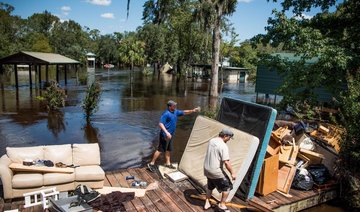
In addition to severe flooding across Florida and extensive property damage in the Keys, residents faced widespread power outages that initially plunged more than half the state into darkness.
Some 4.3 million homes and businesses were still without power on Wednesday in Florida and neighboring states.
About 150 of the Florida’s nearly 700 nursing facilities were without electricity as of Wednesday morning, according to the Florida Health Care Association, which represents most of them.
Florida Power & Light provided electricity to parts of the nursing home in Hollywood but the facility was not on a county priority list for emergency power restoration, the utility said.
Total insured losses from the storm are expected to run about $25 billion, including $18 billion in the US and $7 billion in the Caribbean, catastrophe modeler Karen Clark & Company estimated on Wednesday.
The Florida Keys were particularly hard hit, with federal officials saying 90 percent of its homes were destroyed or heavily damaged. The remote island chain stretches nearly 160 km into the Gulf of Mexico from Florida’s southern tip, connected by a single highway and series of bridges.
On Key West, at the end of the archipelago, hundreds of residents who had refused evacuation orders lined up on Wednesday outside the island’s Salvation Army outpost for water and military-style rations after enduring days of intense heat with little water, power or contact with the outside world.
The stench of dead fish and decaying seaweed permeated the air.
Irma wreaked utter devastation on several of the northern Leeward Islands of the Caribbean, where at least 43 people died. Irma hit Florida about two weeks after Hurricane Harvey plowed into Houston, killing about 60 and causing some $180 billion in damage, mostly from flooding.


![]()

Trump visits hurricane-hit Florida
Trump visits hurricane-hit Florida


Latest updates


© 2026 SAUDI RESEARCH & PUBLISHING COMPANY, All Rights Reserved And subject to Terms of Use Agreement.