Hurricane-damaged US firms dig in for insurance fight

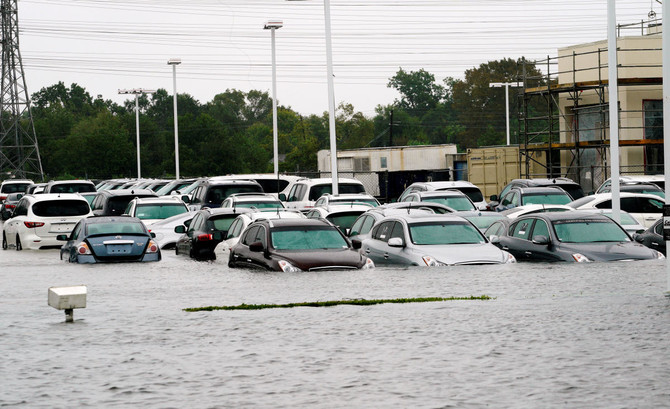
A car dealership is covered by Hurricane Harvey floodwaters near Houston. (Reuters)
Updated 15 September 2017
Follow

Hurricane-damaged US firms dig in for insurance fight

NEW YORK: Business owners who are trying to get back on track after hurricanes Harvey and Irma now face a different sort of challenge: trying to recoup lost income from their insurers.
Exclusions in the fine print of policies, along with waiting periods and disagreements over how to measure a company’s lost income, make business interruption claims among the trickiest in an industry renowned for complexity.
“I think the whole thing is a rip-off,” said Thomas Arnold, an optometrist in Sugar Land, Texas. He said his business, Today’s Vision, was shuttered for almost five days after Hurricane Harvey struck because nearby flooding kept employees and patients from getting there.
Arnold says he pays $1,083 per month for coverage. But after he filed a claim, he said the US unit of Zurich Insurance Group, rejected it because his business was not physically damaged.
Zurich does not comment about specific claims, the company said in a statement. It added that business interruption coverage generally requires “direct physical damage” to a property for a payout.
It was Arnold’s second disappointing experience with business interruption coverage. He said another insurer denied his claim in 2008 after a nine-day power outage from Hurricane Ike.
Devastating storms are hitting the US with increasing frequency. Risk modeling firm AIR Worldwide predicts losses to all properties from the flooding in Texas alone will be $65 billion to $75 billion, regardless of whether they are insured.
The income lost by shuttered firms makes up a significant chunk of overall losses from a natural disaster and can hobble the pace of a community’s economic and social recovery.
Hurricane Katrina in 2005, for example, caused about $25 billion in insured commercial losses, of which $6 billion to $9 billion has been attributed to business interruption, according to information posted on AIR’s website.
The National Flood Insurance Program does not offer a business interruption component. The program is largely used by homeowners, but it also covers commercial structures for up to $500,000 in damage, with another $500,000 for the contents.
That is why companies able to afford the additional protection of business interruption insurance, usually large and medium-sized firms, often purchase it despite the potential for unsuccessful and drawn-out claims.
Big Star Honda, a car dealership in Houston, lost 600 vehicles – 95 percent of its inventory – and was shut for five days after Harvey.
Its managers are now girding themselves for a potentially long slog with the firm’s insurance company as the dealership prepares to make a claim on its business interruption policy.
“We’re collecting every single invoice that pertains to the hurricane,” said Allen Paul, Houston regional vice president of Ken Garff Automotive Group, which owns the dealership.
“I’m really curious to see how that goes,” he said.


Trump’s Iran war violates international law, experts say

Updated 06 March 2026
Follow

Trump’s Iran war violates international law, experts say

  • Mary Ellen O’Connell, a professor at the University of Notre Dame, said the attack on Iran “had no justification under international law“
  • “The US probably could have prevented any Israeli attack on Iran by virtue of the leverage afforded by critical US military support,” said Finucane

WASHINGTON: The United States insists it attacked Iran to curb “direct threats” from the Islamic republic, but legal experts say the dangers cited by Washington do not justify war under international law.
US and Israeli forces launched a massive air campaign against Iran on February 28, with Washington saying it aimed to curb nuclear and missile threats from Tehran. Yet the war has also decapitated the country’s government, and President Donald Trump is now demanding “unconditional surrender.”
The White House laid out Washington’s justification for the war during a news conference this week.
“This decision to launch this operation was based on a cumulative effect of various direct threats that Iran posed to the United States of America, and the president’s feeling, based on fact, that Iran does pose (an) imminent and direct threat,” Press Secretary Karoline Leavitt said Wednesday.
She went on to cite Iranian sponsorship of “terrorism,” its ballistic missile program and its alleged efforts to “create nuclear weapons and nuclear bombs.”
But Mary Ellen O’Connell, a professor at the University of Notre Dame, said the attack on Iran “had no justification under international law.”
“The law is clear that international disputes are to be resolved using peaceful means — negotiation, mediation, the intervention of international organizations,” said O’Connell, an expert in international law on the use of force and international legal theory.
The Trump administration has offered “vague mentions of imminent attacks by Iran and to prevent Iran from acquiring a nuclear weapon,” while the UN Charter “requires, at the least, that evidence of a significant attack by Iran be underway,” she said.

- ‘Even less plausible’ -

“No shred of such evidence has been provided. Nor is there any right whatsoever to start a war over a weapons program.”
While Leavitt cited threats from missiles and militants, US Secretary of State Marco Rubio offered a different justification for the war earlier in the week: fears that an Israeli attack would trigger reprisals against US forces.
Brian Finucane, senior adviser for the International Crisis Group’s US Program, said there were several issues with Rubio’s explanation, including that the Trump administration has since offered other rationales for the war.
“The US probably could have prevented any Israeli attack on Iran by virtue of the leverage afforded by critical US military support,” said Finucane, who previously worked in the Office of the Legal Adviser at the US Department of State.
The Iran war is not the only legally dubious military intervention by the Trump administration.
In early September, the United States began carrying out strikes on alleged drug-smuggling boats in the Caribbean and later the eastern Pacific — a campaign that has killed more than 150 people.
The US government has yet to provide definitive evidence that the vessels it targets are involved in drug trafficking, and legal experts and rights groups say the strikes likely amount to extrajudicial killings.
Trump also ordered strikes on Iranian nuclear sites last year, and sent US forces into Caracas in early January to seize leftist Venezuelan leader Nicolas Maduro, who is now on trial in the United States.
Finucane said Trump’s Friday demand for “unconditional surrender” by Iran “further undercuts prior justifications for US military action.”
“The administration has not even bothered to argue that Operation Epic Fury complies with international law, but certainly statements like this make any such argument even less plausible,” he said, referring to the Iran operation.