MANILA: The battle to retake Marawi City is drawing to a close after months of intense fighting between government forces and the Daesh-inspired Maute group, the Philippine defense chief has said.
Defense Secretary Delfin Lorenzana said the military is closing in on Maute militants and has nearly eradicated them from the country’s only Islamic city.
The militants are now contained in a small geographical area, he said.
“That’s why I’ve been told by our ground commanders that (the battle to retake) Marawi is nearly over,” Lorenzana said.
The military has not set a deadline for an end to the battle, but assured that government troops are “doing their best” and that “only a little more patience” is required.
President Rodrigo Duterte earlier said that the Marawi conflict had dragged on because he opposed a plan to bomb mosques that were occupied by the enemy. Duterte reiterated this on Friday.
“Look, if you are a president, you have a lot of things to consider. One is that the battle of Marawi is a war against a group of people, terrorists; these are (Daesh) and the Mautes. It has never been an issue of religion,” Duterte stressed.
“If you bomb purposely to destroy, to force the surrender, you’d have inflicted the pain on all Muslims. Now remember, there are more than 2 million Filipinos working in the Middle East, most of them (in) Muslim states. You get my point?” he added.
“(If we bomb and destroy the mosques) we will not recover this, the love (of the Muslim people) … So I said look for another option,” Duterte continued, adding that he told the troops to crawl their way forward.
The president asked the troops to keep their calm and not be offended, adding: “Who doesn’t want this conflict to end? But there’s a larger picture at stake here.”
When asked if the government needs help from outside — particularly intelligence agencies of Malaysia and Indonesia and equipment from US, Australia, and Japan — the president said “it can help.”
With the Marawi conflict nearly over, Lorenzana said the construction of transitional shelter areas had started on Sept. 8.
A task force for the rehabilitation of Marawi also met on Sept. 13 to discuss the provision of water in the shelter areas.
Lorenzana said that more than $1 billion was required to rebuild the war-torn Islamic City.
A post-conflict assessment team went to Marawi last week, visiting areas already cleared by the military.
Foreign assistance for the relief and rehabilitation efforts in Marawi continues to pour in, including funds from Australia, the US, Japan, Thailand, China and the EU.
The Marawi crisis broke out on May 23 after a failed attempt to capture Isnilon Hapilon, leader of the Daesh-affiliated Abu Sayyaf group.
The armed conflict has so far resulted in the death of 670 Maute militants, 147 from the government side, and 47 civilians.


![]()
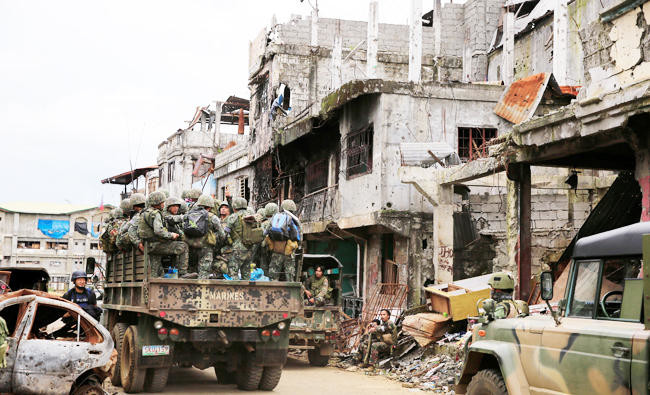
Battle of Marawi City in Philippines ‘nearly over’
Battle of Marawi City in Philippines ‘nearly over’
Latest updates


© 2026 SAUDI RESEARCH & PUBLISHING COMPANY, All Rights Reserved And subject to Terms of Use Agreement.