BEIJING: The founder of a Chinese online peer-to-peer lender has been sentenced to life in prison on charges he defrauded investors of $7.7 billion in one of China’s biggest financial scams.
Ezubo was the biggest competitor in an informal finance industry that Chinese authorities allowed to flourish with little oversight over the past decade to support entrepreneurs who cannot get loans from state banks. A series of lenders have collapsed as economic growth slowed, leaving authorities struggling to defuse protests by depositors.
Ezubo’s founder, Ding Ning, and his younger brother, Ding Dian, were sentenced Tuesday to life by the Beijing No. 1 Intermediate People’s Court for “fundraising fraud,” according to the official Xinhua News Agency.
It said another 24 executives were sentenced to prison terms ranging from three to 15 years.
Two companies affiliated with Ezubo were fined a total of 1.9 billion yuan ($291 million), Xinhua said. It said some defendants also were convicted of offenses including smuggling precious metals and illegal gun possession.
Regulators seized Ezubo in December 2015 on charges of taking deposits without a license. Xinhua said authorities have confiscated the company’s assets to repay depositors but gave no indication how much money was recovered.
Regulators allowed private sector lending to support entrepreneurs who create China’s new jobs and wealth but are largely shut out of lending by the state-owned banking industry. The national bank regulator estimated in 2015 the industry had grown to $1.5 trillion.
Beijing tightened control as defaults mounted following the 2008 financial crisis. The finance industry as a whole has come under tougher scrutiny after a plunge in stock prices in 2015 led to accusations of insider trading and other offenses.
Ding, 34, was a high school dropout who worked at his mother’s hardware factory, where he gained experience running online sales, according to media reports. With no technical or financial training, Ding launched Ezubo in July 2014 and opened marketing offices across China.
Ezubo appeared to gain Beijing’s endorsement when the Cabinet website, gov.cn, published an interview with Ding discussing his life as an entrepreneur. That interview has since been removed.
The seizure of Ezubo prompted protests by depositors who complained the government failed to protect them.
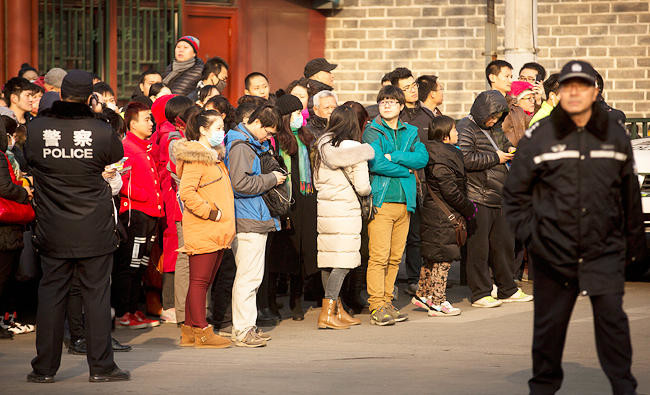
Depositors traveled to Beijing to protest at government offices and the headquarters of state television, which had broadcast advertisements for Ezubo.
Ezubo attracted deposits by promising returns of 9 to 14.6 percent, according to investigators. But authorities say a former executive admitted 95 percent of those borrowers were fictional entities created by Ezubo. In a confession broadcast by state television in February 2016, the executive called the company “a fraud ... a typical Ponzi scheme.”
The court said Ding and other defendants “inflicted huge losses on investors in many parts of China and disrupted the national financial management system,” according to Xinhua.
The Internet has helped lenders attract money from working class or rural depositors, many of them financial novices with little knowledge of the risks involved.
After Ezubo depositors poured out their anger on Chinese social media, police phoned some Internet users to warn them against criticizing the Communist Party online.
One investor from northeastern China who lost 480,000 yuan ($76,000) told The Associated Press that police confiscated her computer and cell phone after she posted online that she might file a petition with the central government.
Earlier, two businesswomen in southern China were sentenced to death in 2012 and 2013 in separate cases on charges of “illegal fundraising.” The penalty for the first was converted to a prison term following an outcry online that it was too severe.


Founder of online Chinese lender sentenced to life for fraud
Founder of online Chinese lender sentenced to life for fraud



US envoys juggle two crisis talks, raising questions about prospects for success
- “Trump seems more focused on quantity over quality instead of the difficult detailed work of diplomacy,” said Bruen
- A regional official close to Iran’s leadership said the US team’s double agenda in Geneva reinforced doubts
WASHINGTON/GENEVA/DUBAI: Even for a US president long fixated on deal-making, Donald Trump’s assignment of his favorite envoys to juggle two sets of negotiations – the Iranian nuclear standoff and Russia’s war in Ukraine — in a single day in Geneva has left many in the foreign policy world scratching their heads.
The shuttle diplomacy on Tuesday by US special envoy Steve Witkoff and Trump’s son-in-law Jared Kushner has raised questions not only about whether they are overstretched and outmatched, but about their serious prospects for resolving either of the twin crises, experts say.
Trump, who has frequently boasted about having ended multiple wars and conflicts in the first year of his second four-year term, has made clear he is looking to add more international deals that he can tout in his quest for the Nobel Peace Prize.
But the high-stakes negotiations over the two long-running issues were arranged quickly, and the choice of Geneva as the setting for both was never clearly explained, except for the city’s long history of hosting international diplomacy.
“Trump seems more focused on quantity over quality instead of the difficult detailed work of diplomacy,” said Brett Bruen, who was a foreign policy adviser in the Obama administration and now heads the Global Situation Room strategic consultancy. “Tackling both issues at the same time in the same place doesn’t make a lot of sense.”
Iran was the opening act in a carefully choreographed diplomatic dance in Geneva, where talks took place under high security in two locations on different sides of the Swiss, French-speaking city.
After 3-1/2 hours of indirect discussions between the US team and Iranian Foreign Minister Abbas Araqchi mediated by Oman, both sides indicated that some progress was made, but there was no suggestion that an agreement was imminent in the longstanding dispute over Iran’s nuclear program.
As long as the diplomatic process continues, Trump can keep expanding his massive military buildup near Iran, making clear that use of force remains on the table. That is likely to keep the Middle East on edge, with many fearing that US strikes could escalate into a wider regional war.
’OVERSTRETCH’?
With barely a pause on Tuesday, the US delegates went straight from the Iran talks at Oman’s diplomatic mission to the five-star InterContinental hotel for the first of two days of Russia-Ukraine negotiations over a war that Trump, during the 2024 presidential campaign, had promised to end in a day.
Expectations were low for a breakthrough in the latest round of talks to end Europe’s biggest war since World War Two ended in 1945.
A regional official close to Iran’s leadership said the US team’s double agenda in Geneva reinforced doubts about whether Washington was sincere about either of the diplomatic efforts.
“The approach risks overstretch,” the official, who spoke on condition of anonymity, told Reuters. “It resembles an emergency room with two critically ill patients and a single doctor unable to give either case sustained attention, increasing the likelihood of failure.”
Mohanad Hajj-Ali of the Carnegie Middle East Center in Beirut said there was too much at stake in the Iran crisis for the US to handle diplomacy this way.
“Having a team of Witkoff and Kushner tasked with resolving all the world’s problems is, frankly, a shocking reality,” he said.
Some experts said the two, both from Trump’s world of New York real estate development, lack the depth of knowledge and experience to go up against veteran negotiators like Araqchi and their Russian interlocutors and that they were in over their heads in such complicated conflicts.
Absent from the Geneva meetings was US Secretary of State Marco Rubio, Trump’s top diplomat, who is known as a foreign policy wonk.
Asked for comment, White House spokesperson Anna Kelly said Trump and his team “have done more than anyone to bring both sides together to stop the killing and deliver a peace deal” in Ukraine. She denounced anonymous “critics” of the president’s approach but did not provide answers to Reuters’ specific questions for this story.
’ENVOY FOR EVERYTHING’
Administration officials have long defended Witkoff and Kushner’s roles, citing their skills as dealmakers, the trust Trump puts in them, and the failings over the years of more traditional diplomatic approaches. Witkoff, a longtime Trump friend often called the “envoy for everything” due to his broad remit, played a key role in securing a ceasefire agreement last year between Israel and Hamas in the Gaza war, though progress has stalled toward a more permanent resolution. His diplomatic efforts with Iran and Russia have had little success so far.
In Trump’s first term, Kushner spearheaded the Abraham Accords, under which several Arab states forged landmark diplomatic relations with Israel. But the pact has not advanced much since Trump returned to office nearly 13 months ago.
Kushner and Witkoff’s ability to handle their latest diplomatic tasks has been undercut by Trump’s stripping down of the government’s foreign policy apparatus, both at the State Department and the National Security Council, where many veteran staffers were sent packing, some analysts say.
”We’ve seen a hollowing-out of our diplomatic bench,” said former Obama foreign policy adviser Bruen. “So there’s a question of whether we still have the right people to work on these big issues.”