COX’S BAZAR: International divisions emerged on Tuesday ahead of a UN Security Council meeting on a worsening refugee crisis in Myanmar, with China voicing support for a military crackdown that has been criticized by the US, slammed as “ethnic cleansing” and forced 370,000 Rohingya to flee the violence.
Beijing’s intervention appears aimed at heading off any attempt to censure Myanmar at the council when it convenes on Wednesday.
China was one of the few foreign friends of Myanmar’s former junta.
Beijing has tightened its embrace under Aung San Suu Kyi’s civilian government as part of its giant trade, energy and infrastructure strategy for Southeast Asia.
The exodus from Myanmar’s western Rakine state began after Rohingya militants attacked police posts on Aug. 25, prompting a military backlash that has sent a third of the Muslim minority population fleeing for their lives.
Exhausted Rohingya refugees have given accounts of atrocities at the hands of soldiers and Buddhist mobs who burned their villages to the ground.
They cannot be independently verified as access to Rakhine state is heavily controlled.
Myanmar’s government denies any abuses and instead blames militants for burning down thousands of villages, including many belonging to Rohingya.
But international pressure on Myanmar heightened this week after UN rights chief Zeid Ra’ad Al-Hussein said the violence seemed to be a “textbook example of ethnic cleansing.”
The US also raised alarm over the violence while the Security Council announced it would meet Wednesday to discuss the crisis.
Opprobrium has been heaped Suu Kyi, who was once a darling of the rights community but now faces accusations of turning a blind eye to — and even abetting — a humanitarian catastrophe by Western powers who once feted her as well as a slew of fellow Nobel Laureates.
But Beijing offered more encouraging words to her on Tuesday, with Foreign Ministry spokesman Geng Shuang voicing support for her government’s efforts to “uphold peace and stability” in Rakhine.
“We hope order and the normal life there will be recovered as soon as possible,” he told a press briefing.
The Rohingya minority are denied citizenship and have suffered years of persecution in Buddhist-majority Myanmar.
“An estimated 370,000 Rohingya have entered Bangladesh,” since Aug. 25 Joseph Tripura, a spokesman for the UN refugee agency, told AFP.
The real figure may be higher as many new arrivals are still on the move making it difficult to include them in the count, the UN said, adding 60 percent of refugees are children.
Most are in dire need of food, medical care and shelter after trekking for days through hills and jungles or braving dangerous boat journeys.
In a statement late Monday Suu Kyi’s Foreign Ministry defended the military for doing their “legitimate duty to restore stability,” saying troops were under orders “to exercise all due restraint, and to take full measures to avoid collateral damage.”
Britain and Sweden requested the urgent Security Council meeting amid growing international concern over the ongoing violence.
The council met behind closed doors in late August to discuss the violence, but could not agree a formal statement.
The UN special rapporteur on human rights in Myanmar has said the latest violence may have left more than 1,000 dead, most of them Rohingya.
Myanmar says the number of dead is around 430, the majority of them “extremist terrorists” from the Arakan Rohingya Salvation Army (ARSA).
It says a further 30,000 ethnic Rakhine and Hindus have been displaced inside northern Rakhine, where aid programs have been severely curtailed due to the violence.


![]()
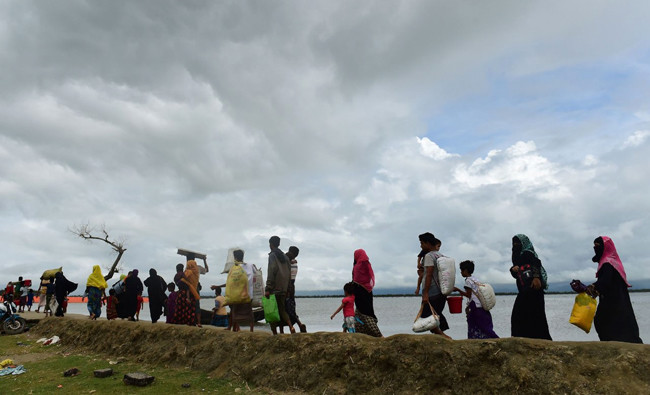
China backs military crackdown on Rohingya Muslims
China backs military crackdown on Rohingya Muslims


Latest updates


© 2026 SAUDI RESEARCH & PUBLISHING COMPANY, All Rights Reserved And subject to Terms of Use Agreement.