

UN to discuss Myanmar after Rohingya ‘ethnic cleansing’ claim

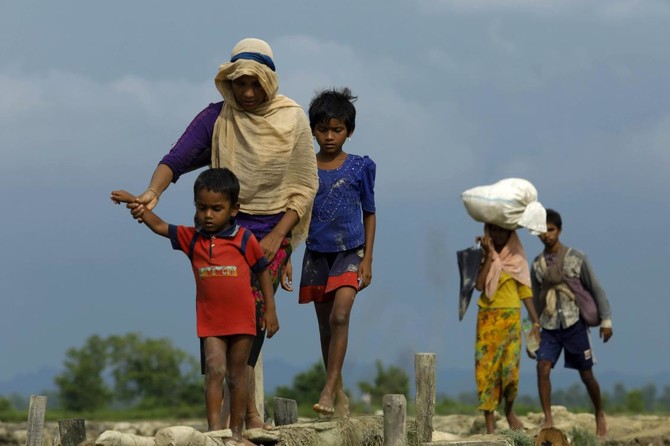
Displaced Rohingya refugees from Rakhine state in Myanmar walk near Ukhia, at the border between Bangladesh and Myanmar. (AFP)
Updated 12 September 2017
Follow

UN to discuss Myanmar after Rohingya ‘ethnic cleansing’ claim

COX’S BAZAR, BANGLADESH: The United Nations Security Council will hold an urgent meeting to discuss violence barrelling through western Myanmar, after the UN’s rights chief warned that “ethnic cleansing” appeared to have driven the flight of over 300,000 Rohingya Muslims from the country.
The remote border region was plunged into crisis after Rohingya militants attacked police posts in late August, prompting a military backlash that has sent nearly a third of the Muslim minority population fleeing to Bangladesh.
Rohingya refugees fleeing the unrest have told stories of soldiers and Buddhist mobs burning entire villages to the ground, while the government blames militants for the arson.
On Monday the United Nations rights chief, Zeid Ra’ad Al Hussein, said the violence seemed to be a “textbook example of ethnic cleansing.”
Hours after the warning, the Security Council announced it would meet Wednesday to discuss the crisis, which has heaped global opprobrium on Myanmar’s civilian leader Aung San Suu Kyi.
A Nobel peace laureate, Suu Kyi has been pilloried by rights groups for failing to speak up for the maligned Rohingya minority, who are denied citizenship by the state and have suffered years of persecution in Buddhist-majority Myanmar.
Late Monday her office said Myanmar “welcomes the statements issued by the United Nations and a number of countries firmly condemning the terrorist attacks,” without mentioning the UN’s charge of ethnic cleansing.
The statement also defended the military’s operations as part of their “legitimate duty to restore stability,” saying troops were under orders “to exercise all due restraint, and to take full measures to avoid collateral damage and the harming of innocent civilians.”
Britain and Sweden requested the urgent UNSC meeting amid growing international concern over the ongoing violence, with fellow Nobel peace laureates urging Suu Kyi to intervene.
The council met behind closed doors in late August to discuss the violence, but there was no formal statement.
UN diplomats have said China, one of Myanmar’s top trade partners, has been resisting involvement by the top UN council in addressing the crisis.
“It’s a sign of the significant worry that Security Council members have about the situation that is continuing to deteriorate for the many Rohingyas who are seeking to flee Rakhine state,” British Ambassador Matthew Rycroft told reporters.

The UN special rapporteur on human rights in Myanmar has said the latest violence may have left more than 1,000 dead, most of them Rohingya.
The exodus, topping 313,000 escapees, has sparked a humanitarian crisis in Bangladesh, where refugee camps were already overcrowded and food and other aid is in short supply.
Most refugees have walked for days in harrowing journeys across rivers and through jungle, arriving sick, exhausted and in desperate need of shelter, food and water.
Tens of thousands of ethnic Rakhine Buddhists as well as Hindus have also fled their homes inside Rakhine, where aid programs have been severely curtailed due to the violence.
Dhaka, which initially tried to block the Rohingya from entering, said Monday that it would start registering all new arrivals.
The Bangladesh government plans to build a huge new camp that will house a quarter of a million refugees.
But it remains unclear when or whether they will be able to return.
On Sunday, the Arakan Rohingya Salvation Army, the militant group whose attacks sparked the latest crackdown, declared a unilateral cease-fire to allow aid to reach the increasingly desperate refugees.
There was no direct response from Myanmar’s military, though government spokesman Zaw Htay tweeted: “We have no policy to negotiate with terrorists.”


World not ready for rise in extreme heat, scientists say

A man drinks water under the sun on a beach in Puerto Madryn, Chubut province, Argentina on January 26, 2024. (AFP)
Updated 5 sec ago
Follow

World not ready for rise in extreme heat, scientists say

  • In a new study, they looked at different global warming scenarios to project how often people in the future might experience temperatures considered uncomfortably hot or cold

PARIS: Nearly 3.8 billion people could face extreme heat by 2050, and while tropical countries will bear the brunt, cooler regions will also need to adapt, scientists said Monday.

Demand for cooling will “drastically” increase in large countries like Brazil, Indonesia, and Nigeria, where hundreds of millions of people lack air conditioning or other means to beat the heat.

But even a moderate increase in hotter days could have a “severe impact” in nations not accustomed to such conditions, such as Canada, Russia, and Finland, said scientists from the University of Oxford.

In a new study, they looked at different global warming scenarios to project how often people in the future might experience temperatures considered uncomfortably hot or cold.

They found “that the population experiencing extreme heat conditions is projected to nearly double” by 2050 if global average temperatures rise 2°C above preindustrial times.

But most of the impact would be felt this decade as the world fast approaches the 1.5°C mark, said the study’s lead author Jesus Lizana.

“The key takeaway from this is that the need for adaptation to extreme heat is more urgent than previously known,” said Lizana, an environmental scientist.

“New infrastructure, such as sustainable air conditioning or passive cooling, needs to be built out within the next few years to ensure people can cope with dangerous heat.”

Prolonged exposure to extreme heat can overwhelm the body’s natural cooling systems, causing symptoms ranging from dizziness and headaches to organ failure and death.

It is often called a silent killer because most heat deaths occur gradually as high temperatures and other environmental factors work together to undermine the body’s internal thermostat.

Climate change is making heatwaves longer and stronger, and access to cooling — especially air conditioning — will be vital in the future.

The study, published in the journal Nature Sustainability, projected that 3.79 billion people worldwide could be exposed to extreme heat by mid century.

This would “drastically” increase energy demand for cooling in developing nations where the gravest health consequences would be felt. India, the Philippines, and Bangladesh would be among the countries with the largest populations affected.

The most significant change in “cooling degree days” — temperatures hot enough to require cooling, such as air conditioning or fans — was projected in tropical or equatorial countries, particularly in Africa.

Central African Republic, Nigeria, South Sudan, Laos, and Brazil saw the biggest rise in dangerously hot temperatures.

“Put simply, the most disadvantaged people are the ones who will bear the brunt of this trend, our study shows for ever hotter days,” said urban climate scientist and research co-author Radhika Khosla.

But wealthier countries in traditionally cooler climates also “face a major problem — even if many do not realize it yet,” she added.

Countries like Canada, Russia, and Finland may experience steep drops in “heating degree days” — temperatures low enough to require indoor heating — under a 2°C scenario.

But even a moderate rise in hotter temperatures would be felt more acutely in countries not designed to withstand heat, the authors said.

In these countries, homes and buildings are usually built to maximize sunlight and minimize ventilation, and public transport runs without air conditioning.

Some cold-climate nations may see a drop in heating bills, Lizana said, but over time these savings would likely be replaced by cooling costs, including in Europe, where air conditioning is still rare.

“Wealthier countries cannot sit back and assume they will be OK — in many cases, they are dangerously underprepared for the heat that is coming over the next few years,” he said.