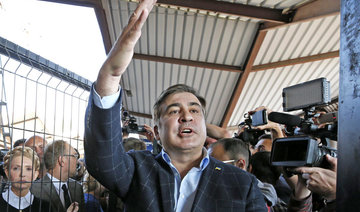

MEDYKA, Poland: Former Georgian president Mikheil Saakashvili and hundreds of his supporters on Sunday forced their way into Ukraine in a bid by the firebrand politician to reclaim his citizenship stripped by President Petro Poroshenko after they fell out.
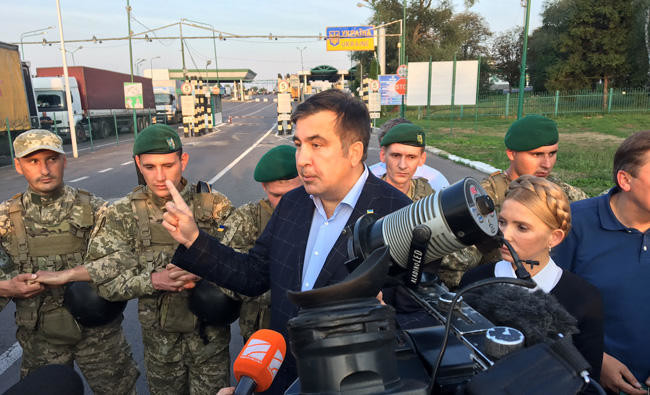
The one-time Ukraine governor and his supporters entered from Poland’s Medyka border crossing, pushing aside Ukrainian border guards who had turned him back just hours earlier.
“They did it against all the rules, what’s happening here?” Saakashvili told reporters in Medyka when he was initially refused entry, adding: “We hope that we can still break through.”
At that point hundreds of his supporters chanting “Misha, Misha” — a diminutive of his name — forced their way into Poland from Ukraine and marched back along with Saakashvili, who now risks extradition to his native Georgia.
Saakashvili was president of his native country Georgia in from January 2004 to November 2013, during which he foughtt and lost a brief war with Russia in 2008.
Barred by the constitution of Georgia from seeking a third term, he left for Ukraine, which granted him citizenship. Georgia subsequently cancelled his citizenship.
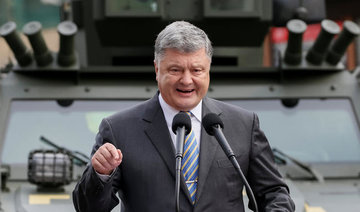
But he quit in November 2016 amid a dramatic falling out with Poroshenko, who stripped him of his Ukrainian citizenship in July while he was out of the country.
Now, Saakashvili wants to return to challenge that decision in court and get back into politics.
Extradition request
On Tuesday, Georgia asked Ukraine to extradite Saakashvili to face charges of misappropriation of property and abuse of office among others.
Saakashvili denies the accusations branding them a political witch hunt.
He says Georgia’s extradition request was driven by “oligarchs” who fear his presence in Ukraine, where he fought corruption.
Earlier Sunday, Ukrainian authorities blocked a Kiev-bound train in Poland carrying Saakashvili, who eventually got off and took a bus to the Medyka crossing.
Ukraine’s outspoken ex-prime minister Yulia Tymoshenko threw her support behind the 49-year-old, accompanying him as he attempted to cross into Ukraine the first time.
Saakashvili said “several hundred thugs were mobilized by the Ukrainian government to stop several thousand” of his supporters waiting to greet him on the Ukrainian side.
Kiev is “panicking,” Saakashvili said, adding that he did “not want to overthrow President Poroshenko” but just defend his rights.
“We believe that Mikheil Saakashvili can lead our country out of the crisis,” Lyudmyla Goretska, one of thousands of supporters waiting in Krakovets on the Ukrainian side of the border, told AFP.
“We see what he did in his own country and that’s enough for us,” Goretska said of Saakashvili, who set up the Movement of the New Forces political party in Ukraine.
“The main problem in our country is corruption... We need to overcome the oligarchy.”
Pro-Western, anti-corruption
The charismatic Saakashvili is credited with pushing through pro-Western and anti-graft reforms in Georgia which he led from 2004 to 2013.
Another supporter, Maria, 49, who declined to give her surname, said she believes “Saakashvili is the future president” of Ukraine and “will finish the war” with Russia.
“We see a roll-back of reforms in Ukraine, we see a crackdown on anti-corruption activities in Ukraine. This is very sad,” Saakashvili said Friday in Warsaw.
Saakashvili has brandished his Ukrainian passport on several occasions and also maintains that officials working for the UN High Commissioner for Refugees in Geneva have confirmed his status as “stateless in Ukraine,” meaning he has the right to be there to appeal against Poroshenko’s decision to withdraw his citizenship.
Kiev justified the move by claiming that Saakashvili had provided “inaccurate information” in his citizenship application.