US denies Iran’s report of confrontation with American vessel

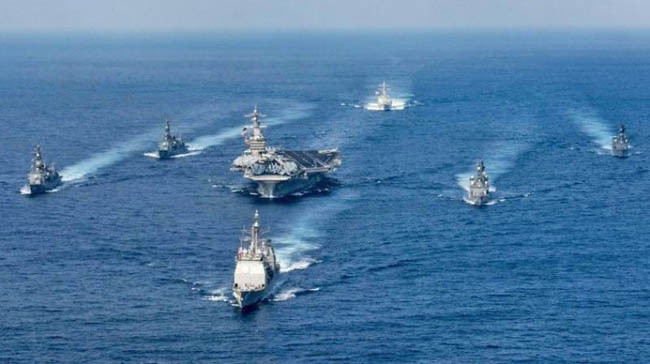
The USS Mahan and other US Navy warships are seen sailing across the Arabian Gulf in this file photo. Iran claimed Sunday that one of its military vessels confronted an American warship in the Gulf and warned it to stay away from a damaged Iranian fishing boat, but the US Navy denied any such direct contact. (AFP)
Updated 10 September 2017
Follow

US denies Iran’s report of confrontation with American vessel

BEIRUT: An Iranian military vessel confronted an American warship in the Gulf and warned it to stay away from a damaged Iranian fishing boat, Tasnim news agency reported on Sunday, but the US Navy denied any direct contact with Iranian forces.
The American vessel turned away after the warning from the Iranian ship, which belonged to the naval branch of the Iranian army, according to Tasnim. The Iranian military vessel then towed the fishing boat, which had sent out a distress signal after taking on water, back to shore.
The agency did not specify when the incident, close to the strategic Strait of Hormuz, took place.
In statement, US Naval Forces Central Command (NAVCENT) said the coastal patrol USS Tempest, operating in the Gulf of Oman on Sept. 6, heard the distress call of an unidentified small boat about 75 nautical miles from the Tempest’s position.
At the same time the motor vessel Nordic Voyager, much closer to the boat in distress, offered help and had made visual contact with it. The Tempest offered to support the Nordic Voyager which declined the offer, NAVCENT said.
Following the radio traffic from a distance, USS Tempest heard the Nordic Voyager coordinate additional Iranian Navy help for the vessel in distress to tow it back to Iran.
“At no time was there any direct contact between the US and Iranian maritime forces,” NAVCENT spokesman Chloe Morgan said.
Tensions have been on the rise between the Iranian and US military in the Gulf in recent months.
In August, an unarmed Iranian drone came within 31 meters of a US Navy warplane as it prepared to land on an aircraft carrier in the Gulf, a US official said at the time.
And in July, a US Navy ship fired warning shots when an Iranian vessel in the Gulf came within 137 meters in the first such incident since President Donald Trump took office in January, US officials said.
Years of mutual animosity had eased when Washington lifted sanctions on Tehran last year as part of a deal to curb Iran’s nuclear ambitions. But serious differences remain over Iran’s ballistic missile program and conflicts in Syria and Iraq.
The Trump administration, which has taken a hard line on Iran, recently declared that Iran was complying with its nuclear agreement with world powers, but warned that Tehran was not following the spirit of the accord and that Washington would look for ways to strengthen it.
During the presidential campaign last September, Trump vowed that any Iranian vessels that harass the US Navy in the Gulf would be “shot out of the water.”


Trump warns Iran of ‘very traumatic’ outcome if no nuclear deal

Updated 12 February 2026
Follow

Trump warns Iran of ‘very traumatic’ outcome if no nuclear deal

  • Speaking a day after he hosted Netanyahu at the White House, Trump said he hoped for a result “over the next month”

WASHINGTON: US President Donald Trump threatened Iran Thursday with “very traumatic” consequences if it fails to make a nuclear deal — but Israeli Prime Minister Benjamin Netanyahu said he was skeptical about the quality of any such agreement.
Speaking a day after he hosted Netanyahu at the White House, Trump said he hoped for a result “over the next month” from Washington’s negotiations with Tehran over its nuclear program.
“We have to make a deal, otherwise it’s going to be very traumatic, very traumatic. I don’t want that to happen, but we have to make a deal,” Trump told reporters.
“This will be very traumatic for Iran if they don’t make a deal.”
Trump — who is considering sending a second aircraft carrier to the Middle East to pressure Iran — recalled the US military strikes he ordered on Tehran’s nuclear facilities during Israel’s 12-day war with Iran in July last year.
“We’ll see if we can get a deal with them, and if we can’t, we’ll have to go to phase two. Phase two will be very tough for them,” Trump said.
Netanyahu had traveled to Washington to push Trump to take a harder line in the Iran nuclear talks, particularly on including the Islamic Republic’s arsenal of ballistic missiles.
But the Israeli and US leaders apparently remained at odds, with Trump saying after their meeting at the White House on Wednesday that he had insisted the negotiations should continue.

- ‘General skepticism’ -

Netanyahu said in Washington on Thursday before departing for Israel that Trump believed he was laying the ground for a deal.
“He believes that the conditions he is creating, combined with the fact that they surely understand they made a mistake last time when they didn’t reach an agreement, may create the conditions for achieving a good deal,” Netanyahu said, according to a video statement from his office.
But the Israeli premier added: “I will not hide from you that I expressed general skepticism regarding the quality of any agreement with Iran.”
Any deal “must include the elements that are very important from our perspective,” Netanyahu continued, listing Iran’s ballistic missile program and its support for armed groups such as the Palestinian movement Hamas, Yemen’s Houthi rebels and Hezbollah in Lebanon.
“It’s not just the nuclear issue,” he said.
Despite their differences on Iran, Trump signaled his strong personal support for Netanyahu as he criticized Israeli President Isaac Herzog for rejecting his request to pardon the prime minister on corruption charges.
“You have a president that refuses to give him a pardon. I think that man should be ashamed of himself,” Trump said on Thursday.
Trump has repeatedly hinted at potential US military action against Iran following its deadly crackdown on protests last month, even as Washington and Tehran restarted talks last week with a meeting in Oman.
The last round of talks between the two foes was cut short by Israel’s war with Iran and the US strikes.
So far, Iran has rejected expanding the new talks beyond the issue of its nuclear program. Tehran denies seeking a nuclear weapon, and has said it will not give in to “excessive demands” on the subject.