

Hurricane Irma will ‘devastate’ part of US: Emergency services chief

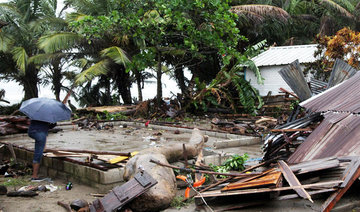
Aerial view of devastation following Hurricane Irma at Bitter End in Virgin Gorda, British Virgin Islands on Friday, is seen in this still image taken from social media video. (Reuters)
Updated 09 September 2017
Follow

Hurricane Irma will ‘devastate’ part of US: Emergency services chief

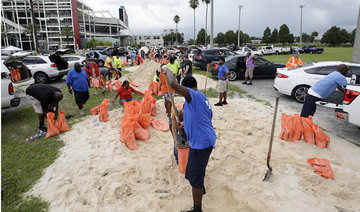
WASHINGTON: Anticipating that Hurricane Irma will “devastate” part of the US, officials were preparing a massive response to the storm, the head of the Federal Emergency Management Agency (FEMA) said on Friday.
With Irma set to hit Florida as early as Saturday night, parts of Florida was expected to lose electricity for days, if not longer, and more than 100,000 people may need shelter, FEMA Administrator Brock Long warned at a news conference.
“Hurricane Irma continues to be a threat that is going to devastate the United States in either Florida or some of the southeastern states,” Long said.

Dangerous measure
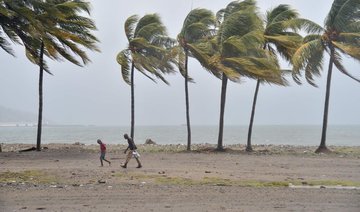
Irma was a Category 5 hurricane, the most dangerous measure by the National Hurricane Center, before being downgraded to Category 4 early Friday after pummeling islands in the Caribbean.
The US has experienced only three Category 5 storms since 1851 and Irma is far larger than the last one to hit the US in 1992, Hurricane Andrew, according to Long.
He warned people not to ignore evacuation orders.
“They need to get out and listen and heed the warnings,” Long said.
Officials have thousands of personnel ready to respond and millions of meals and liters of water in place nearby, Long said.
The National Weather Service said that Friday was the last day to evacuate before winds would start to reach unsafe speeds in Florida.

Extra flights
Airlines added extra flights from Florida on Thursday before announcing plans to halt service from some southern Florida airports starting Friday afternoon.
US Health and Human Services Secretary Tom Price called Irma a “remarkably dangerous storm and the window to get yourself in the right spot ... is closing rapidly.”
Price said the main hospital in St. Thomas in the US Virgin Islands was closed after being damaged by Irma, and critically ill patients were being evacuated to Puerto Rico or other islands.
On Thursday, the US Senate voted 80-17 to approve a measure to more than double funding to $15.25 billion to FEMA and for local block grants to handle natural disasters.
FEMA’s disaster assistance fund could run out of money without action, senators said.
South Korea will boost medical school admissions to tackle physician shortage

Updated 9 sec ago
Follow

South Korea will boost medical school admissions to tackle physician shortage

  • Jeong said all of the additional students will be trained through regional physician programs

SEOUL: South Korea plans to increase medical school admissions by more than 3,340 students from 2027 to 2031 to address concerns about physician shortages in one of the fastest-aging countries in the world, the government said Tuesday.

The decision was announced months after officials defused a prolonged doctors’ strike by backing away from a more ambitious increase pursued by Seoul’s former conservative government. Even the scaled-down plan drew criticism from the country’s doctors’ lobby, which said the move was “devoid of rational judgment.”

Kwak Soon-hun, a senior Health Ministry official, said that the president of the Korean Medical Association attended the healthcare policy meeting but left early to boycott the vote confirming the size of the admission increases.

The KMA president, Kim Taek-woo, later said the increases would overwhelm medical schools when combined with students returning from strikes or mandatory military service, and warned that the government would be “fully responsible for all confusion that emerges in the medical sector going forward.” The group didn’t immediately signal plans for further walkouts.

Health Minister Jeong Eun Kyeong said the annual medical school admissions cap will increase from the current 3,058 to 3,548 in 2027, with further hikes planned in subsequent years to reach 3,871 by 2031. This represents an average increase of 668 students per year over the five-year period, far smaller than the 2,000-per-year hike initially proposed by the government of former President Yoon Suk Yeol, which sparked the months long strike by thousands of doctors.

Jeong said all of the additional students will be trained through regional physician programs, which aim to increase the number of doctors in small towns and rural areas that have been hit hardest by demographic pressures. The specific admissions quota for each medical school will be finalized in April.