

Florida mass exodus as Hurricane Irma closes in

1 / 3
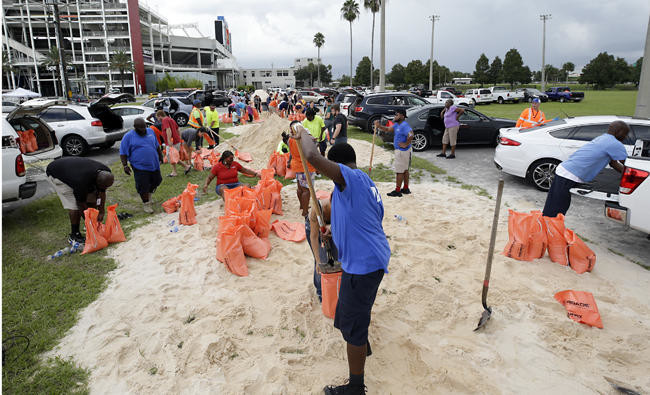
Orlando city employees and volunteers fill sandbags for residents as they prepare for Hurricane Irma on Friday, Sept. 8, 2017, in Orlando, Florida. Lines of vehicles stretched for miles and many waited several hours to get the sandbags. (AP Photo/John Raoux)
2 / 3
US Navy helicopters land at Maxwell Air Force Base in Montgomery, Alabama, on Friday, Sept. 8, 2017. The helicopters came from Florida and were flown in to be protected from Hurricane Irma. (Albert Cesare/The Montgomery Advertiser via AP)
3 / 3
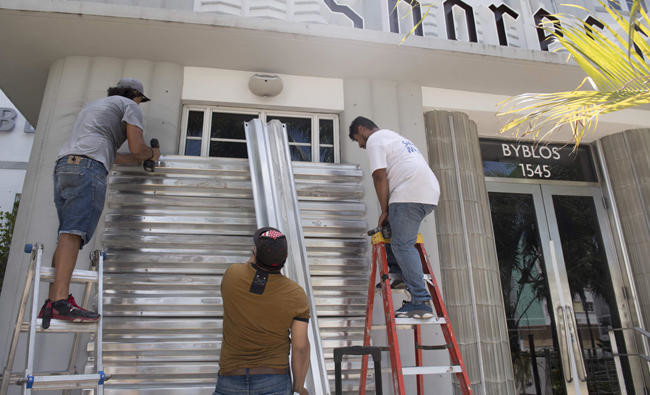
Workers put up storm shutters in preparation of Hurricane Irma in Miami Beach, Florida, on September 8, 2017. (AFP / SAUL LOEB)
Updated 08 September 2017
Follow

Florida mass exodus as Hurricane Irma closes in

MIAMI, US: Florida’s highways were jammed Friday with families fleeing their homes as Hurricane Irma honed in on the Sunshine State after reducing island resorts to rubble and killing at least 17 people across the Caribbean.
Bumper-to-bumper traffic snaked north out of the peninsula, with mattresses, gas cans, mattresses and kayaks strapped to car roofs, as residents heeded increasingly insistent warnings to get out and Florida’s governor said all of the state’s 20.6 million inhabitants should be prepared to evacuate.
“Hurricane Irma is of epic proportion, perhaps bigger than we have ever seen,” US President Donald Trump warned on Twitter. “Be safe and get out of its way, if possible.”
Roaring across the Caribbean, the monster storm laid waste to a series of tiny islands like Saint Barthelemy and Saint Martin, where 60 percent of homes were wrecked and scenes of looting have broken out, before slamming into the Virgin Islands and Puerto Rico.
“Houses are smashed, the airport is out of action, telephone and electricity poles are on the ground,” Olivier Toussaint, a resident of Saint-Barthelemy, told AFP. “Upside-down cars are in the cemeteries. Boats are sunk in the marina, shops are destroyed.”
Irma was downgraded overnight from a rare Category Five storm to a still-deadly Category Four, and continued to pack extremely dangerous winds of 150 miles per hour (240 kilometers per hour).
Forecasters warned of storm surges of up to 25 feet (almost eight meters) above normal tide levels, as the hurricane bears down for a direct hit on southern Florida, where the mass exodus is being complicated by gridlock and fuel shortages.
Normally bustling Miami Beach was deserted and storefronts were boarded up with plywood, some bearing graffiti reading “Say no to Irma” or “You don’t scare us Irma.”
“Nobody can be prepared for a storm surge. They can destroy everything,” said David Wallack, a 67-year-old salsa club owner doing his best to secure his property on the city’s Ocean Drive.
“We just can pray for the best. You put what you can in a suitcase and hope.”
Police cars crawled the coastal roads of West Palm Beach, blaring out “Attention, attention, this is a mandatory evacuation zone, please evacuate.”

'It will be truly devastating'
“The entire southeastern United States better wake up and pay attention,” warned US federal emergency chief Brock Long. “It will be truly devastating.”
In neighboring Georgia, Governor Nathan Deal ordered a mandatory evacuation of the city of Savannah, which has a population of around 150,000 people, and other coastal areas.
According to the latest trajectory from the Miami-based National Hurricane Center, Irma is expected to strike the Florida Keys late on Saturday before moving inland.
At 11 am (1500 GMT) Friday, the hurricane was over the northern edge of Cuba and the central Bahamas and heading northwest at around 14 miles per hour (22 kph).
Even as Irma barrelled toward Florida, meteorologists were closely monitoring two other hurricanes: Jose — a Category Four storm following Irma’s path in the Atlantic — and Katia, set to reach Mexico on Friday.
“The storm is powerful and deadly,” Florida Governor Rick Scott said.
“Today is the day to do the right thing for your family and get inland for safety,” he said. “Do not ignore evacuation orders. All Floridians should be prepared to evacuate soon.”
“Remember, we can rebuild your home, we can’t rebuild your life,” he said.
In the Caribbean, violent winds ripped roofs and facades off buildings, hurling lumps of concrete, cars and even shipping containers aside.
At least two people were killed in Puerto Rico, and more than half of its three million residents were without power after rivers broke their banks in the center and north of the island.
Another four people were killed on the US Virgin Islands, with a number of badly injured people airlifted to Puerto Rico.

Islands suffer massive destruction
One person died in tiny Barbuda where 30 percent of properties were demolished and 300 people had been evacuated to Antigua.
France said at least nine had been killed across its Caribbean territories with seven more missing. There were 112 people injured, two seriously.
Six out of 10 homes were left uninhabitable, with insurers in Paris estimating their overall costs would likely be “much higher” than 200 million euros ($240 million).
On the Dutch side of St. Martin, one person died, officials said. Dutch King Willem-Alexander will head to the island of Curacao to the south on Sunday for a briefing on the aid operation, and may travel on to St. Martin, officials said.
Residents in the British Virgin Islands spoke of scenes of “devastation.”
“Our downstairs doors suddenly blew out, which was terrifying,” Emily Killhoury told the BBC from her home in Tortola.
“We eventually emerged at about 7 p.m. to see total devastation.”
Britain’s defense ministry said it was sending two military transport planes to the region carrying personnel, supplies and recovery equipment.
European nations quickly mobilized to help their citizens in the Caribbean, with France and the Netherlands ordering hundreds of extra police to St. Martin to tackle an outbreak of looting amid major shortages of food, water and petrol.
Speaking to Algemeen Dagblad, one witness reported seeing “people with guns and machetes” in the street.
French Overseas Territories Minister Annick Girardin said 400 police officers would be deployed after seeing “pillaging right in front of us” in St. Martin where most of the 80,000 inhabitants have lost their homes.
In the Dominican Republic, torrential rain and powerful winds left 17 districts cut off, with nearly 20,000 people evacuated and more than 100 houses destroyed.
And in Cuba, some 10,000 foreign tourists were evacuated from beach resorts as authorities hiked the disaster alert level to maximum.

House votes to slap back Trump’s tariffs on Canada in rare bipartisan rebuke

Updated 6 sec ago
Follow

House votes to slap back Trump’s tariffs on Canada in rare bipartisan rebuke

WASHINGTON: The House voted Wednesday to slap back President Donald Trump’s tariffs on Canada, a rare if largely symbolic rebuke of the White House agenda as Republicans joined Democrats over the objections of GOP leadership.
The tally, 219-211, was among the first times the House, controlled by Republicans, has confronted the president over a signature policy, and drew instant recrimination from Trump himself. The resolution seeks to end the national emergency Trump declared to impose the tariffs, though actually undoing the policy would require support from the president, which is highly unlikely. It next goes to the Senate.
Trump believes in the power of tariffs to force US trade partners to the negotiating table. But lawmakers are facing unrest back home from businesses caught in the trade wars and constituents navigating pocketbook issues and high prices.
“Today’s vote is simple, very simple: Will you vote to lower the cost of living for the American family or will you keep prices high out of loyalty to one person — Donald J. Trump?” said Rep. Gregory Meeks of New York, the top Democrat on the House Foreign Affairs Committee, who authored the resolution.
Within minutes, as the gavel struck, Trump fired off a stern warning to those in the Republican Party who would dare to cross him.
“Any Republican, in the House or the Senate, that votes against TARIFFS will seriously suffer the consequences come Election time, and that includes Primaries!” the president posted on social media.
The high-stakes moment provides a snapshot of the House’s unease with the president’s direction, especially ahead of the midterm elections as economic issues resonate among voters. The Senate has already voted to reject Trump’s tariffs on Canada and other countries in a show of displeasure. But both chambers would have to approve the tariff rollbacks, and send the resolution to Trump for the president’s signature — or veto.
Six House Republicans voted for the resolution, and one Democrat voted against it.
From Canada, Ontario, Premier Doug Ford on social media called the vote “an important victory with more work ahead.” He thanked lawmakers from both parties “who stood up in support of free trade and economic growth between our two great countries. Let’s end the tariffs and together build a more prosperous and secure future.”
Trump recently threatened to impose a 100 percent tariff on goods imported from Canada over that country’s proposed China trade deal, intensifying a feud with the longtime US ally and Prime Minister Mark Carney.
GOP defections forced the vote
House Speaker Mike Johnson tried to prevent this showdown.
Johnson insisted lawmakers wait for a pending Supreme Court ruling in a lawsuit about the tariffs. He engineered a complicated rules change to prevent floor action. But Johnson’s strategy collapsed late Tuesday, as Republicans peeled off during a procedural vote to ensure the Democratic measure was able to advance.
“The president’s trade policies have been of great benefit,” Johnson, R-Louisiana, had said. “And I think the sentiment is that we allow a little more runway for this to be worked out between the executive branch and the judicial branch.”
Late Tuesday evening, Johnson could be seen speaking to holdout Republican lawmakers as the GOP leadership team struggled to shore up support during a lengthy procedural vote, but the numbers lined up against him.
“We’re disappointed,” Kevin Hassett, the director of the White House’s National Economic Council, told reporters at the White House on Wednesday morning. “The president will make sure they don’t repeal his tariffs.”
Terminating Trump’s emergency
The resolution put forward by Meeks would terminate the national emergency that Trump declared a year ago as one of his executive orders.
The administration claimed illicit drug flow from Canada constitutes an unusual and extraordinary threat that allows the president to slap tariffs on imported goods outside the terms of the US-Mexico-Canada trade agreement.
The Republican chairman of the House Foreign Affairs Committee, Rep. Brian Mast of Florida, said the flow of fentanyl into the US is a dire national emergency and the policy must be left in place.
“Let’s be clear again about what this resolution is and what it’s not. It’s not a debate about tariffs. You can talk about those, but that’s not really what it is,” Mast said. “This is Democrats trying to ignore that there is a fentanyl crisis.”
Experts say fentanyl produced by cartels in Mexico is largely smuggled into the US from land crossings in California and Arizona. Fentanyl is also made in Canada and smuggled into the US, but to a much lesser extent.
Torn between Trump and tariffs
Ahead of voting, some rank-and-file Republican lawmakers expressed unease over the choices ahead as Democrats — and a few renegade Republicans — impressed on their colleagues the need to flex their power as the legislative branch rather than ceding so much power to the president to take authority over trade and tariff policy.
Rep. Don Bacon, R-Nebraska, said he was unpersuaded by Johnson’s call to wait until the Supreme Court makes its decision about the legality of Trump’s tariffs. He voted for passage.
“Why doesn’t the Congress stand on its own two feet and say that we’re an independent branch?” Bacon said. “We should defend our authorities. I hope the Supreme Court does, but if we don’t do it, shame on us.”
Bacon, who is retiring rather than facing reelection, also argued that tariffs are bad economic policy.
Other Republicans had to swiftly make up their minds after Johnson’s gambit — which would have paused the calendar days to prevent the measure from coming forward — was turned back.
“At the end of the day, we’re going to have to support our president,” said Rep. Keith Self, R-Texas.
Rep. Darrell Issa, R-Calif., said he doesn’t want to tie the president’s hands on trade and would support the tariffs on Canada “at this time.”