Deutsche Bank boss calls on ECB to halt cheap money

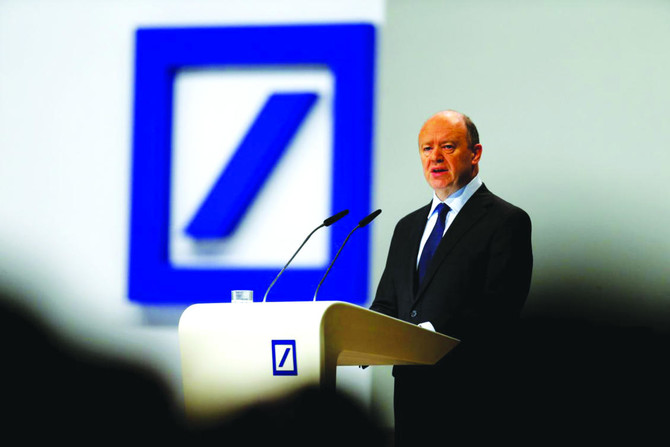
John Cryan, the CEO of Deutsche Bank warned of the fallout from cheap money, cautioning against using the strong euro as a justification for printing more. (Reuters)
Updated 07 September 2017
Follow

Deutsche Bank boss calls on ECB to halt cheap money

FRANKFURT: Deutsche Bank chief executive John Cryan has called on the European Central Bank to change course on providing cheap money, warning he sees price bubbles in stocks, bonds and property.
“The era of cheap money in Europe should come to an end — despite the strong euro,” Cryan told a room full of bankers in Frankfurt on Wednesday, a day before the ECB’s governors meet to discuss policy.
Low interest rates, money printing and a penalty charge for hoarding cash have been at the heart of attempts by the central bank to reinvigorate the 19-country euro zone economy in the wake of the 2008-09 financial crisis.
But the policy, which has seen the ECB print more than €2 trillion ($2.4 trillion) so far, has been politically divisive, prompting fierce criticism from the famously thrifty Germans.
It has also imposed a heavy cost on still fragile banks, turning deposits into a hot potato that many would rather avoid so as not to pay charges to their central bank for storing them.
The head of Germany’s largest commercial bank warned of the fallout from cheap money, cautioning against using the strong euro as a justification for printing more.
“We are now seeing signs of bubbles in more and more parts of the capital market,” he said.
Cryan also said Frankfurt was the most natural location as a financial hub as banks move from London after Britain’s decision to leave the EU — ahead of Paris, Dublin and Amsterdam.
“There is only one European city which can fulfil these requirements and that city is Frankfurt,” he said, pointing to Frankfurt’s supervisory authorities, law firms, consultancies and airport.
Britain’s planned departure from the EU has prompted banks and investors in London to examine other cities to keep a foothold in the bloc, allowing them to sell across the continent without additional costs or trade hurdles after Brexit.
Frankfurt and Dublin have emerged as the most popular centers.
“It’s not about a choice between Dublin, Paris or Frankfurt — it’s about a choice between New York, Singapore or Frankfurt,” he said. “Brexit could become a large stimulus package for Frankfurt’s economy.”
— Reuters


First EU–Saudi roundtable on critical raw materials reflects shared policy commitment

Updated 16 January 2026
Follow

First EU–Saudi roundtable on critical raw materials reflects shared policy commitment

RIYADH: The EU–Saudi Arabia Business and Investment Dialogue on Advancing Critical Raw Materials Value Chains, held in Riyadh as part of the Future Minerals Forum, brought together senior policymakers, industry leaders, and investors to advance strategic cooperation across critical raw materials value chains.

Organized under a Team Europe approach by the EU–GCC Cooperation on Green Transition Project, in coordination with the EU Delegation to Saudi Arabia, the European Chamber of Commerce in the Kingdom and in close cooperation with FMF, the dialogue provided a high-level platform to explore European actions under the EU Critical Raw Materials Act and ResourceEU alongside the Kingdom’s aspirations for minerals, industrial, and investment priorities.

This is in line with Saudi Vision 2030 and broader regional ambitions across the GCC, MENA, and Africa.

ResourceEU is the EU’s new strategic action plan, launched in late 2025, to secure a reliable supply of critical raw materials like lithium, rare earths, and cobalt, reducing dependency on single suppliers, such as China, by boosting domestic extraction, processing, recycling, stockpiling, and strategic partnerships with resource-rich nations.

The first ever EU–Saudi roundtable on critical raw materials was opened by the bloc’s Ambassador to the Kingdom, Christophe Farnaud, together with Saudi Deputy Minister for Mining Development Turki Al-Babtain, turning policy alignment into concrete cooperation.

Farnaud underlined the central role of international cooperation in the implementation of the EU’s critical raw materials policy framework.

“As the European Union advances the implementation of its Critical Raw Materials policy, international cooperation is indispensable to building secure, diversified, and sustainable value chains. Saudi Arabia is a key partner in this effort. This dialogue reflects our shared commitment to translate policy alignment into concrete business and investment cooperation that supports the green and digital transitions,” said the ambassador.

Discussions focused on strengthening resilient, diversified, and responsible CRM supply chains that are essential to the green and digital transitions.

Participants explored concrete opportunities for EU–Saudi cooperation across the full value chain, including exploration, mining, and processing and refining, as well as recycling, downstream manufacturing, and the mobilization of private investment and sustainable finance, underpinned by high environmental, social, and governance standards.

From the Saudi side, the dialogue was framed as a key contribution to the Kingdom’s industrial transformation and long-term economic diversification agenda under Vision 2030, with a strong focus on responsible resource development and global market integration.

“Developing globally competitive mineral hubs and sustainable value chains is a central pillar of Saudi Vision 2030 and the Kingdom’s industrial transformation. Our engagement with the European Union through this dialogue to strengthen upstream and downstream integration, attract high-quality investment, and advance responsible mining and processing. Enhanced cooperation with the EU, capitalizing on the demand dynamics of the EU Critical Raw Materials Act, will be key to delivering long-term value for both sides,” said Al-Babtain.

Valere Moutarlier, deputy director-general for European industry decarbonization, and directorate-general for the internal market, industry, entrepreneurship and SMEs at European Commission, said the EU Critical Raw Materials Act and ResourceEU provided a clear framework to strengthen Europe’s resilience while deepening its cooperation with international partners.

“Cooperation with Saudi Arabia is essential to advancing secure, sustainable, and diversified critical raw materials value chains. Dialogues such as this play a key role in translating policy ambitions into concrete industrial and investment cooperation,” she added.