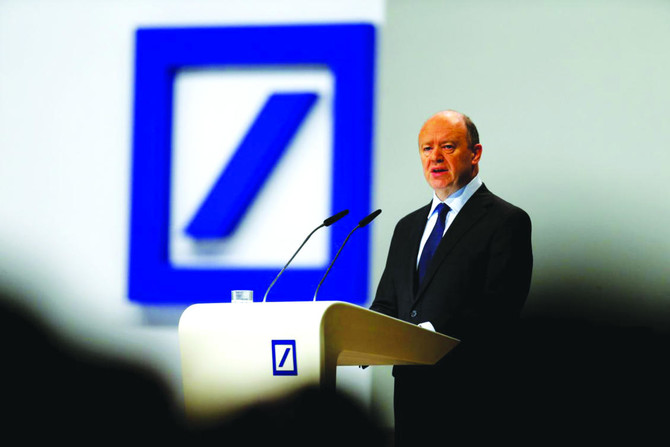
FRANKFURT: Deutsche Bank chief executive John Cryan has called on the European Central Bank to change course on providing cheap money, warning he sees price bubbles in stocks, bonds and property.
“The era of cheap money in Europe should come to an end — despite the strong euro,” Cryan told a room full of bankers in Frankfurt on Wednesday, a day before the ECB’s governors meet to discuss policy.
Low interest rates, money printing and a penalty charge for hoarding cash have been at the heart of attempts by the central bank to reinvigorate the 19-country euro zone economy in the wake of the 2008-09 financial crisis.
But the policy, which has seen the ECB print more than €2 trillion ($2.4 trillion) so far, has been politically divisive, prompting fierce criticism from the famously thrifty Germans.
It has also imposed a heavy cost on still fragile banks, turning deposits into a hot potato that many would rather avoid so as not to pay charges to their central bank for storing them.
The head of Germany’s largest commercial bank warned of the fallout from cheap money, cautioning against using the strong euro as a justification for printing more.
“We are now seeing signs of bubbles in more and more parts of the capital market,” he said.
Cryan also said Frankfurt was the most natural location as a financial hub as banks move from London after Britain’s decision to leave the EU — ahead of Paris, Dublin and Amsterdam.
“There is only one European city which can fulfil these requirements and that city is Frankfurt,” he said, pointing to Frankfurt’s supervisory authorities, law firms, consultancies and airport.
Britain’s planned departure from the EU has prompted banks and investors in London to examine other cities to keep a foothold in the bloc, allowing them to sell across the continent without additional costs or trade hurdles after Brexit.
Frankfurt and Dublin have emerged as the most popular centers.
“It’s not about a choice between Dublin, Paris or Frankfurt — it’s about a choice between New York, Singapore or Frankfurt,” he said. “Brexit could become a large stimulus package for Frankfurt’s economy.”
— Reuters

Deutsche Bank boss calls on ECB to halt cheap money
Saudi Arabia’s cultural sector is a new economic engine between Riyadh and Paris, says ambassador
RIYADH: Culture has become a fundamental pillar in bilateral relations between France and Saudi Arabia, according to the French Ambassador to the Kingdom, Patrick Maisonnave.
Maisonnave noted its connection to the entertainment and tourism sectors, which makes it a new engine for economic cooperation between Riyadh and Paris.
He told Al-Eqtisadiah during the opening ceremony of La Fabrique in the Jax district of Diriyah that cultural cooperation with Saudi Arabia is an important element for its attractiveness in the coming decades.
La Fabrique is a space dedicated to artistic creativity and cultural exchange, launched as part of a partnership between the Riyadh Art program and the French Institute in Riyadh.
Running from Jan. 22 until Feb 14, the initiative will provide an open workspace that allows artists to develop and work on their ideas within a collaborative framework.
Launching La Fabrique as a space dedicated to artistic creativity
The ambassador highlighted that the transformation journey in the Kingdom under Vision 2030 has contributed to the emergence of a new generation of young artists and creators, alongside a growing desire in Saudi society to connect with culture and to embrace what is happening globally.
He affirmed that the relationship between the two countries is “profound, even cultural par excellence,” with interest from the Saudi side in French culture, matched by increasing interest from the French public and cultural institutions unfolding in the Kingdom.
Latest estimates indicate that the culture-based economy represents about 2.3 percent of France’s gross domestic product, equivalent to more than 90 billion euros ($106.4 billion) in annual revenues, according to government data. The sector directly employs more than 600,000 people, making it one of the largest job-creating sectors in the fields of creativity, publishing, cinema, and visual arts.
Saudi Arabia benefiting from French experience in the cultural field
Maisonnave explained that France possesses established cultural institutions, while Saudi Arabia is building a strong cultural sector, which opens the door for cooperation opportunities.
This comes as an extension of the signing of 10 major cultural agreements a year ago between French and Saudi institutions, aiming to enhance cooperation and transfer French expertise and knowledge to contribute to the development of the cultural system in the Kingdom.
He added that experiences like La Fabrique provide an opportunity to meet the new generation of Saudi creators, who have expressed interest in connecting with French institutions and artists in Paris and France.
La Fabrique encompasses a space for multiple contemporary artistic practices, including performance arts, digital and interactive arts, photography, music, and cinema, while providing the public with an opportunity to witness the stages of producing artistic works and interact with the creative process.