

Mighty Hurricane Irma makes landfall in Caribbean island of Barbuda

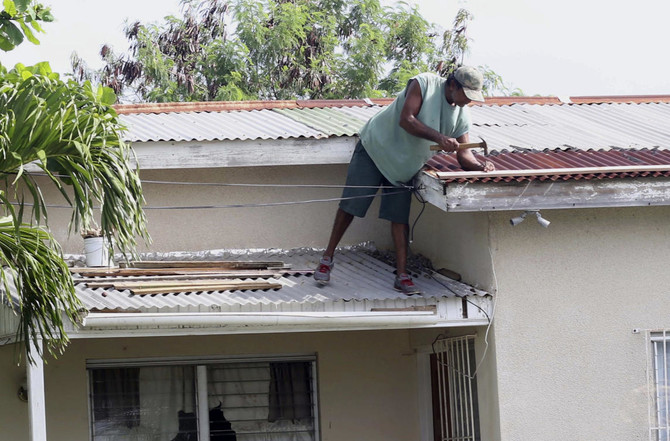
A homeowner makes last minute repairs to his roof in preparation for Hurricane Irma, in St. John's, Antigua and Barbuda. (AP)
Updated 06 September 2017
Follow

Mighty Hurricane Irma makes landfall in Caribbean island of Barbuda

ST. JOHN’S, ANTIGUA AND BARBUDA: Monster Hurricane Irma slammed into the island of Barbuda early on Wednesday as it barreled its way across the Caribbean packing ferocious winds and potential for towering coastal surges.
The eye of the rare Category Five storm made landfall on Barbuda — part of the twin island nation of Antigua and Barbuda — just before 0600 GMT with winds gusting at up to 185 mph (295 kph)), the Miami-based US National Hurricane Center said.
The storm is headed northwest toward the Virgin Islands and Puerto Rico, with potential for storm surges of up to 20 feet (six meters) above normal tide levels, it added.
The NHC said on Tuesday that while Irma was in the Atlantic headed for the Caribbean it was the strongest hurricane ever recorded in that ocean.
Ahead of the storm, which comes on the heels of the devastating Hurricane Harvey late last month in Texas, people packed shelters, stocked up on provisions and evacuated tourist areas as far north as Florida. The storm is expected to last for days.
The NHC said in a bulletin at 0600 GMT that the eye of Irma was passing over Barbuda.
As people hunkered down in the north of the Caribbean arc known as the Leeward Islands, the NHC said Irma was a potentially catastrophic storm.
“I am just praying to God. Everything happens for a reason,” an Antigua woman who gave her name as Kazia said as she endured what she called 60-80 mph winds in a town called Sea View Farm. This was hours before the eye passed over.
Davina, a woman in the town of Yorks on the same island, said: “I can hear very strong winds and things being thrown around, but I am scared to look outside.”
Power was turned off across Antigua as a safety precaution because power lines are above ground. Families packed shelters. One after another, scared people sitting in the dark called in to radio stations.
The core of the hurricane was expected to move over other parts of the northern Leeward Islands early Wednesday, the NHC said.
It will then head northwest toward the Virgin Islands and Puerto Rico later Wednesday or Wednesday night.
Category Five is the highest on the scale for hurricanes in the Atlantic and Caribbean.

Schools and government offices in French overseas territory Guadeloupe have been ordered shut, while hospitals are stocking up on medicines, food and drinking water. People living on shorelines will be moved to safety, authorities said.
In Guadeloupe, families filed into shelters with their children, along with tourists.
“We came here to protect our little two-year-old boy,” said a tourist who only gave his first name as Ludovic.
“We hadn’t prepared for this disaster scenario. Our rental home is beautiful but it only has bay windows.”
Florida expects the greatest danger from Friday night through Monday.
President Donald Trump declared states of emergency in Florida, Puerto Rico and the US Virgin Islands, authorizing federal funding to help local authorities respond.
Florida Governor Rick Scott said Irma posed “a severe threat to the entire state” barely a week after Harvey claimed at least 42 lives.
Tourists in the popular Key West islands were packing their bags on a mandatory evacuation order and were due to begin leaving at sunrise on Wednesday, with a similar order for residents due to follow.
“We’re emphatically telling people you must evacuate, you cannot afford to stay on an island with a Category 5 hurricane coming at you,” said Monroe County emergency operations center director Martin Senterfitt.
There were long queues as people rushed to get batteries, bottled water, groceries and fuel, while many cut trees around their homes and sought to tie down objects and seal up their windows.
In a crowded supermarket in Miami Beach where people were scrambling to buy provisions, it was already difficult to find some basic supplies, like water.
Whole shelves stood empty.
“It’s because people go crazy and buy up everything,” 81-year-old resident Gladys Bosque told AFP.
“There’s no water, no milk, there are very few cans — and no cat food.”
Category Five hurricanes are rare. They can tear off roofing, shatter windows, uproot palm trees and turn them into projectiles that can kill people.
In Puerto Rico, Governor Ricardo Rossello activated the National Guard and announced the opening of storm shelters able to house up to 62,000 people.
A US aircraft carrier with a field hospital and dozens of aircraft able to conduct rescue or supply missions have been positioned in the area, according to Alejandro de la Campa of the Caribbean division of the US Federal Emergency Management Agency.
Sheilyn Rodriguez of Rio Grande, 33, said “I really am scared for my kid,” a son who is nine. She was stocking up on batteries, canned goods and ice in case the power goes out.

UK cyclists to ride 550km in Saudi Arabia to save children with heart defects

Updated 3 sec ago
Follow

UK cyclists to ride 550km in Saudi Arabia to save children with heart defects

  • The H&K Cycle Club was the first team to take the Hejaz route, and their endeavour has since 2022 inspired hundreds of other cyclists to follow suit
  • The cyclists expect to face scorching heat, brutal headwinds, sandstorms, and long no-U-turn stretches of roads, along with physical and mental exhaustion

LONDON: A cycling team from London set out on Sunday on a 550km journey from Makkah to Madinah in Saudi Arabia to raise funds for children in developing countries with congenital heart defects.

This is the fifth year that Shamsul Abdin, the head of the H&K Cycle Club, and 40 riders aged between 18 and 65, are taking on the challenge through the Hejaz region.

Abdin told Arab News that the “Hijrah Ride” was a replication of the journey made by Prophet Muhammad over 1,400 years ago, when he migrated from Makkah to Madinah, where he established the first city-state of Islam. This migration, known as Hijrah, also marked the beginning of the Islamic Hijri calendar.

The H&K Cycle Club has expanded from just six riders 14 years ago to more than 40 members from various cities across the UK, including London, Manchester, Oxford, and Birmingham. In November, they began their training in the freezing temperatures of the UK, aiming to cycle over 100 kilometers each day within 6 to 7 hours for a 4-day ride in Saudi Arabia. On Wednesday, they are expected to arrive in Madinah.

Riders from the H&K Cycle Club are expected to arrive in Madinah on Wednesday. (Muntada Aid)

They have cycled throughout the UK and parts of Europe, riding from London to Istanbul to raise funds for various causes through Muntada Aid, a charity that works on projects in developing countries and organizes the “Hijrah Ride”.

They were also the first cycling team to take the Hejaz route, and their endeavour has since inspired hundreds of other cyclists to follow suit. Abdin has seen Saudi Arabia become more bike-friendly over the past five years, with cycling lanes integrated into city development, while drivers, locals, and authorities are now more aware of cyclists on the roads.

The cyclists expect to face scorching heat, brutal headwinds, sandstorms, and long no-U-turn stretches of roads, along with physical and mental exhaustion. For many riders, this will be their fifth ride in Hejaz. Some of them include Uber and bus drivers, business analysts, and even entrepreneurs, according to Abdin.

“The headwind feels like climbing a mountain; it’s a constant resistance. To overcome this challenge, we ride in a peloton, taking turns at the front. One person heads into the wind while the others line up behind, shielded from the gusts. After a while, we rotate, allowing everyone a chance to lead,” Abdin explained.

Almost £923,000 has been raised by the “Hijrah Ride” since its inception, to reach a target of one million pounds this year. Some of the money went into emergency aid programs in Gaza and Sudan. Muntada Aid aims to raise about £250,000 for its flagship project, “Little Hearts,” which will fund 150 surgeries for children with congenital heart defects in Pakistan and Bangladesh this year.

“I fell in love with this project, which gives children the opportunity to live up to their potential as adults, truly,” said Abdin, who was awarded the MBE (Member of the Order of the British Empire) in December for his contribution to charitable fundraising.

Shamsul Abdin, the head of the H&K Cycle Club. (Muntada Aid)

The riders will be escorted by two vehicles, one in front and one in the rear, carrying paramedics and media staff, along with food and water. They will split into two groups based on their cycling powers. Along the route, they will pass several locations, including Jeddah on the Red Sea, King Abdullah Economic City, Rabigh, Masturah, and Badr, before reaching the elevated roads of Madinah, where their journey, which started with performing Umrah in Makkah, will end.

Muntada Aid is a part of Al-Muntada Trust, which was founded in 1986 by a group of Middle Eastern students, including individuals from Qatar and Saudi Arabia, to address the famine crisis in Ethiopia. Since then, the organization has assisted children in 17 countries, including Somalia, Sudan, Chad, Kosovo, Bosnia, Bangladesh, Pakistan, Mali, and Niger. They focus on developing infrastructure in education, health, water and sanitation sectors.

Nasrun Mir, the marketing director of Muntada Aid, told Arab News that they support “Hijrah Ride” with financial backing and logistics, and that they have obtained permits through communication with the Saudi Ministry of Transport, the Ministry of Foreign Affairs, the Saudi embassy in London, and the British Consulate in Jeddah.

Muntada Aid is a part of Al-Muntada Trust, which was founded in 1986 by a group of students, including individuals from Qatar and Saudi Arabia. (Muntada Aid)

Mir, who is joining the journey as part of the media team this week, said that the reception in Saudi Arabia could not be friendlier.

“People offer us free food and drinks. They want to have conversations with us. They want to know what we do. In the Middle East, there is still no concept of using sports as a tool for charity. The general idea is that if I want to give money to the charity, I’ll give it to them. You don’t need to run. You don’t need to cycle,” Mir said.

In one incident, a local community prevented the riders from passing through their village unless they disembarked and sat down to eat with them. In particular sections of the road near Madinah, a Saudi police vehicle has escorted the riders for a few kilometers, he added.

“There have been incidents where people have stopped us from eating our own food during the break. 
They literally took our food and said, ‘No, you come to our village; you cannot eat your food. You have to have food, which we will prepare.’ This delayed ride for a couple of hours,” Mir said.