VENICE: In a year of strong women on screen, Frances McDormand plays one of the strongest: A bereaved mother who resorts to drastic action to bring her daughter’s killer to justice in “Three Billboards Outside Ebbing, Missouri.”
It is a slight surprise to learn she drew inspiration from John Wayne.
McDormand seems guaranteed an Oscar nomination for her role in Martin McDonagh’s witty, visceral drama, which premiered Monday at the Venice Film Festival. She oozes righteous fury, tinged with irony and compassion, as Mildred Hayes, a woman so desperate to find her daughter’s murderer that she uses three billboards on the edge of town to goad the police into action.
Mildred is a force of nature: single-minded, uncompromising and tough as nails.
“When I was looking for iconic characters in cinema that I might model myself after as Mildred, the only ones I could find were male,” McDormand told reporters in Venice on Monday.
“I thought maybe Pam Grier in blaxploitation films in the 70s, but her characters always led much more with their sexuality, which Mildred does not. So really the one that I latched onto the most was John Wayne.
“His politics aside, and his personal beliefs aside, I think that as an American iconic cinematic figure he has stood the test of time.
“That is whose footsteps I was trying to walk in. And he was a size 10 1/2.”
In the film, Mildred’s quest brings all the rage in her small town boiling to the surface. It also puts her in conflict with Woody Harrelson’s police chief — a decent man facing his own trauma — and Sam Rockwell’s brutal police officer.
Writer-director McDonagh made the similarly tragicomic “In Bruges” and “Seven Psychopaths.” Like those films, “Three Billboards” is darkly funny. But it is also surprisingly moving, as the plot and characters develop in unexpected directions.
“That is what Martin does best — melancholy and funny,” McDormand said. “That is a really good combination, and that kind of is what humanity is about.”
One of 21 films competing for the Golden Lion prize at the Venice festival, “Three Billboards” takes a bracingly honest approach to grief, particularly the almost inexpressible pain of losing a child.
McDormand noted that “if your spouse dies you are a widow or a widower. If your parents die you are an orphan. If your child dies, there is no word for it.”
McDonagh said the inspiration for the film came from real billboards he saw during a bus journey in the US 20 years ago bearing a message not unlike that in the movie, “painful and dark and tragic.”
“I thought: ‘Who would put something there that is so painful and so raging?’” he said.
“I did not think about that for 10 or 11 years or more but it always lodged there in the back of my head,” where eventually it merged with a desire to write a female-centered film.
“My previous two films have been quite male-centered, but my early plays were not,” said London-born McDonagh, whose work for the stage includes “The Beauty Queen of Leenane” and “The Pillowman.”
“I was very determined that this film would have a very strong female lead,” he said.
He wrote the part of Mildred with McDormand in mind — in part, he said, because of her ability to capture a “working-class sensibility, which a lot of actors maybe do not have or can be patronizing about.”
“One of the fundamental points of this story was to be truthful to a working-class woman,” McDonagh said.
Critics are calling this McDormand’s best performance since “Fargo.” She won an Academy Award in 1996 as police officer Marge Gunderson, a laconic center of calm in a chaotic world, in Joel and Ethan Coen’s drama.
The 60-year-old performer has had a rich career, and three other Oscar nominations. But, McDormand said, “I will go to my grave being known as Marge Gunderson.”
“It will be on my gravestone if I have one,” she said. “I do not mind that, because it was a great character. But Mildred is Marge grown up.”


![]()
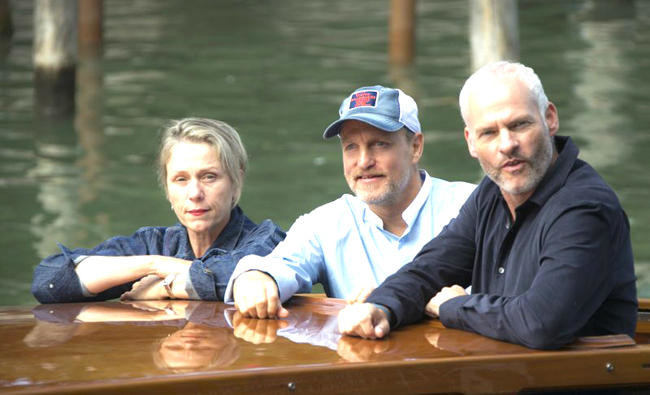
Frances McDormand scorches in ‘Three Billboards’ at Venice
Frances McDormand scorches in ‘Three Billboards’ at Venice
Latest updates


© 2026 SAUDI RESEARCH & PUBLISHING COMPANY, All Rights Reserved And subject to Terms of Use Agreement.