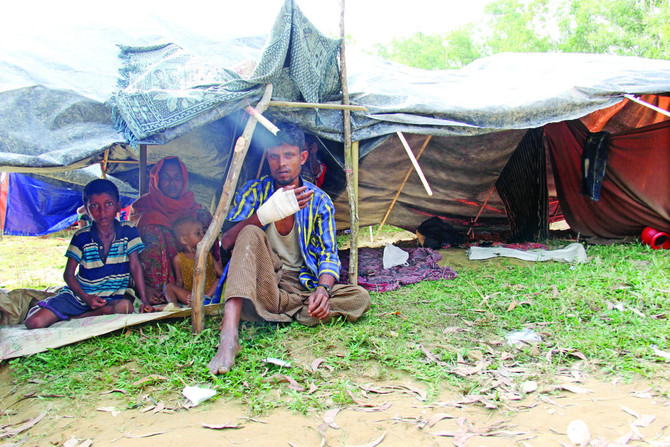
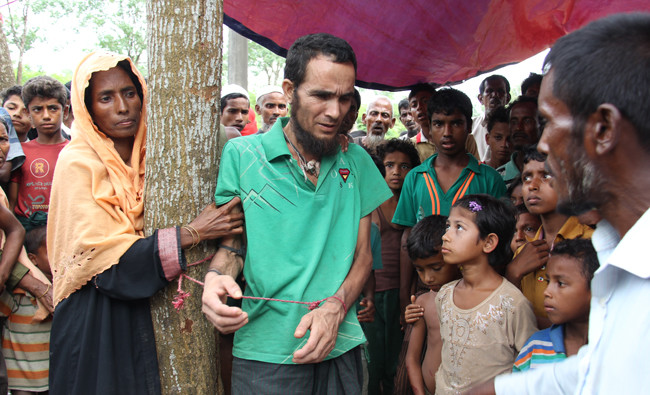
COX’S BAZAR, Bangladesh / ISLAMABAD: Almost every Rohingya refugee that Arab News met in Kutupalang camp on Monday suffered from some type of skin disease. Facing torrential rain, many lack shelter. Children are malnourished.
Zaed Alam, 45 — formerly a rich farmer in Kumarkhali village in Rakhine state, Myanmar — reached Kutupalang Monday morning empty-handed.
His journey across the border into Bangladesh involved hiding in caves by day with 13 of his family members, and traveling by night, without food or water. They had walked more than 175 km in 10 days, with nothing to eat but tree leaves.
Sayed Nur, 22, lived in Shaheb Bazar village in Rakhine. A poor farmer who used to cultivate his neighbors’ land, he arrived in Kutupalang with a bullet injury on his left arm, sustained while fleeing his village with four of his family members.
Four fellow villagers were killed by the Myanmar Army. “I’m very fortunate. By the grace of Almighty Allah, I was able to save my life,” he told Arab News.
It took him six days to reach the refugee camp, arriving five days ago. He also had to hide in caves by day from the Myanmar Army.
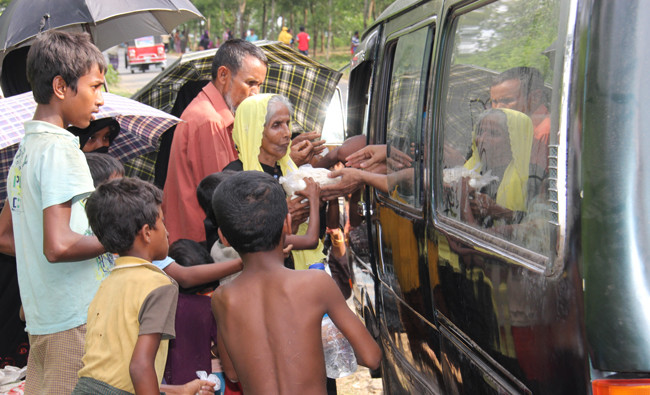
During those six days in hiding, the four-member family only had 2 kg of rice. On Sunday, fellow Rohingya who have been in the camp for longer gave the family a small quantity of cooked rice.
Nur and his family arrived with nothing. When asked what he will do, he replied: “I don’t know. Only Allah Almighty can help us.”
Meanwhile, two blasts rocked an area on Myanmar’s side of the border with Bangladesh on Monday, accompanied by the sound of gunfire and thick black smoke, as violence that has sent nearly 90,000 Rohingya fleeing to Bangladesh showed no sign of easing.
Border Guards Bangladesh said a woman lost a leg from a blast about 50 meters inside Myanmar, and was carried into Bangladesh for treatment. Reuters reporters heard explosions and saw black smoke rising near a village in Myanmar.
A Rohingya refugee who went to the blast site — on a footpath near where civilians fleeing violence are huddled in no man’s land on the border — filmed what appeared to be a mine: A metal disc about 10 cm in diameter partially buried in the mud. He said he believed there were two more such devices buried in the ground.
Border Guards Bangladesh said they believed the injured woman stepped on an anti-personnel mine, although that was not confirmed. Two refugees told Reuters they saw members of the Myanmar Army around the site just before the blasts.
Separately, Turkey’s President Recep Tayyip Erdogan said he was pressing world leaders to do more to help the Rohingya, who face what he has described as genocide.
“You watched the situation that Myanmar and Muslims are in. You saw how villages have been burned... Humanity remained silent to the massacre in Myanmar,” he said.
“There are some leaders we can achieve results with and some that we cannot. Not everyone has the same sensitivity. We will do our duty,” Erdogan said, adding that Turkey is continuing to deliver aid to the region.
In another development, Khawaja Mohammed Asif, Pakistan’s foreign minister, said he “expressed deep anguish at the ongoing violence against the Rohingya Muslims.”
He added: “The plight of the Rohingya Muslims was a challenge to the conscience of the international community.”


![]()
![]()
![]()
![]()
Rohingya who fled violence to Bangladesh recount horror

Rohingya who fled violence to Bangladesh recount horror

Latest updates


© 2026 SAUDI RESEARCH & PUBLISHING COMPANY, All Rights Reserved And subject to Terms of Use Agreement.