DHAKA: “I can’t believe I’m still alive,” said Abdur Rahman, a 46-year-old Rohingya who fled Chikon Jhuria village in Rakhine state, Myanmar.
“The army suddenly attacked our village at around 9 a.m. The whole village was burned down. Me, my wife and our 4-year-old boy took shelter in the adjacent jungle. My mother and two uncles were shot dead by the army.”
It took four days for Abdur Rahman, his wife and son to reach Ukhia refugee camp in Bangladesh.
Rahela Begum, 29, said it took her three days “without any food or even water” to reach the camp. “I don’t know what awaits me here. I only know that I’m safe,” she said.
This is a glimpse of the suffering of Rohingya Muslim refugees. Since Aug. 25, some 60,000 have escaped from Rakhine to Bangladesh, according to the UN.
Local reports say there are at least 10,000 more people waiting at the Bangladesh-Myanmar border.
“I’ve never witnessed such a big number of Rohingya refugees within such a short span of time,” said Ataur Rahman, a member of the Bangladesh Borders Guard.
The International Organization for Migration (IOM) is struggling to provide basic humanitarian support for the rapidly rising number of refugees, an IOM staff member said on condition of anonymity.
Local Bangladeshis are trying to help, but “the situation is so grave that Bangladesh can’t handle it anymore by itself,” said a government official on condition of anonymity.
“The international community and the Organization of Islamic Cooperation (OIC) need to come up with emergency aid.”
Prime Minister Sheikh Hasina has urged the US to pressure Myanmar’s government to stop atrocities against the Rohingya.


Rohingya refugee numbers in Bangladesh skyrocket
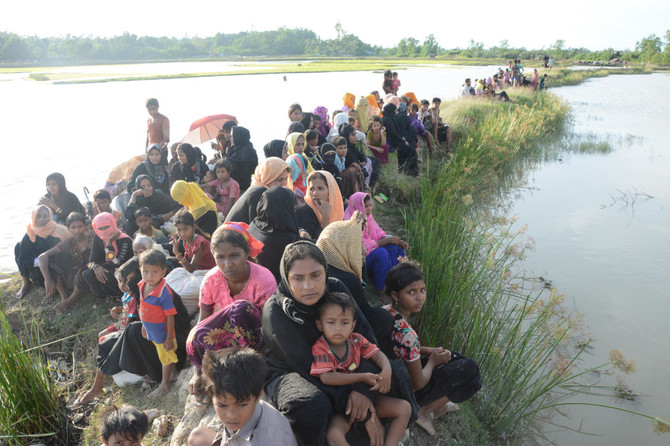
Rohingya refugee numbers in Bangladesh skyrocket




Floods ravage Minas Gerais, killing 36 as rescuers race to find dozens missing
- Minas Gerais’s fire department said 33 people were still missing and about 3,000 residents had been forced to leave their homes
- 600 families living in endangered areas were about to be relocated to local schools improvised as shelters
JUIZ DE FORA, Brazil: Dozens are still missing in southeastern Brazil on Wednesday after floods killed at least 36 people in the state of Minas Gerais, officials said Wednesday. Rescue teams worked through the night, as heavy rain is expected in the region in the next few days.
All the victims found so far are in the cities of Juiz de Fora and Uba, about 310 kilometers (192 miles) north of Rio de Janeiro.
Minas Gerais’s fire department said 33 people were still missing and about 3,000 residents had been forced to leave their homes as of Wednesday morning.
The streets of Juiz de Fora, a city of 560,000 residents, were covered in mud as authorities feared more landslides. Life in neighboring Uba, with its 107,000 residents, came to a stop. Classes were suspended in both cities, their mayors said.
Juiz de Fora’s City Hall said in a statement that around 600 families living in endangered areas were about to be relocated to local schools improvised as shelters and that the city experienced double the rain expected for February. Mayor Margarida Salomão said at least 20 landslides had been reported since the torrential rain began Monday evening.
On Tuesday, Brazilian President Luiz Inácio Lula da Silva said on his social media channels that security forces have been deployed on rescue missions and are providing immediate assistance to the population affected by the rain. He also said health care teams had been sent to the region, which lies close to hills, valleys and slopes.


