WASHINGTON/LONDON/SEOUL: North Korea’s biggest nuclear test to date was condemned around the world on Sunday, with the UN nuclear watchdog expressing grave concern and Russia saying it could lead to serious consequences.
US President Donald Trump will meet with his national security advisers on Sunday to discuss N. Korea’s nuclear test, the White House said.
“The national security team is monitoring this closely,” White House spokeswoman Sarah Sanders said in a statement. “The president and his national security team will have a meeting to discuss further later today. We will provide updates as necessary.”
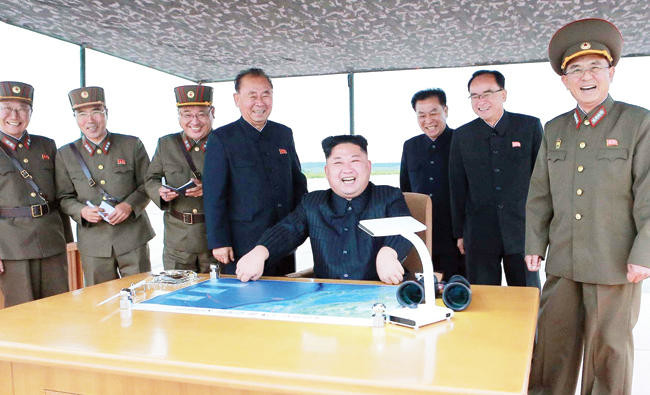
North Korea said its sixth and most powerful nuclear test on Sunday was an advanced hydrogen bomb for a long-range missile, marking a dramatic escalation of the regime’s stand-off with the US and its allies.
The test drew swift international condemnation. Trump described North Korea as a “rogue nation” and said its actions “continue to be very hostile and dangerous to the United States.”
“Appeasement with North Korea will not work, they only understand one thing,” he said in messages on Twitter.
Hours before the test Trump had talked by phone with Japanese Prime Minister Shinzo Abe about the “escalating” nuclear crisis in the region. The US president has previously vowed to stop North Korea developing nuclear weapons that could threaten the US.
North Korea, which carries out its nuclear and missile programs in defiance of UN Security Council resolutions and sanctions, said on state television that a hydrogen bomb test ordered by leader Kim Jong-un had been a “perfect success.”
The bomb was designed to be mounted on its newly developed intercontinental ballistic missile (ICBM), the North said.
The test had registered with international seismic agencies as a manmade earthquake near a test site in the North. Japanese and South Korean officials said it was around 10 times more powerful than the tremor picked up after North Korea’s last nuclear test a year ago.
There was no independent confirmation that the detonation was a hydrogen bomb, rather than a less powerful atomic device, but Japan’s Chief Cabinet Secretary Yoshihide Suga said Tokyo could not rule out such a possibility.
The head of the UN’s nuclear watchdog, International Atomic Energy Agency (IAEA) Director General Yukiya Amano said the nuclear test was “an extremely regrettable act” that was “in complete disregard of the repeated demands of the international community.”
French President Emmanuel Macron called on the international community to react firmly to this “new provocation,” and South Korean President Moon Jae-in said Seoul would push for strong steps to further isolate the North, including new UN sanctions.
Japan also raised the prospect of further sanctions, saying curbs on North Korea’s oil trade would be on the table.
China, North Korea’s sole major ally, said it strongly condemned the nuclear test and urged Pyongyang to stop its “wrong” actions.
The US has repeatedly urged Beijing to do more to rein in its neighbor, but Beijing has lambasted the West and its allies in recent weeks for suggesting that it is solely responsible for doing so. It has said military drills by South Korea and the US on the Korean peninsula have done nothing to lessen tensions.
Russia said North Korea risked “serious consequences” but urged cool heads to avoid further escalation.


![]()
N. Korea conducts N-test again; US calls it ‘rogue nation’
N. Korea conducts N-test again; US calls it ‘rogue nation’

Latest updates


© 2026 SAUDI RESEARCH & PUBLISHING COMPANY, All Rights Reserved And subject to Terms of Use Agreement.