UNITED NATIONS: North Korea’s deputy UN ambassador accused the United States on Monday of turning the Korean Peninsula into “the world’s biggest hotspot” and creating “a dangerous situation in which a thermonuclear war may break out at any moment.”
Kim In Ryong told a news conference that “if the US dares opt for a military action,” North Korea “is ready to react to any mode of war desired by the US“
He said the Trump administration’s deployment of the Carl Vinson nuclear carrier task group to waters off the Korean Peninsula again “proves the US reckless moves for invading the DPRK have reached a serious phase of its scenario.”
Kim stressed that US-South Korean military exercises being staged now are the largest-ever “aggressive war drill” aimed at his country, formally the Democratic People’s Republic of Korea.
“The prevailing grave situation proves once again that the DPRK was entirely just when it increased in every way its military capabilities for self-defense and pre-emptive attack with a nuclear force as a pivot,” he said.
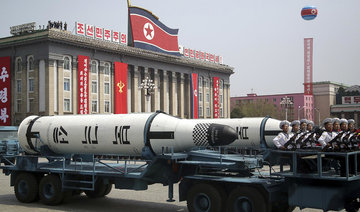
Tensions have escalated over North Korean moves to accelerate its weapons development. The North conducted two nuclear tests and 24 ballistic missile tests last year, defying six Security Council sanctions resolutions banning any testing, and it has launched more missiles this year including a failed attempt this past weekend.
The North’s Foreign Ministry said the missile launches are as part of a normal process of building up the country’s defenses and economy. Ministry official Kim Chang Min also said in the interview in Pyongyang that the UN, the Security Council and big countries ignored South Korean missile launches and Japanese surveillance satellites.
“This is the limit of double standards,” Kim of the Foreign Ministry said. “How can we have any dialogue to get any result with anyone who has this kind of approach?“
On Monday, US Vice President Mike Pence traveled to the Demilitarized Zone dividing the Koreas and warned Pyongyang that “the era of strategic patience is over.”
After 25 years of trying to deal patiently with North Korea’s nuclear and missile ambitions, Pence said, “all options are on the table” to deal with threat.
Deputy UN Ambassador Kim said North Korea’s policy is shaped by the Trump administration’s push for “high-intensity sanctions” against the country, deploying tactical nuclear weapons in South Korea and launching military action aimed at “beheading” the North’s leadership headed by Kim Jong Un.
He said rolling back the hostile US policy toward the DPRK “is the precondition to solving all the problems in the Korean Peninsula.”
Kim called the news conference to “categorically reject” the US decision to hold an open meeting of the Security Council on April 28 on North Korea’s nuclear program which is scheduled to be chaired by US Secretary of State Rex Tillerson.
He called it “another abuse of authority” by the United States, which holds the Security Council presidency this month, and a violation of the DPRK’s sovereignty.
Kim ignored questions about the DPRK’s relationship with China and reports that the government didn’t respond to requests from Chinese officials for a meeting.
Instead he reiterated two Chinese proposals that the US rejected.
One called for “dual-track” talks on denuclearization of the Korean Peninsula — the top priority of the United States — and replacing the armistice that ended the 1950-53 Korean War with a formal peace treaty, a key demand of Pyongyang. The other called for a freeze on US-South Korean military exercises and a freeze on DPRK missile and nuclear tests.


![]()

North Korea accuses US of creating situation for nuclear war
North Korea accuses US of creating situation for nuclear war


Latest updates


© 2026 SAUDI RESEARCH & PUBLISHING COMPANY, All Rights Reserved And subject to Terms of Use Agreement.