Honest Hajj pilgrim returns bag with cash and jewelry

1 / 2
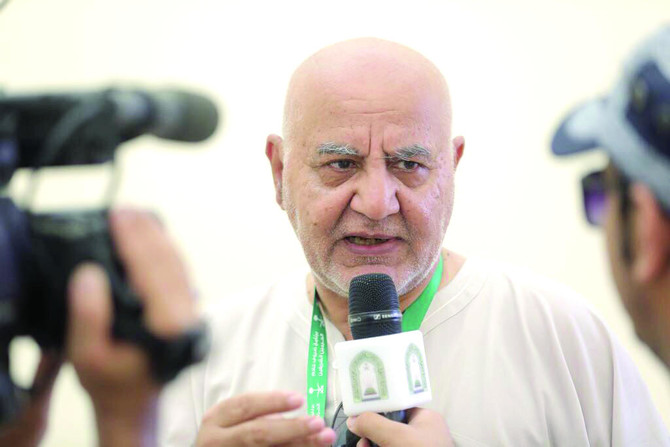
Egyptian pilgrim Lutfi Mohammed Abdulkarim. (AN photo)
2 / 2
Updated 01 September 2017
Follow

Honest Hajj pilgrim returns bag with cash and jewelry

JEDDAH: A pilgrim who found a bag containing cash and jewelry has been praised for his honesty after he handed it over to authorities.
Lutfi Mohammed Abdulkarim, from Egypt, was looking for pebbles to perform the rami Al-Jamrat ritual in Mina when he found the unattended bag. He asked around, but could not find the owner.
Inside the bag, as well as the valuables, Abdulkarim found an ID card suggesting it belonged to a Nigerian woman. He handed the bag over to officials from King Salman’s Hajj and Umrah Program, of which he is a guest.
Ahmed Jailan, a member of the program’s Sharia committee, said: “The pilgrim is with us in the program after one of his sons, a police officer, was killed in his country. He is of high moral standards and a good example of the guests of the program.”
The bag and its contents will be returned to their owner, Jailan said. “This emphasizes the meaning of solidarity and cooperation.”
He said he hoped all pilgrims would follow such a good example.
Meanwhile, Palestinian pilgrim Abdullah Mohammed Sharaka’s grief at losing his 14-year-old son was replaced by pleasure and joy when he and his wife arrived in Makkah as guests of King Salman’s Hajj and Umrah Program.
Sharaka said King Salman’s generosity had healed the wounds of many Palestinians who had been living in bitterness after losing children, brothers, fathers or mothers. His son, Ahmed, was shot dead by Israeli soldiers for throwing stones.
Sharaka said he could not express his pleasure when he was selected for the Hajj and Umrah Program. He found it hard to believe as he was walking in the districts of Makkah and the holy sites.
He said he would pray for King Salman, asking Allah to keep him and bestow security on the Kingdom of Saudi Arabia.


Saudi Arabia’s KAUST named FIFA’s first research institute in MENA

The canal in the King Abdullah University of Science and Technology campus. (Shutterstock)
Updated 10 February 2026
Follow

Saudi Arabia’s KAUST named FIFA’s first research institute in MENA

  • KAUST President Prof. Sir Edward Byrne said that the university’s selection as the fifth FIFA Research Institute in the world — and the first in the region — marks a significant achievement, reflecting Kingdom’s growing presence in international football

RIYADH: FIFA has designated the King Abdullah University of Science and Technology as its first research institute in the Middle East and Asia to support the development of innovative football research, the Saudi Press Agency reported on Tuesday.

The recognition highlights KAUST’s commitment to integrating sports, academic research and industry through advanced, high-level initiatives grounded in rigorous scientific methodologies, contributing to the advancement of football studies.

KAUST President Prof. Sir Edward Byrne said that the university’s selection as the fifth FIFA Research Institute in the world — and the first in the region — marks a significant achievement, reflecting Saudi Arabia’s growing presence in international football.

The accreditation aligns with national efforts to invest in research and development and promote the knowledge economy, supporting Saudi Vision 2030’s goals of building an advanced sports system based on innovation and sustainability.

The collaboration’s first project focuses on developing advanced AI algorithms to analyze historical FIFA World Cup broadcast footage, transforming decades of match videos into structured, searchable data, according to the KAUST website.

This work opens new opportunities to apply state-of-the-art computer vision techniques and deepen understanding of how football has evolved over time.

The second project uses player and ball tracking data from the FIFA World Cup 2022 in Qatar and the FIFA Women’s World Cup 2023 in Australia and New Zealand to compile comprehensive datasets capturing in-game dynamics.

These datasets provide deeper insights into human movement, playing techniques and performance dynamics through AI-driven analysis.