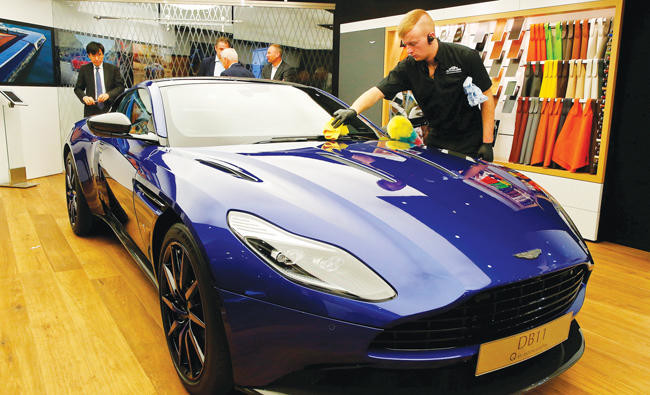
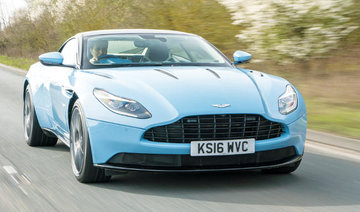
LONDON: Even before I got behind the wheel of a DB11, one fact had already sold me on the new Aston Martin super car: the leather chosen for the interior upholstery was from one specific herd of Scottish long haired cattle grazing on land not enclosed by barbed wire.
As designer Marek Reichman explained at the Aston headquarters in Gaydon, UK, the manufacturer is so concerned about even the most seemingly trivial detail on the DB11, that it sought to avoid any pits and pockmarks that might disfigure the seat leather.
The Aston long hairs don’t get their hide caught on the barbs, nor get bitten by mosquitos, so there are no blemishes on the finished article.
If the designer pays so much attention to the smallest detail, you can be sure the finished product is pretty close to motoring perfection.
And so it was as I put the car through its paces on the winding lanes and country roads of Warwickshire. I’m no petrol head, but even I know a superb piece of motor engineering when I drive one. I’ve tested many of the Aston range in the past, and the DB11 is a few gear-changes up from the others.
It’s sporty, but not really a sports car. It’s a grand tourer (GT), and therefore rather bigger than traditional two-seaters. But the body lines — designed on the geometrical proportions of a Nautilus shell, as Reichman had also explained — make it look as elegant as any of its bigger luxury rivals like Bentley.
Powerful too, although less gas-guzzling than its predecessors. A 5.2 liter V-12 twin-turbo engine delivers acceleration of 0 to 100km in 3.9 seconds and a top speed of 320km per hour. Fast enough to lose your license, if you’re not careful.
But as I say, I’m not really into the torque talk, so other things impressed me on the DB11 more than just performance. The interior is spacious for a GT, with rear seats conformable enough to accommodate passengers on a long journey without the risk of rigor mortis — a definite improvement on predecessors.
And it’s stacked with hi-tech gadgetry, much of it courtesy of Daimler-Mercedes, which has a 5 percent stake in Aston. Windscreen display, 360 degree radar and cameras, and self-parking function are rounded off with a Bang 7 Olufsen sound system to blast out those hard-core road tracks.
It handled and performed as well on congested British motorways as on the country roads. But I can’t wait to open it up on the Middle East’s wide open highways.

Aston Martin DB11 super car: Sporty, but not really a sports car
Saudi Arabia’s non-oil exports surge 32.3% in October: GASTAT
RIYADH: Saudi Arabia’s non-oil exports, including re-exports, rose 32.3 percent year on year in October to reach SR33.88 billion ($9.03 billion), according to official data.
Preliminary figures released by the General Authority for Statistics showed that national non-oil exports, excluding re-exports, increased by 2.4 percent in October compared to the same period a year earlier.
The rise in non-oil exports underscores progress under Saudi Arabia’s Vision 2030 program, which aims to diversify the economy by reducing reliance on crude oil revenues.
In its latest report, GASTAT stated: “The ratio of non-oil exports (including re-exports) to imports increased to 42.3 percent in October 2025 from 33.4 percent in October 2024. This was due to a 32.3 percent increase in non-oil exports and a 4.3 percent increase in imports during the same period.”
It added: “The value of re-exported goods increased by 130.7 percent during the same period, driven by a 387.5 percent increase in transportation equipment and parts, which represented 37.4 percent of total re-exports.”
The report showed that machinery, electrical equipment, and parts led the non-oil export basket, accounting for 23.6 percent of outbound shipments and recording an 82.5 percent year-on-year increase.
Chemical products followed with a 19.4 percent share of non-oil exports.
In October, Moody’s said in a report that Saudi Arabia is on course to sustain annual non-oil sector growth of between 4.5 percent and 5.5 percent over the next five to 10 years as its Vision 2030 diversification program gathers pace.
Earlier this month, GASTAT reported that Saudi Arabia’s gross domestic product expanded by 4.8 percent in the third quarter compared to the same period in 2024, driven by growth in both oil and non-oil activities.
The authority added that oil activities advanced by 8.3 percent year on year in the third quarter, while the non-oil sector grew by 4.3 percent over the same period.
Top non-oil destinations
China was the top destination for Saudi non-oil goods, with shipments totaling SR14.68 billion.
The UAE ranked second, receiving goods worth SR11.37 billion, followed by India at SR10.25 billion, Japan at SR8.37 billion, and South Korea at SR7.37 billion.
In October, Saudi Arabia exported non-oil goods valued at SR5.20 billion to the US, while Bahrain and Egypt received products worth SR5.02 billion and SR4.01 billion, respectively.
Export gateways
GASTAT said ports played a crucial role in facilitating non-oil shipments during October.
Jeddah Islamic Seaport handled the largest volume of non-oil exports at SR3.76 billion, followed by Ras Al Khair Seaport at SR3.64 billion and King Fahad Industrial Seaport in Jubail at SR3.21 billion.
Jubail Seaport was the exit point for goods worth SR2.88 billion, while Ras Tanura Seaport and King Abdulaziz Seaport in Dammam handled non-oil shipments valued at SR2.53 billion and SR2.21 billion, respectively.
Overall merchandise exports
Saudi Arabia’s total merchandise exports stood at SR103.98 billion in October, representing an 11.8 percent increase compared to the same month a year earlier.
The share of oil exports in total exports declined to 67.4 percent in October 2025, from 72.5 percent in October 2024.
China was the Kingdom’s largest export destination, accounting for 14.1 percent of total exports. The UAE and India followed with shares of 10.9 percent and 9.9 percent, respectively.
Japan, South Korea, the US, Bahrain, Egypt, Singapore, and Poland were also among the top 10 export destinations.
“Exports of the Kingdom to those 10 countries account for 70.4 percent of total exports,” added GASTAT.
Imports in October
Imports rose 4.3 percent year on year in October to SR80.07 billion, while the merchandise trade surplus increased by 47.4 percent compared to the same month last year, according to the report.
China was the Kingdom’s largest source of imports, accounting for 24.8 percent of total inbound shipments, followed by the US at 8.7 percent and the UAE at 6.4 percent.
Switzerland, India, Germany, Japan, Italy, France, and Egypt were also among the top 10 countries exporting goods to Saudi Arabia.
Sea routes remained the dominant entry channel for imports, handling SR44.49 billion worth of goods, while air and land routes accounted for SR27.25 billion and SR8.33 billion, respectively.
King Abdulaziz Seaport in Dammam was the leading sea entry point with imports valued at SR20.57 billion.
Jeddah Islamic Seaport handled inbound shipments worth SR15.82 billion, followed by Jubail Seaport at SR1.83 billion and King Fahad Industrial Seaport in Jubail at SR854.9 million.
Among land entry points, Al-Batha Port processed SR3.75 billion worth of goods, while Riyadh Dry Port and the King Fahad Bridge handled SR2.13 billion and SR822.9 million, respectively.
By air, King Khalid International Airport received SR11.99 billion in imports during October, while King Abdulaziz International Airport and King Fahad International Airport handled SR10.38 billion and SR4.65 billion, respectively.