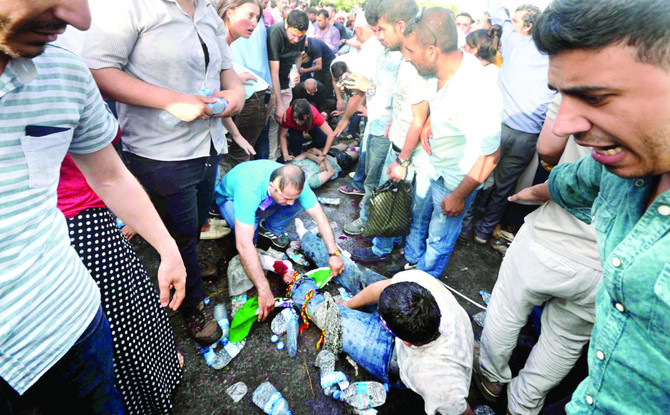
ANKARA: Turkey’s western province of Izmir woke up on the eve of Eid Al-Adha to an explosion near a moving prison bus.
No organization has claimed responsibility for the blast, which is being investigated by the police. Eight people were wounded, one of whom is in critical condition.
The bomb, which also damaged vehicles parked nearby, was in a garbage container on the route of the bus, which was carrying wardens and officials from a maximum-security prison.
The public prosecutor’s office said the attack was carried out by an improvised explosive device.
The Justice Ministry said: “This attack is not just against our prison wardens, but also against our law, justice, nation and state. We strongly condemn and damn those who carried out such a cowardly attack.”
On Tuesday, counterterrorism police in Izmir detained six suspects, including Syrian nationals, for their alleged links to Daesh.
Authorities said the suspects were found with “digital materials and documents” containing Daesh propaganda.
Izmir city, Turkey’s third-largest, is known for its secular and liberal lifestyle, and hosts a NATO headquarters.
Experts say the attack was most likely carried out by the Kurdistan Workers’ Party (PKK), or by Daesh.
The Kurdistan Freedom Hawks (TAK), the urban wing of the PKK, claimed responsibility for attacks in Turkey’s big cities last year that killed dozens of people. Ankara considers both TAK and the PKK as terrorist organizations.
Since the emergence of Daesh, Turkey has detained about 5,000 suspects and prohibited the entry of more than 53,000.
Meanwhile, on Wednesday Turkey’s President Recep Tayyip Erdogan hinted at further operations in Syria and Iraq.
“They should know that whatever we did in the Euphrates Shield Operation, we are ready to carry out the same in the upcoming process,” Erdogan said, referring to Turkey’s military operation in northern Syria against Daesh and Kurdish forces.
Aykan Erdemir, a former Turkish MP and a senior fellow at the Foundation for Defense of Democracies, said the targeting of prison guards points to a political motive, possibly in retaliation for the treatment of political inmates at the prison in question.
“In March 2017, there was a similar PKK attempt in Buca to place an improvised explosive device in a garbage container, but the bomb detonated prematurely, killing one of the two plotters,” Erdemir told Arab News.
Earlier this month, there were complaints of ill-treatment of political inmates at Kiriklar, he added. “The bomb attack could be linked to such grievances.”
Abdullah Agar, a security analyst based in Turkey, agreed. “The style of this terrorist act, using an improvised explosive device, leads us to think that the PKK/TAK may be behind it, because the PKK intends to expand terrorism in the southeast to a wider geography and an extended period of time; it does this by using its offshoots,” he told Arab News. Last month, TAK said it would carry out attacks in Turkey’s big cities, Agar said.


![]()
Speculation rife over explosion in Turkey’s Izmir province
Speculation rife over explosion in Turkey’s Izmir province


Latest updates


© 2026 SAUDI RESEARCH & PUBLISHING COMPANY, All Rights Reserved And subject to Terms of Use Agreement.