ROME: School playgrounds across Syria are being transformed into vegetable gardens where children whose diets have been devastated by six years of war can learn to grow — and then eat — aubergines, lettuces, peppers, cabbages and cucumbers.
Traditional Syrian cuisine is typical of the region, and rich in vegetables.
Its mainstays include hummus, minced lamb cooked with pine nuts and spices, beautiful and varied salads, stews made with green beans, okra or courgettes and tomatoes, stuffed cabbage leaves and artichoke hearts.
But the six-year war has changed that for much of the population, and many now live mainly on bread or food aid.
According to UN figures, unemployment now stands at more than 50 percent, and nearly 70 percent of the population is living in extreme poverty, in what was once a relatively wealthy country.
“The ongoing crisis in Syria is having a devastating effect on the health and nutrition of an entire generation of children,” Adam Yao, the UN Food and Agriculture Organization’s (FAO) acting representative in Syria, said on Tuesday, ahead of the start of the new school year.
FAO is helping some 17 primary schools in both regime and opposition-controlled areas to plant up 500 meter-square fruit and vegetable plots in war-torn areas including Aleppo, Hama, Homs, Idlib and the outskirts of Damascus.
Malnutrition
Young children are often the most vulnerable to malnutrition in a crisis, which can have serious and long-lasting effects on their growth and future development.
“Good nutrition is a child’s first defense against common diseases and important for children to be able to lead an active and healthy life,” Yao added.
So far the primary schools, which began planting in May, have produced 12 tons of fruit and vegetables. Another 35 schools are expected to start transforming their playgrounds soon in Aleppo and in rural areas around Damascus.
The price of food has risen since the start of the war — agriculture production has plummeted, and the country now relies on food imports to make up the shortfall. Transporting food around the country has also become difficult and costly.
About 13.5 million people in Syria are in need of humanitarian assistance. Of those, 7 million are unable to meet their basic food needs.
Some 5 million people receive international food aid, but not everyone in need can be reached, and the World Food Program says it has had to cut the amount of calories in its family food baskets because of funding shortages.
“The donors are generous, but we don’t know how long they can continue to be generous and rely on taxpayer’s money,” the FAO’s Yao told the Thomson Reuters Foundation.
Vulnerable families are receiving help from FAO to grow food at home, so they can become less reliant on food aid.
“Food aid is very important, but ... we should combine both, in a way that people grow their own food and move away from food aid gradually,” he said.
In a country where more than half the population has been forced to flee their homes, many moving several times, investing in agriculture helps people to stay put for as long as it is safe, Yao added.
“Agriculture has become a hope for (many) because they can grow their own food and survive — even in the besieged areas.”


![]()
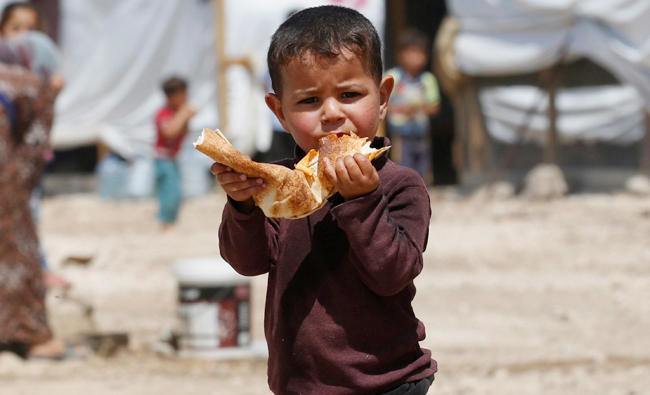
Syrian schools transform playgrounds in gardens to boost diets of hungry children
Syrian schools transform playgrounds in gardens to boost diets of hungry children

Latest updates


Recommended


© 2026 SAUDI RESEARCH & PUBLISHING COMPANY, All Rights Reserved And subject to Terms of Use Agreement.