

Top Biden official doubts Israel can achieve ‘total victory’ in Gaza

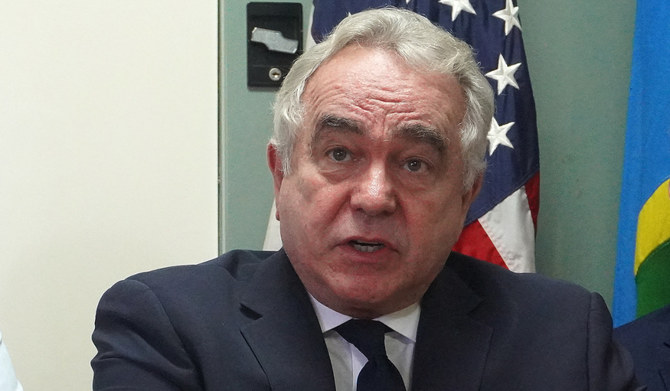
US Deputy Secretary of State Kurt Campbell. (AFP file photo)
Short Url
Updated 14 May 2024
Follow

Top Biden official doubts Israel can achieve ‘total victory’ in Gaza

  • Israel has killed more than 35,000 Palestinians, according to Gaza’s Health Ministry

WASHINGTON: The Biden administration does not see it likely or possible that Israel will achieve “total victory” in defeating Hamas in the Palestinian enclave of Gaza, US Deputy Secretary of State Kurt Campbell said on Monday.
While US officials have urged Israel to help devise a clear plan for the governance post-war Gaza, Campbell’s comments are the clearest to date from a top US official effectively admitting that Israel’s current military strategy won’t bring the result that it is aiming for.
“In some respects, we are struggling over what the theory of victory is,” Campbell said at a NATO Youth Summit in Miami. “Sometimes when we listen closely to Israeli leaders, they talk about mostly the idea of....a sweeping victory on the battlefield, total victory,” he said.
“I don’t think we believe that that is likely or possible and that this looks a lot like situations that we found ourselves in after 9/11, where, after civilian populations had been moved and lots of violence that...the insurrections continue.”
Israeli Prime Minister Benjamin Netanyahu has repeatedly vowed to achieve “total victory” against Hamas, the Palestinian militant group that attacked Israel on Oct. 7 and killed 1,200 people and took 250 others hostage.
In response, Israel unleashed a relentless assault on the Gaza Strip, killing more than 35,000 people, according to the figures of the Gazan health ministry, and reducing the densely populated tiny enclave to a wasteland.
Campbell’s comments come as Washington is warning Israel not to go ahead with a major military offensive in Rafah, the southernmost city of the Gaza Strip where over a million people who have already been displaced by Israeli attacks are taking shelter.
Likening the situation in Gaza to that of a recurring insurgency that the United States faced in Afghanistan and Iraq after its invasions there following the Sept. 11 attacks, Campbell said a political solution was required.
“I think we view that there has to be more of a political solution...What’s different from the past in that sense, many countries want to move toward a political solution in which the rights of Palestinians are more respected,” he said.
“I don’t think it’s ever been more difficult than right now,” he added.


Syria announces new currency framework, 2-zero redenomination

Updated 33 min 32 sec ago
Follow

Syria announces new currency framework, 2-zero redenomination

  • Under the plan, every 100 Syrian pounds will be converted into one unit of the new Syrian Arab Republic’s pound
  • Governor calls move ‘pivotal milestone within a comprehensive strategy’

DAMASCUS: Syria’s Central Bank announced executive instructions on Sunday to introduce a new Syrian currency, launching a monetary reform that includes removing two zeros from the pound and allowing a 90-day period of dual circulation.

The announcement was made during a press conference at the bank’s headquarters in Damascus.

Central Bank Gov. Abdulkader Husrieh said the step was part of a comprehensive institutional strategy to restore confidence and achieve sustainable economic stability.

He said: “The launch of the new currency is not a formal measure, but a pivotal milestone within a comprehensive strategy based on solid institutional foundations.”

Under the plan, every 100 Syrian pounds will be converted into one unit of the new Syrian Arab Republic’s pound. The old and new currencies will circulate together for 90 days, a period which may be extended.

All bank balances will be converted to the new currency at the beginning of next year, while the overall money supply will be maintained without increase or reduction.

An employee at a currency exchange shop stacks Syrian bills at a shop in Damascus. The old currency is expected to be taken out of the market in the next few months. (AFP file photo)

Husrieh said the economic strategy was based on five pillars: monetary stability, a stable and transparent foreign-exchange market, effective and accountable financial institutions, secure digital transformation, and balanced international economic relations.

He said the move required updating financial laws and regulations, improving data systems, keeping pace with global digital developments, and ensuring sustainable financing and training for the financial sector.

The currency exchange will be provided free of charge, with no commissions, fees, or taxes.

All public and private entities must apply the official conversion standard to prices, salaries, wages, and financial obligations. Official exchange-rate bulletins will be issued in both currencies to ensure transparency and prevent speculation.

The governor said the central bank was closely monitoring markets to stabilize the exchange rate and would supply Syrian pounds if demand for foreign currency rises, adding that citizens will feel the impact more clearly after the exchange process is completed.

“Our policy is financial discipline, with no room for inflation,” Husrieh added.

He confirmed that the decree regulating the exchange limits the process to Syrian territory, and said the measures fell within the bank’s 2026-2030 strategy to align with international standards.

The new banknotes, he added, were being printed by leading international companies to prevent counterfeiting.