

Slovak PM’s ‘life in danger’ and in operating theater: interior minister

1 / 2
Slovakia’s Interior Minister Matus Sutaj Estok addresses the press with Deputy PM Robert Kalinak, F. D. Roosevelt University Hospital, Banska Bystrica, Slovakia, Wednesday, May 15, 2024. (AP Photo)
2 / 2
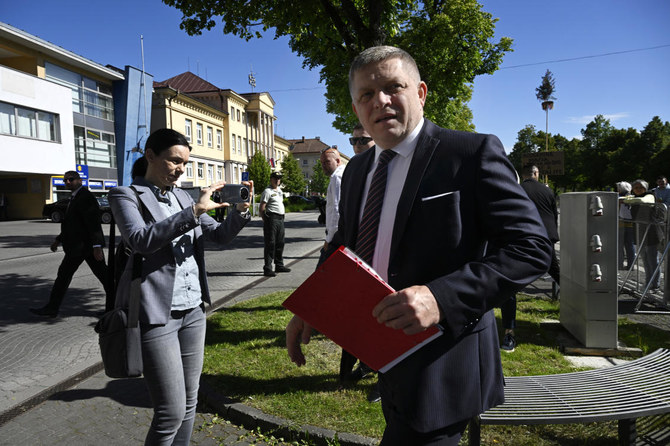
Slovakia’s Prime Minister Robert Fico arrives for a cabinet’s away-from-home session in the town of Handlova, Slovakia, Wednesday, May, 15, 2024. (AP Photo)
Short Url
Updated 15 May 2024
Follow

Slovak PM’s ‘life in danger’ and in operating theater: interior minister

  • Matus Sutaj Estok: ‘We received information from the operating doctors that the prime minister is in a critical condition and his life is in danger and he is still in the operating theater’
  • European Commission President Ursula von der Leyen condemned what she described as a ‘vile attack’

BANSKA BYSTRICA, Slovakia: Slovak Prime Minister Robert Fico’s life “is in danger” and he is still in the operating theater after being shot multiple times, the country’s interior minister said on Wednesday.
“We received information from the operating doctors that the prime minister is in a critical condition and his life is in danger and he is still in the operating theater,” Matus Sutaj Estok told reporters at the hospital where Fico is being treated.

Reports on TA3, a Slovakian TV station, said that Fico, 59, was hit in the stomach after four shots were fired outside the House of Culture in the town of Handlova, some 150 kilometers northeast of the capital, where the leader was meeting with supporters. A suspect has been detained, it said.
Police sealed off the scene, and Fico was taken to a hospital in Banska Bystrica.
The shooting in Slovakia comes three weeks ahead of crucial European Union Parliament elections, in which populist and hard-right parties in the 27-nation bloc appear poised to make gains.
Deputy speaker of parliament Lubos Blaha confirmed the incident during a session of Parliament and adjourned it until further notice, the Slovak TASR news agency said.
Slovakia’s major opposition parties, Progressive Slovakia and Freedom and Solidarity, canceled a planned protest against a controversial government plan to overhaul public broadcasting that they say would give the government full control of public radio and television.
“We absolutely and strongly condemn violence and today’s shooting of Premier Robert Fico” said Progressive Slovakia leader Michal Simecka. “At the same time we call on all politicians to refrain from any expressions and steps which could contribute to further increasing the tension.”
President Zuzana Caputova condemned “a brutal and ruthless” attack on the premier.
“I’m shocked,” Caputova said. “I wish Robert Fico a lot of strength in this critical moment and a quick recovery from this attack.”
Fico, a third-time premier, and his leftist Smer, or Direction, party, won Slovakia’s Sept. 30 parliamentary elections, staging a political comeback after campaigning on a pro-Russian and anti-American message.
Critics worried Slovakia under Fico would abandon the country’s pro-Western course and follow the direction of Hungary under populist Prime Minister Viktor Orbán.
Thousands have repeatedly rallied in the capital and across Slovakia to protest Fico’s policies.
Condemnations of political violence came from leaders across Europe.
European Commission President Ursula von der Leyen condemned what she described as a “vile attack.”
“Such acts of violence have no place in our society and undermine democracy, our most precious common good,” von der Leyen said in a post on X.
Leaders in Latvia and Estonia also quickly condemned political violence.
Polish Prime Minister Donald Tusk wrote on the social media network X: “Shocking news from Slovakia. Robert, my thoughts are with you in this very difficult moment.”


Ukraine, China mineral dominance on agenda as G7 meets

Updated 11 November 2025
Follow

Ukraine, China mineral dominance on agenda as G7 meets

  • There will also be discussions on Sudan, gripped by a war since April 2023
  • China’s dominance of critical mineral supply chains is a growing area of concern for the G7

NIAGRA-ON-THE-LAKE: G7 foreign ministers were gathering in Canada on Tuesday for talks expected to focus on Ukraine, as the club of industrialized democracies seeks a path toward ending the four-year-old conflict.
Options to fund Kyiv’s war needs against invasion by Russia could feature prominently at the talks in Canada’s Niagara region on the US border.
The diplomats are meeting after US President Donald Trump slapped sanctions on Moscow’s two largest oil companies in October, slamming Russian President Vladimir Putin over his refusal to end the conflict.
Trump has also pushed other European countries to stop buying oil that he says funds Moscow’s war machine.
Ukraine is enduring devastating Russian attacks on its energy infrastructure, but Canadian Foreign Minister Anita Anand stopped short of promising concrete outcomes to aid Kyiv at the Niagara talks.
She told AFP a priority for the meeting was broadening discussion beyond the Group of Seven, which includes Britain, Canada, France, Germany, Italy, Japan and the United States.
“For Canada, it is important to foster a multilateral conversation, especially now, in such a volatile and complicated environment,” Anand said.
Representatives from Saudi Arabia, India, Brazil, Australia, South Africa, Mexico and South Korea will also be at the meeting held a short drive from the iconic Niagara Falls.
US Secretary of State Marco Rubio will hold bilateral talks with Anand on Wednesday, the second and final day of the G7 meeting.
Anand said she did not expect to press the issue of Trump’s trade war, which has forced Canadian job losses and squeezed economic growth.
“We will have a meeting and have many topics to discuss concerning global affairs,” Anand told AFP.
“The trade issue is being dealt with by other ministers.”
Trump abruptly ended trade talks with Canada last month — just after an apparently cordial White House meeting with Prime Minister Mark Carney.
The president has voiced fury over an ad, produced by Ontario’s provincial government, which quoted former US president Ronald Reagan on the harm caused by tariffs.

- Sudan, Critical minerals -

Italy’s foreign ministry said there will also be discussions on Sudan, gripped by a war since April 2023 that has created one of the world’s worst humanitarian crises.
Delivering aid to the war-ravaged African country will be a focus of the talks, which come hours after UN humanitarian coordinator Tom Fletcher met with Sudan’s army chief Abdel Fattah Al-Burhan on getting life-saving supplies to civilians.
The G7’s top diplomats are meeting two weeks after the grouping’s energy secretaries agreed on steps to counter China’s dominance of critical mineral supply chains, a growing area of concern for the world’s industrialized democracies.
Beijing has established commanding market control over the refining and processing of various minerals — especially the rare earth materials needed for the magnets that power sophisticated technologies.
The G7 announced an initial series of joint projects last month to ramp up refining capacity that excludes China.
While the United States was not party to any of those initial deals, the Trump administration has signaled alignment with its G7 partners.
A State Department official told reporters ahead of the Niagara meet that critical mineral supply chains would be “a major point of focus.”
“There’s a growing global consensus among a lot of our partners and allies that economic security is national security,” the official said.