JOHANNESBURG: Room 1026 of Johannesburg’s Central Police Station looks like any mid-century office in need of a fresh coat of paint: Dusty vertical blinds hang in the window, opening onto an unremarkable view of a chip shop, a lunchtime favorite for police officers.
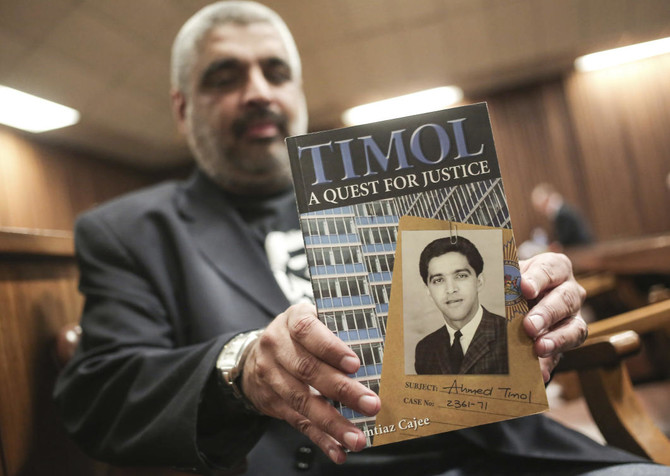
But for the past several weeks, South Africans have been riveted by an inquest into whether anti-apartheid activist Ahmed Timol jumped or was pushed to his death from that 10th-floor window on Oct. 27, 1971.
The hearings have dredged up dark memories of one of the country’s most infamous landmarks and legal experts say the case could set a precedent for investigating similar deaths.
For many who lived through apartheid, the system of white-minority rule that ended in the early 1990s, the building remains an ominous symbol of racial and political oppression in a country still struggling to find justice for the atrocities of a not-so-distant past.
For decades, the Johannesburg Central Police Station was known as John Vorster Square, named after the apartheid leader who oversaw the sentencing of Nelson Mandela to life in prison. Its top two floors were home to the notorious Security Branch, where anti-apartheid activists were detained and tortured. Eight people, including Timol, died while in custody in the building.
Last week Timol’s family recommended that South Africa’s government open a new criminal investigation into his death, saying police covered up having assaulted him during his detention by pushing him to his death and calling it suicide.
“What was the Security Branch covering up? It could only have been two things: the torture, and the fact that there was no suicide,” Howard Varney, an attorney for the Timol family, said during his closing arguments during the inquest at the North Gauteng High Court in Pretoria. “If there wasn’t a suicide, it must have been murder.”
Timol, a member of the South African Communist Party, was arrested at a police roadblock on Oct. 22, 1971. He died five days later after being held in Room 1026, one of 73 political detainees who died in police custody in South Africa between 1963 and 1990.
A 1972 inquest into Timol’s death upheld the police assertion that he was not tortured during his detention but jumped to his death to avoid a long prison sentence, among other reasons. The Timol family maintained he was assaulted and pushed or thrown from the building. In June, South Africa’s National Prosecuting Authority opened a new inquest to re-examine the circumstances of his death.
Taking the witness stand last month, former security policeman Joao Rodrigues, who said he was in Room 1026 with Timol when he died, stood by his story. He said he was asked by colleagues to guard Timol and the activist dove out of the window before Rodrigues had the chance to stop him.
Inconsistencies in Rodrigues’ story and crucial aspects of Timol’s death cast doubt on that version of events, the family’s counsel argued. Forensic pathologists testified that Timol suffered serious injuries to his head and leg that were incompatible with his fall and that would have made it difficult for him to climb onto the window sill and jump out.
The police version of events “would have us believe that Timol was treated with care and compassion by the Security Branch,” Varney said Thursday. “None of it is believable.”
The lawyer recommended that Rodrigues be investigated for murder, accessory after the fact and perjury.
Judge Billy Mothle now will make a recommendation to state prosecutors whether a criminal case should be opened into Timol’s death, a decision that could set an important precedent for other apartheid-era cases of political prisoners’ deaths during detention.
Today, Room 1026 where Timol spent his final moments is occupied by South African border police who spend their days tackling drug smuggling and human trafficking.
The small offices on the 10th floor have not changed much in the last 40 years, observers say. Tshepiso Gloria Nkwe, a black police officer who now works in the office, admits she found it disconcerting when she learned its history. “I was scared at first,” Nkwe said.
A small plaque inside the building’s lobby lists the names of the 73 detainees who died in police custody during apartheid, including Timol’s.
Outside the building, there is little testament to its dark history. A sculpture across the street, entitled “Simakade,” or “forever standing” in the Zulu language, commemorates those who died in the building, but its plaque has been ripped off, leaving passersby to guess at its meaning.
Gerald Garner, who helped launch the popular 1 Fox development that sells craft beer and artisanal coffee in the police station’s shadow, said he finds the building “offensive.” He believes that more could be done to educate the public about its history as the new Johannesburg grows up around it.
“The fact that the building is there means you can’t avoid it,” he said.


S. Africa case is opening doors to grim apartheid deaths
S. Africa case is opening doors to grim apartheid deaths

Germany says UN rights rapporteur for Palestinian territories should quit
- Albanese has said that her comments are being falsely portrayed
- “I have never, ever, ever said ‘Israel is the common enemy of humanity’,” Albanese said
BERLIN: German Foreign Minister Johann Wadephul on Thursday called for the resignation of the UN special rapporteur for the Palestinian territories, Francesca Albanese, over comments she made allegedly targeting Israel at a conference.
“I respect the UN system of independent rapporteurs. However, Ms Albanese has made numerous inappropriate remarks in the past. I condemn her recent statements about Israel. She is untenable in her position,” Wadephul wrote on X.
Albanese has said that her comments are being falsely portrayed. She denounced what she called “completely false accusations” and “manipulation” of her words in an interview with broadcaster France 24 on Wednesday.
Speaking via videoconference at a forum in Doha on Saturday organized by the Al Jazeera network, Albanese referred to a “common enemy of humanity” after criticizing “most of the world” and much of Western media for enabling the “genocide” in Gaza.
“And this is a challenge — the fact that instead of stopping Israel, most of the world has armed, given Israel political excuses, political sheltering, economic and financial support,” she said.
Albanese said that “international law has been stabbed in the heart” but added that there is an opportunity since “we now see that we as a humanity have a common enemy.”
Wadephul’s French counterpart Jean-Noel Barrot on Wednesday made the same call for Albanese to resign over the comments.
“France unreservedly condemns the outrageous and reprehensible remarks made by Ms Francesca Albanese, which are directed not at the Israeli government, whose policies may be criticized, but at Israel as a people and as a nation, which is absolutely unacceptable,” Barrot told French lawmakers.
Albanese posted video of her comments to X on Monday, writing in the post that “the common enemy of humanity is THE SYSTEM that has enabled the genocide in Palestine, including the financial capital that funds it, the algorithms that obscure it and the weapons that enable it.”
In her interview with France 24, which was recorded before Barrot’s statement, she contended that her comments were being misrepresented.
“I have never, ever, ever said ‘Israel is the common enemy of humanity’,” Albanese told the broadcaster.


