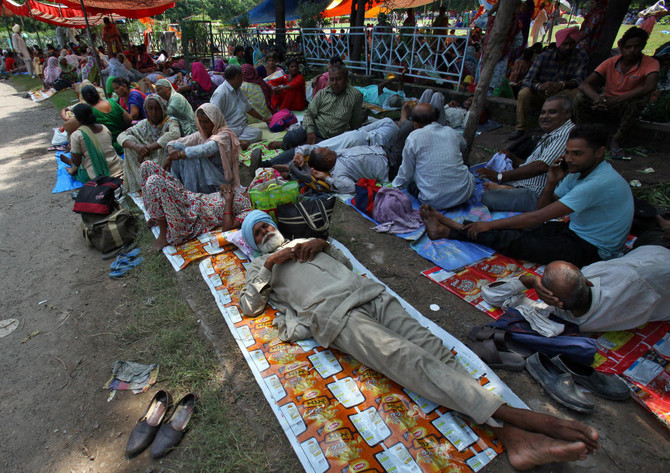
PANCHKULA, India: Indian authorities have arrested hundreds of people and canceled more than 300 trains passing through two northern states after at least 29 people were killed in violent protests following the conviction of a self-styled ‘godman’.
Security forces were on “standby” outside the spiritual leader’s headquarters where some 10,000 followers remained holed up, the Director General of Police in Haryana state, Baljit Singh Sandhu, told India Today news station.
Gurmeet Ram Rahim Singh, the head of a social welfare and spiritual group with a wide following in Punjab and Haryana states, was found guilty on Friday of raping two followers in a case dating back to 2002 at the headquarters of his Dera Sacha Sauda group in the northern town of Sirsa.
Supporters rampaged in response, attacking railway stations, petrol stations and television vans in towns across the northern states of Punjab and Haryana, witnesses said.
At least 29 people were killed in Panchkula town where the court returned its verdict on Singh and more than 200 people were injured, mainly in Haryana state.
The protests, about 250 km (155 miles) from the Indian capital New Delhi, was one of the biggest this year related to a ‘godman’ spiritual leader.
About 524 people had been arrested, Ram Niwas, a top Haryana administrator, told Reuters.
Authorities said they were bracing for Singh’s sentencing on Monday when there could be more violence.
A spokesman for the northern division of Indian Railways said 340 trains have been canceled on Saturday as a precaution.
“We’re monitoring the situation but we may have to cancel more trains,” Neeraj Sharma told Reuters.
Security personnel were still guarding Panchkula, which was among the worst affected towns during the violence, as some shops started to reopen and people came out of their homes.
“I was just speaking with an army general to continue patrolling in Sirsa,” said Niwas. “We’ve asked everyone to continue effective patrolling, because the (sentence) will be announced the day after.”
Singh is also under investigation over allegations that he convinced 400 of his male followers to undergo castration. He denies those charges.


India detains hundreds, cancels more than 300 trains after deadly ‘godman’ protests
India detains hundreds, cancels more than 300 trains after deadly ‘godman’ protests

26 Doctors without Borders workers remain unaccounted for in South Sudan a month after attacks
- A hospital in the town of Lankien was bombed by government forces, MSF said
- “We have lost contact with them amid ongoing insecurity”
NAIROBI: More than two dozen Doctors Without Borders workers remain unaccounted for a month after attacks in South Sudan, the medical charity said.
Two facilities belonging to the group, known by French acronym MSF, were attacked on Feb. 3 in Jonglei State, northeast of the capital, Juba, where violence has displaced an estimated 280,000 people since December.
A hospital in the town of Lankien was bombed by government forces, MSF said, while another medical facility in the town of Pieri was raided by “unknown assailants.” Both were located in opposition-held areas.
Staff working at the two facilities fled alongside much of the local population into deeply rural areas where armed clashes and aerial bombardments were ongoing.
MSF said in a statement on Monday that “26 of 291 of our colleagues working in Lankien and Pieri remain unaccounted for.
“We have lost contact with them amid ongoing insecurity,” it said.
The lack of communication with its staff could be linked to the limited network connectivity in much of the state. Staff members who had been contacted described “destruction, violence and extreme hardships.”
Fighting escalated sharply in December, when opposition forces captured a string of government outposts in north central Jonglei. In January, the government responded with a counteroffensive that recaptured most of the area it had lost.
Displaced people in Akobo, an opposition-held town near the Ethiopian border, described horrific violence by government fighters. Many described not being able to find food or water as they walked for days to reach safety.
The attacks on MSF facilities in Lankien and Pieri are part of an uptick in violence on humanitarian staff, supplies and infrastructure, aid groups say. MSF facilities have been attacked 10 times in the last 12 months.
“This violence has taken an unbearable toll not only on health care services, but on the very people who kept them running,” said Yashovardhan, MSF head of mission in South Sudan, who only uses one name.
“Medical workers must never be targets,” he said. “We are deeply concerned about what has happened to our colleagues and the communities we serve.”