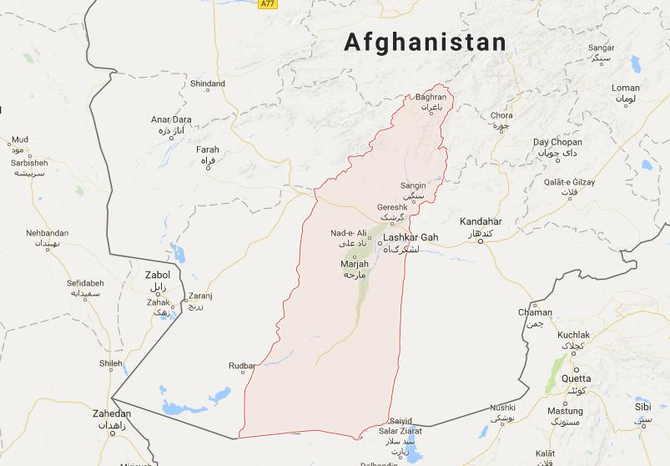
Afghan official: Taliban suicide car bombing kills 7 people

(Google Maps)
Updated 23 August 2017
Follow

Afghan official: Taliban suicide car bombing kills 7 people

KABUL: A Taliban suicide car bomber targeted a military convoy in Afghanistan’s southern Helmand province on Wednesday, killing at least seven people, a provincial official said.
The attack comes just days after President Donald Trump announced his new strategy for Afghanistan, which involves maintaining a US military presence in the country and upending a campaign vow to end America’s longest war.
According to Omar Zwak, the spokesman for the Helmand provincial governor, Wednesday’s explosion in Lashkar Gah, the provincial capital, also wounded 42 people, mostly civilians.
Initial reports show that those killed included a small girl, two women and four soldiers, Zwak said, expressing fears that the death toll could rise further.
“This is from our initial reports, I am afraid the casualty tolls might change once we get a final report form the attack,” he added.
The bombing took place near the police chief’s headquarters. Local TV broadcast footage showing several military Humvees, which the Afghan army also uses, destroyed as a result of the attack.
Taliban spokesman Zabihullah Mujahid claimed responsibility for the attack in a posting on his twitter account.
Senior Afghan government officials on Tuesday welcomed Trump’s strategy announcement from Monday. Senior US officials said Trump may send up to 3,900 more troops, with some deployments beginning almost immediately.
Trump also had harsh words for Pakistan, accusing Islamabad of giving extremists a safe haven, while next door in Afghanistan they kill US troops. He said he wanted “immediate” results without saying what actions the United States might take against Pakistan if it ignored his warning.
The United States and Afghanistan have routinely accused Pakistan — and particularly its powerful intelligence agency — of harboring insurgents and of waging a selective war, attacking those militants Islamabad considers its enemy and allowing those it has been known to use as proxies, either against hostile neighbors India or Afghanistan, to flourish.
Taliban attacks have stepped up all across Afghanistan since the withdrawal of foreign combat forces from the war-torn nation at the end of 2014, and the insurgents have lately been constantly expanding their footprint.
Earlier this month, the Taliban in an “open letter” to Trump, reiterated their calls for the withdrawal of all remaining US troops. The United States has about 8,400 troops in Afghanistan, who support local forces and carry out counterterrorism operations.


US allies, foes alarmed by capture of Venezuela’s Maduro

Updated 55 min 26 sec ago
Follow

US allies, foes alarmed by capture of Venezuela’s Maduro

  • Countries such as Russia and China, which had ties with Maduro’s government, were quick to condemn the operation but alarm also shared by France and EU
  • UN Secretary-General Antonio Guterres was “deeply alarmed” by the US strikes

PARIS: The US military operation that led to the seizure of Venezuelan President Nicolas Maduro on Saturday sparked alarm across the international community, with allies and foes of Washington and Caracas expressing disquiet.
US President Donald Trump said Maduro and his wife would be taken to New York to face federal charges after military strikes and an operation which he described as looking like a “television show.”
The Venezuelan government decried what it termed a “extremely serious military aggression” by Washington and declared a state of emergency.
Countries such as Russia and Iran, which had longstanding ties with Maduro’s government, were quick to condemn the operation but their alarm was also shared by Washington’s allies including France and the EU.
Here is a rundown of the main reaction.

Russia

Russia demanded the US leadership “reconsider its position and release the legally elected president of the sovereign country and his wife.”

China

Beijing said “China is deeply shocked and strongly condemns the US’s blatant use of force against a sovereign state and its action against its president.”

Iran

Iran, which Trump bombed last year, said it “strongly condemns the US military attack on Venezuela and a flagrant violation of the country’s national sovereignty and territorial integrity.”

Mexico

Mexico, which Trump has also threatened with military force over drug trafficking, strongly condemned the US military action in Venezuela, saying it “seriously jeopardizes regional stability.”

Colombia

Colombian President Gustavo Petro — whose country neighbors Venezuela — called the US action an “assault on the sovereignty” of Latin America which would lead to a humanitarian crisis.

Brazil

Brazilian President Luiz Inacio Lula da Silva slammed the US attacks as a “serious affront” to Venezuela’s sovereignty.

Cuba

Cuba, a strong ally of Venezuela, denounced “state terrorism against the brave Venezuelan people.”

Spain

Spain offered to mediate in the crisis to find a way to a peaceful solution, while calling for “de-escalation and restraint.”

France

France condemned the US operation, saying it undermined international law and no solution to Venezuela’s crisis can be imposed from the outside.

EU

The EU more generally expressed concern at the developments and urged respect for international law, even as it noted that Maduro “lacks legitimacy.”
EU candidate country North Macedonia, along with fellow Balkan nations Albania and Kosovo, backed Washington, however.
“We stand with the United States and the Venezuelan people for freedom and democracy,” North Macedonia FM Timco Mucunski said on X.

Britain

British Prime Minister Keir Starmer said all countries should “uphold international law” and added that “the UK was not involved in any way in this operation” as he urged patience in order to “establish the facts.”

Italy

In a rare expression of support for the US operation by a major European country, far-right Italian Prime Minister Giorgia Meloni — a Trump ally — argued the US military action in Venezuela was “legitimate” and “defensive.”

Israel

Israel also hailed the operation, saying Washington acted as the “leader of the free world.”

Ukraine

Ukraine — dependent on US support in its war against invading Russia — did not address the legality of a big country like America using military force against a much smaller one like Venezuela.
Foreign minister Andriy Sybiga instead focused on Maduro’s lack of legitimacy and the Venezuelan government’s repression, while backing “democracy, human rights, and the interests of Venezuelans.”

South Africa

South Africa, which Trump accuses of alleged discrimination — and even “genocide” — of minority white Afrikaners, said: “Unlawful, unilateral force of this nature undermines the stability of the international order and the principle of equality among nations.”

UN

UN Secretary-General Antonio Guterres was “deeply alarmed” by the US strikes, with his spokesman quoting him as saying it could “constitute a dangerous precedent.”